Sunday, March 1, 2020

Lucid Dreaming | Can't do FILD

i tried to do FILD, i set up my alarm for 4 hours later.

when my alarm rang, i woke up and felt no urge to sleep again instantly

i took maybe 15 mins to fall asleep.

i set it up only to ring once for 1 minute, but as long as i hear it i can't fall asleep anymore. what should i do?

sometimes i do wake up naturally in middle of night and can almost fall asleep instantly

but i never know when that happen

Do FILD only work between REM cycles and I have to test what time I'll be the most sleepy and that I can fall asleep instantly?


via Lucid Dreaming - Dream Views - Attaining Lucidity https://ift.tt/2PCjD1S

A Patch Antenna Is Just A Rectangle, It Should Be Easy To Design, Right?

If a grizzled RF engineer who bears the soldering-iron scars of a thousand projects could offer any advice, it would be that microwave antennas are not a field to be entered into lightly. Much heartache is to be saved by using an off-the-shelf design, and only the foolhardy venture willingly down the stripline into the underworld of complex microwave resonances.

But every would-be microwave designer has to start somewhere, and for [Adam Gulyas] that start came with a 2.4 GHz patch antenna. His write-up is a fascinating tale of the challenges and pitfalls of creating something which is deceptively simple at first sight but which becomes significantly more complex as he characterizes his design made real as a PCB.

The process started with a set of calculations to derive the patch dimensions and a bit of PCB work adding a stripline feed. This was produced on a PCB, a normal 1.6mm thick FR4 fiberglass board. When hooked up to a VNA its impedance was all wrong. Further, it had a resonance at the required frequency but also unexpected ones at 3.7 and 4.6 GHz. Simulation of the design also yielded a different resonance from the one calculated, and discussing it with others yielded the conclusion that the feed might be at fault. He ended up using an inset feed, with a co-axial cable emerging away from the edge of the patch, and was able to achieve a far better result.

We can all learn something from [Adam]’s write-up, and we salute him for staying the course to get the design to a usable point. It would be interesting to see the same antenna produced from a more consistent dielectric material than generic FR4. Meanwhile, if you are interested in microwave RF design, take a look at Michael Ossmann’s primer on the subject.


via Radio Hacks – Hackaday https://ift.tt/2weYMe5

Saturday, February 29, 2020

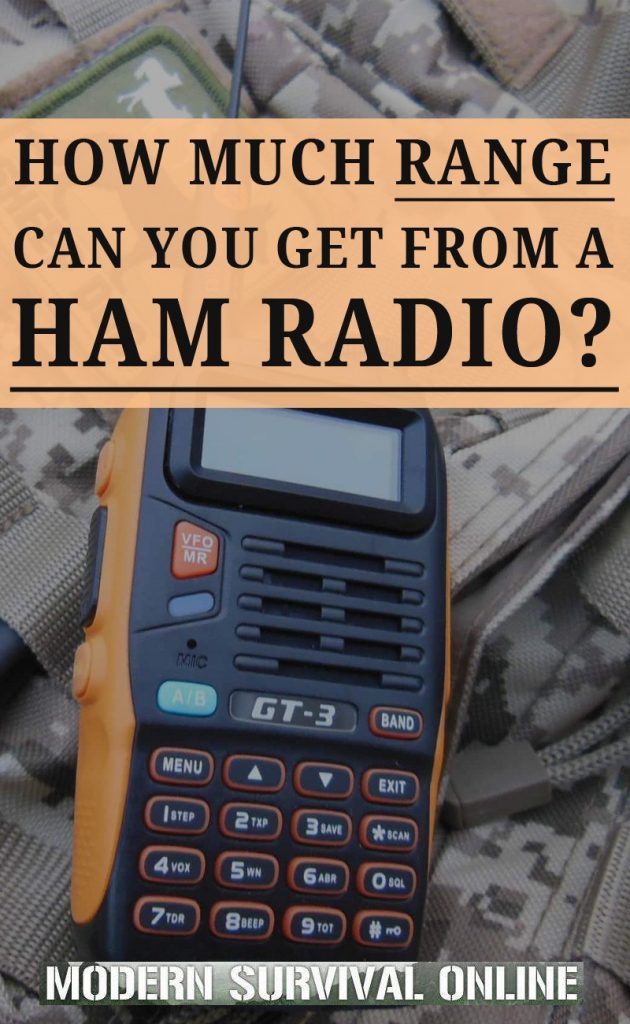
How Much Range Can You Get From a Ham Radio?

The expected effective range of ham radio is a subject that is constantly talked about but poorly understood among many preppers not specialized in radio communication skills.

For all but the shortest-ranged line-of-sight broadcasts there are many factors that will affect the range of your transmissions, and knowing what to expect within a given set of hardware, terrain and atmospheric considerations is essential for a realistic estimation of what your radio set can do.

There is no hard-and-fast rule that can determine the maximum effective transmission range of a given ham radio.

Most fixed ham radios under average conditions and assuming they have proper siting and hardware will have a range of anywhere from 10 to 30 miles. Less powerful sets or ones dealing with serious signal obstacles may have a range that is significantly shorter.

More powerful sets that can take advantage of ideal atmospheric conditions may have a range that is much longer.

Taking the time to understand the specific factors that affect radio range will help inform your choices about what set is right for you and what is required to get good results in your area. Those factors are signal type, signal wattage, obstacles and antenna specifics.

Another limitation to range that is universally applicable to all radios (and often overlooked by beginners) is the radio horizon.

Radio Horizon

Think of the radio horizon like the visual horizon. To help, imagine a perfectly smooth , flat and featureless earth that will allow you to see clear out to the actual horizon, not the horizon as determined by intervening terrain features.

Anything that lies beyond the horizon is actual below where you can see due to the curvature of the earth.

The radio horizon works similarly, but thanks to some effects from the atmosphere and radio waves ability to “bend” somewhat the radio horizon is a little bit farther than the visual horizon, but the effect is largely identical.

Consider that you can see farther, in effect extending the visual horizon, if you get higher off the ground.

You can see significantly farther in our magically flat and featureless place if you simply stand on a ladder, quite a ways farther if you were to stand on top of a two story building and a drastically farther if you were to stand on top of a ship’s mast.

Now take that analogy and apply it to your radio transmission and you’ll receive a similar benefit. All things equal, transmitting from a higher place (or just using a taller antenna) will extend your radio horizon regardless of other factors.

In our example environment, only receiving radios that lay within the “shadow” below the horizon would not be able to pick up the ever-expanding signal transmitted by your set; they would need a correspondingly tall antenna or elevated placement to get out of the radio shadow cast by the “downslope” beyond the radio horizon.

Signal Type

Different types of radios broadcast different types of signals. The fundamental differences in signal type will significantly alter how they travel and interact with various mediums.

Radio waves are broadly categorized as either low frequency or high-frequency, with more specialized types being on either end of the spectrum, either ultra-low frequency (ULF), very-low frequency (VLF), very-high frequency (VHF) and ultra-high frequency (UHF) respectively.

Generally speaking, the lower the frequency the greater the distance the radio wave can travel. But low frequency waves also have drawbacks in that they are more susceptible to certain negative atmospheric conditions.

But on the other hand, as you get into higher and higher frequencies they have a greater tendency to travel in only straight lines and will generally have poor performance at or be completely unable to go beyond the visual horizon.

Any radio waves that cannot travel beyond the horizon (remember, the Earth is round and the curvature of the earth beyond which we cannot see is the horizon) are limited to line-of-sight only applications without signal boosting and relaying.

On the other hand, VHF waves perform well when passing through obstacles with the exception of buildings and large, broad obstructions. In comparison UHF radio waves do poorly with obstacles with the exception of buildings.

In short, there’s always a trade-off with signal performance based on the signal wavelength. Understanding these differences and choosing a signal type based on your surrounding area and the terrain along the path where you are transmitting is essential for getting maximum range out of your radio.

Signal Wattage

The wattage, or power, of the radio signal is another important factor in determining its maximum range. In short, the stronger your radio signal, the more it can withstand loss when passing through or near obstacles.

The key to obtaining a powerful signal is your radio set output itself. Radio power is measured in watts, and larger fixed radios like those employed by commercial broadcast operations may have broadcast power in the tens of thousands of watts, or even hundreds of thousands of watts.

Small handheld radios by comparison may only rate a 1/2 or single watt, while more powerful versions may be measured in the tens of watts.

For portable systems another important factor in considering power output is the drain on batteries and other power supplies. More power means a faster drain, period. That is simply physics.

Before you go and invest in the most powerful radio set that money can buy, do keep in mind the power and thereby output of given types of radios is regulated by the FCC.

Furthermore power is only one part of the puzzle. An extremely powerful radio working with a shoddy antenna and tons of obstructions or interference will still have a very limited range.

That being said, if all other considerations are equal a more powerful radio will send its signal farther than one that is less powerful.

But you must keep in mind that distance takes its toll on all signals no matter how powerful they start out; for every doubling of distance traveled the power of the signal is reduced by a factor of four!

A weak radio signal is getting awfully ephemeral at the limits of its “theoretical” range. Add in obstructions and detrimental atmospherics and your range can drop precipitously, even with a powerful set.

Power alone is important, but not the end-all, be-all of radio range!

Antenna Considerations

A radio antenna is a major factor in determining its effective range. All things being equal, a taller antenna will considerably increase a radio’s range, and is often the easiest and most straightforward way to increase it.

If you do nothing else but swap out a short, dinky antenna for a taller one you will likely increase your set’s range significantly.

Mobile radio sets with long whip-style antennas mounted on the roof of the vehicle can have an average range of 10 or even 20 miles easily, with much of that performance garnered by the antenna itself.

Nautical radios mounted on boats often enjoy considerable range due to the lack of obstacles on the open ocean along with a tall antenna.

In short, the higher your antenna is the better your range. You can maximize the performance of a short antenna by gaining a height advantage yourself.

If everything else fails, climb on top of your car, the nearest hill or a tall building to gain a height advantage. In essence, you are making the antenna taller!

Antennas can also be had in isometric or directional varieties. Isometric antennas radiate the signal being transmitted in all directions equally.

Think of a sphere or a balloon that begins small at the source the moment you click transmit, but expands in all directions equally as the signal propagates, just like a balloon being inflated. That is how an isometric antenna works.

A directional antenna radiates and receives greater power in specific directions only, the net effect being increased performance when transmitting (meaning better range) and reduced signal interference from unwanted transmissions.

Due to the reciprocity effect, a directional antenna that transmits more effectively will also receive more effectively and equally on both counts.

Obstacle Considerations

Radio signals are blocked by solid objects, and depending on your signal type and strength will be blocked more or less easily. Radio transmissions in very hilly or mountainous areas depend on having antennas mounted above the tops of the hills to get any kind of performance at distance.

Similar setups are required in cities, which also present challenges for radio communication due to the preponderance of metal which is traditionally the one medium that is most detrimental to radio waves.

Some obstructions pose very little challenge to radio waves, in particular nonmetallic obstructions.

Most brick, rock and stone presents very little obstruction as do comparatively thin, light objects like wood, most other building materials like drywall, furniture and even the human body.

That being said, even these relatively minor obstructions will in great enough numbers or thickness, impede or even stop a radio signal from passing through them.

The more permeable obstructions your radio wave has to go through the worse the signal will be degraded. A great number of comparatively light obstacles will equal reduced range for your radio while.

Serious obstructions like buildings or large hills and mountains may limit you to line-of-sight communication only without use of signal-boosting or repeater stations.

Quick Tips for Increasing Your Range

When in doubt, get higher!

If you can get your antenna above intervening instructions, or just get it a little more height compared to shoulder level you will increase your range.

If you’re having trouble getting through when broadcasting or just having trouble receiving, don’t pull your hair out until you increase your altitude.

Even for fixed applications, mobile radios are probably best.

In comparable classes your average mobile radio can have anywhere from three to five times the range of a similar handheld radio.

Even if you aren’t taking your broadcasting on the road, a mobile radio probably has the chops to get you more range than a comparable fixed-site radio.

Install a better antenna.

A high-quality whip-style antenna is almost always a smart replacement for any radio set, fixed or mobile. Mobile, handheld radios in particular are notorious for coming with stubby, low-profile antennas.

This might make them easier to carry and handle but there are serious handicaps when it comes to broadcast performance. If the antenna can be switched out, it should be.

Check your power supplies and keep batteries fully charged.

More available power for your radio set means less power for the signal, and a weaker signal will not go as far.

Conclusion

Under ideal conditions, with a powerful enough set and care taken to minimize signal obstructions a ham radio can obtain anywhere from a 10 to 30 mile range on land, though this may be significantly increased, or decreased, depending on ambient conditions, obstructions and hardware limitations.

ham radio range pin


via Modern Survival Online https://ift.tt/2I7eHOd

Thursday, February 27, 2020

Here’s What to do When Someone Knocks on Your Door Late at Night

A late night knock on the front door. It is the classic beginning to so many Hollywood and real life horror stories it has turned into something of a cliché.

But cliché or not, this defensive scenario continues to be a turning point in so many people’s lives every year I thought it best to address it.

It sounds simple enough, but the complexities pile up quickly when you consider the context of an average person in their home. Is it a neighbor?

A friend in need? Some injured or down-on-their-luck traveler? Or is it an intruder, trying for the easy way in under false pretenses? Or perhaps just trying to see if anyone is home or awake..?

Your response to this simple, eerie event may well dictate whether you live or die. Trusting to luck is not a strategy. In this article, we’ll explore a few responses to this deceptively complex tactical problem.

Being Polite Might Get you Killed

Especially after dark. There is no nicer way to put it.

In an era when home invaders employ especially brazen and deceptive techniques to gain entry to an occupied structure and overwhelm any resistance you must be on your guard.

The daylight and after dark door knock is a time-tested and effective tactic for getting in easily. As soon as you crack the deadbolt on your door, a criminal’s chances of a successful entry go up significantly.

As soon as you actually unlatch the door, their entry is all but guaranteed, chain or no chain.

With the rigid reinforcement of a deadbolt removed, the criminal can throw their weight into the door, bowling you over and leaving you in a poor position to defend yourself.

Leverage is with them; you will not, in almost any circumstance, be able to muster the strength needed to hold the door, much less shut it, against one or more determined invaders.

Even if you are armed, the opening moves of the fight are going against you. It is much better to keep them outside and deal with what comes if it comes down to it.

Worse, the fight might be lost as soon as you go to see who is at the door; many an unwary occupant has received a bullet through the eye or caught a hail of gunfire through a door as soon as the caller saw the peephole darken.

You can meet a similar fate peeping out of sidelight or transom windows.

Even if you don’t get shot or shot at through the door, you will not necessarily be much better off if the Big Bad Wolf decides to huff and puff and blow the door down.

You’ll be in a confined space with very little room to maneuver when things go loud.

The cure to all this? Proper procedures that you stick to, along with perhaps a little technological help.

Are they Expected?

The simplest thing you can do to drastically reduce your chances of getting taken by a late night door knocker is to never, ever go to the door if you are not expecting someone; a friend, a neighbor, a delivery, something. Sound unreasonable?

Okay, name something so important that you’d have to answer the door to take care of it. I’ll wait. Exactly: barring an expected visitor, the chances that any after-dark door knock is benign start falling fast.

Neighbor needs something? Why didn’t they call or text? Same neighbor in trouble or needs help? They’d be calling out your name. Friend stopping by? Again, why didn’t they call first; educate your people! Door to door salesman or solicitor? Hippity, hoppity, get off my property.

There is flat out no reason in this day and age for anyone to come by unannounced. None. Treat any unexpected door knock as a threat, and double your caution for one after dark.

But What About…

Now we get to the “iffy” ones: a supposedly stranded traveler, one out of gas in your unfamiliar neck of the woods.

Another injured by a car wreck. It’s a young person, a woman, a visibly injured man alone. Aww.

Most people are good people. They want to help, and in doing so open the door. “Come on in sweetie- Surprise! You get rushed and taken by a knife they had concealed, and have three friends barging around the corner right behind them. Bummer.

It’s called the “broken bird” play. A fiend in the guise of a poor, bedraggled or injured person in need of assistance and obviously in distress. This plays upon the sentimentality and empathy of the “caregiver” folks among us.

But in doing so they doom themselves, walking right on to the big ‘X’ painted on the pavement…

This seems a proper dilemma, especially for the kind and Christian among us.

Do you ignore the pleas for help, and perhaps in doing so leave a legitimate traveler in the lurch without their Good Samaritan? Or do you risk assault and death or worse by opening the door to save the day?

It is not an easy thing to deal with, especially when you are the perhaps the only person who can help someone genuinely in need. But, there are ethical ways out of even this seeming pit of quicksand.

Your Go-To Play: Stand-off, Ascertain and Standby

There is a simple procedure you can rely on for handling most unknown knocks at your door. When you perceive the knock/doorbell/cry for help, do the following:

  1. Arm yourself – If this is a pretense for a home invasion, you must be ready.
  2. Take up position – A position that lets you catch anyone coming through the door while not being directly near or in front of the door is ideal.
  3. Challenge – Shout, “Who’s there?!” Listen for response. If contact unknown, respond accordingly. Default is “Go away” or “I cannot help you”
  4. Ascertain – View cameras, if installed, or peek through windows away from front door.
  5. Call for help – If person persists or claims to be injured/in trouble, call police. Remain on guard.
  6. Stay alert! – Entire instance might be setup for flanking attack by companions. Keep an eye and ear on back door, garage entrance, etc.

You fundamental response to any knock at the door should be to first arm yourself, then keep your distance, assume a nominal position of cover and find out who is there before approaching.

How? Shout, you idgit! “Who’s there?!” See what the response is. If it is someone you know and recognize all should be well. If it is a salesman or some other itinerant, send them packing.

If it is someone who claims to need help, you’ll have a decision to make. The smartest thing you can do is to call the police and let the “visitor” know that emergency services are on their way.

If they are in need, they’ll be in good hands soon. If they aren’t, and just trying to lure you into opening the door, they should skedaddle most ricky-tick.

It is during this time that a committed invader-in-sheep’s-clothing or band of such miscreants might drop the act and attempt to force entry. Be ready and alert for any such attempt.

Also, be extremely attuned to movement or an invasion attempt from the back of the house; a common tactic employed by home invaders is a distraction at the front of the home to draw the occupants’ attention there while the rest or part of the criminal crew goes around for the flank.

Now, the tricky part. If you are someone who is genuinely self-concerned with helping people, either by disposition, creed or for some other reason, it might seriously go against your grain to simply leave the door closed on an innocent, ailing person in need.

I am not judging! I am only making the case that by not opening the door on any unknown contact you will be in a much better position to avoid harm.

If you cannot bring yourself to abstain from opening the door for anyone who comes by, or you just want better intel on someone’s intentions before doing so, you’ll need an intel gathering apparatus. We’ll cover that in the next section.

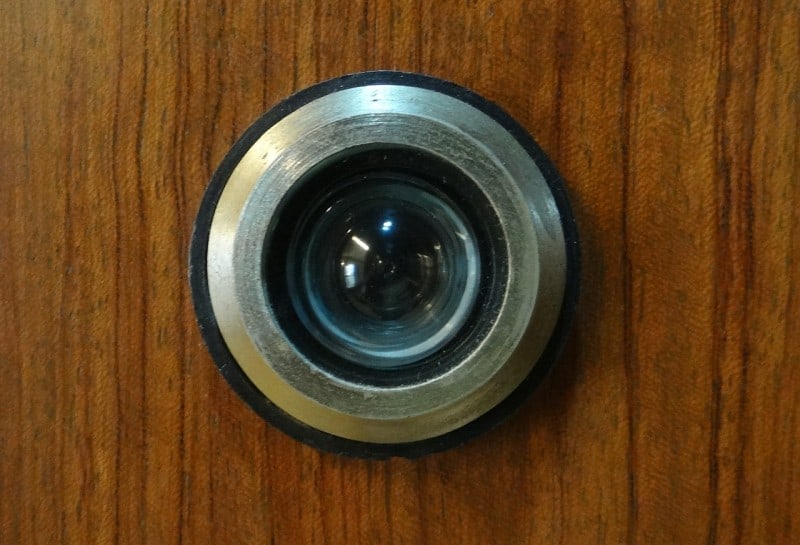
peephole

Getting Eyes On

Seeing someone at your door will help you make an informed decision about who they are and what they are doing there.

A person’s attire, demeanor, physical status and anything they are holding as well as what kind if any vehicle they are driving will all offer clues as to their intent.

But, as I mentioned above, peeping through a peephole or sidelights is not ideal, as this obvious indicator of your position can be used against you immediately to lethal effect.

This is where a technological edge comes in handy. Security cameras of all kinds have in recent years become more user-friendly, affordable and accessible than ever, and are perfect for remotely assessing any who might be knocking or ringing your doorbell.

A simple frontal camera at the door will allow you to see who is there, what they are wearing and likely carrying in front of them, but it will have blind spots to either side, even with a wide angle lens.

This means a savvy prepper will want a multi-camera setup, ideally one covering the spot directly in front of the door, to either side and also a camera above as well as one with a rear view of whoever might be in front of the door.

The latter might be difficult to set up depending on the configuration of your porch, if any.

The reason why you want such an all around view is simple: information is critical. The more info you can gather the better your decisions.

There have been quite a few home invaders who gained access under false pretenses; dressed up as delivery men, census takers, or even uniformed cops.

In each case, with the benefit of hindsight, it was discovered that there is most often something that will betray the impostor.

In one instance a fake deliveryman had a weapon in-hand beneath a box he was holding. When the unwitting homeowner opened the door he barged in, having the homeowner at his mercy.

Another crime saw a couple of uniformed “cops” with vests, belts and all other associated accoutrement attempt to intimidate a homeowner into opening the door under the pretense of a fake warrant.

The clever homeowner peeked outside, seeing their unmarked and atypical model vehicles for his local department and, on further inspection, noticed that the duo were each wearing… sneakers?

That was the tipoff: he called the real police. The pair fled without attempting a forced entry, thankfully.

Another, low-tech option to gather more visual info on who is standing at your door is to install an overhead ¾” mirror, or one of those large, “bubble” mirrors you see at come intersections in buildings and stores.

In conjunction with an overhead transom window, or viewed through a nearby front window, you’ll be able to see more of the person(s) near your front door.

No electricity, no cameras, no problem. While not as comprehensive or as effective as a multi-camera setup, it certainly beats looking thorough a peephole or through sidelights for all the reasons discussed.

security camera

One Word about Cameras

With the proliferation of wireless, “smart” DIY camera systems that seamlessly integrate into your other home and personal devices there has been a sharp increase in the frequency of criminals and malcontents turning these systems to their own benefit or countering them.

Another concern is the privacy-invading nature of the cameras themselves, and the duplicitous corporations who market them…

At any rate, any wireless device can have its security breached and its functionality hacked. This might result in a camera being off or aimed elsewhere when an attack is imminent.

It might allow a criminal to seize control of an interior camera for up to the moment visual surveillance of your home’s interior.

One recent and sobering mystery case had a stranger talking to the toddler-aged child of one couple through the wireless baby camera speaker installed in the child’s room!

The sheer variety in the brands and models of cameras on the market today along with the variations in software and compatible devices means a comprehensive analysis of their pros and cons from a security standpoint is beyond the scope of this article and the author.

If you are considering security cameras for your home, ensure that system hardness and security is a top priority, and do everything you can to ensure that neither corporate interests or bad actors will be able to access the feeds or controls.

If you cannot ensure that, consider traditional hardwired cameras with a remote monitor.

Additional Defensive Considerations

A door-kick home invasion, with or without the deceptive element of a door-knock, is one of the most dangerous and increasingly common crimes an average homeowner will face that can warrant a lethal force response.

Accordingly, it is best to incorporate a few additional action steps along with having the right “unknown contact” plan.

  • Install Anti-kick devices on all exterior doors. It is shockingly easy to kick in any standard door, even a solid one, since the screws holding hinges and locksets together are weak and absorb majority of force, failing easily. An anti-kick device transfers this force to the frame of the building, greatly increasing failure strength of door.
  • Install a “periscope” peephole and peephole cover. An offset peephole keeps your eye out of line with the tube of the peephole. A peephole cover prevents use of a reverse viewer, a device that lets someone outside your home look in through the peephole.
  • Consider reinforced doors and nearby glass, front and rear. Homeowners have been shot through their doors often enough that I would not risk the same fate. A discreetly armored door and heavy ballistic mylar on sidelight and transom windows can give you an edge over evildoers in this situation.
  • Don’t give in to emotion! It is altogether too easy for someone to hit our emotion buttons with pleading or cries for help. You must keep your head on straight; ascertain all facts you can before you decide to “crack the seals” on your home.
  • Always expect the second threat. Criminals increasingly don’t operate alone. Expect a flanking or rear attack or invasion attempt anytime you are managing an unknown contact.

Conclusion

A late night knock at the door is a nerve-wracking and common occurrence, one you must be ready to deal with intelligently if you don’t want to put yourself at risk of harm or death

You’ll need a good plan and a few hardware solutions if you don’t want to roll the dice and take your chances.

Make peace with appearing “cold” or “rude” and stop opening the door for every person that comes by; they have no right to interaction with you and may in fact be planning to harm you.

Only open the door readily to those whom you are expecting and have confirmed their identity.

midnight door knocking pinterest


via Modern Survival Online https://ift.tt/2Ps3s7i

Monday, February 24, 2020

10 Things Old Timers Did that You Should Do Too

The Generational Battle seemingly never ends, and while often well-intentioned and good-natured, it seems to have reached a nasty fever pitch these days.

The older post-WWII generation constantly berates the younger ones for their seeming ineptitude and supposed lack of work ethic, while the younger generations retaliate with a muttered “OK, Boomer…” before dismissing them to the trash bin of history.

The Baby Boomers believe they built the World As We Know It, while the Millennials and Gen Z. dismiss their achievements as half-hearted, a product of largesse and kinder times.

The Old Timers think their wisdom hard-won. The Millennials have the entire world’s knowledge at their finger tips, and know how to use it.

While it is true that every generation improves and builds upon the foundations of the one that came before it, it seems there is a definite mean-streak among the mid-20’s to mid 30’s folks that is increasingly dismissive of their parents’ and grandparents’ generations as hopelessly outdated and out of touch.

That, as they say, would be a bad move. A sting to the ego or not, our parent’s and grandparent’s era has an awful lot to teach us younger whippersnappers about survival, especially in austere settings.

In this article, we’ll have a look at 10 things that “Old Timers” did as part of surviving that us young and young-ish types should do too.

New Problems for a New Age

It is true that modern preppers have to deal with threats and risk factors that our forefathers didn’t, or indeed, weren’t even possible back in their day.

Modern life furnishes us all kinds of invisible and nearly undetectable threats that can no less ruin our day: online privacy issues, a new and growing surveillance state, EMPs, cyberwar and a widening gulf between values and cultures that seems impossible to bridge, much less stop.

Surely the old folks can give us that much at least if they have time to stop acting so smug? What about our precarious economic situation? Living under continual terror threats?

A deadly-serious housing crisis? They didn’t have to worry with any of that! Those agrarian and golden times were Easy Mode for the good, old U.S.A.

True, except, not really. The older generations didn’t have to deal with some of the problems we do, today. But they also had plenty of their own, including some of the most fundamental survival problems that persist across all of human history.

And they had to figure it out using far less in the way of technological sophistication compared to what we enjoy. While our technology is an immense asset, it can also limit our field of view.

Nothing New Under the Sun

Including what problems plague mankind. While each generation has its sort of signature issues it has to struggle against, it never fails that each one will believe the following: the generation that preceded it didn’t know shit and the one that comes after it is woefully defective.

It is just the way of things. But what each might fail to recognize is that every generation is theoretically if not practically at risk of the same fundamental threats.

While our grandparents and great grandparents survive the dread and lack of the Great Depression, our modern economy does not make us immune to a bursting bubble and subsequent recession.

Our grandparents and great grandparents lived through the quaking tumult of the Civil Rights Movements and associated chaos.

It remains to be seen if the unrest and viciousness of our latter-day societal troubles will boil over into mass conflict and violence.

Our parents lived through the Cold War in earnest, the specter of nuclear annihilation loomed much closer then. Today, a nuclear war among major powers is almost laughable in reality, though the proliferation of nuclear weapons and the smalltime madmen who would actually use them seems to be growing by the day…

The point is this: our elders did have to deal with some serious stuff, and they did have to do it without so much of our fancy technology.

For them, at least for many of them, an austere day-to-day existence that many of us would call a proper survival situation was just… Living!

No matter how peaceful or “Leave it to Beaver” wholesome an era was, there were always threats to the solvency of a family. Natural disasters sure as hell still happened.

Man-made disasters, too, in the form of chemical spills, train crashes and the like. Preppers might not have had the same label back then, but you had better believe any man or woman worth two cents took pains to ensure their family was ready and insulated against disaster.

Modern Prepping has Advantages and Drawbacks

Modern preppers enjoy all kinds of technological advantage over our forbearers. We have the right tools, the right info, the right “hacks” for any conceivable issue, great or small.

In fact, our modern database is so vast and so intricate, it oftentimes feels like we barely have to think at all about a solution! A few words of text in a search bar and we’ll have a dozen possible solutions with expansive step-by-step guidance on implementation.

This is good and bad. It is good because specialization often yields the most efficient response to any given problem, but it is bad because we have, in a way, outsourced a big part of our problem-solving skills to an electronic software solution.

Don’t think it’s a problem? Tell you what, next time you have a novel and unknown problem crop up, resist the urge to turn to Google, Bing and whatever other search engines, forums, wikis and so on you typically do to get your fix.

You can have all the hardware solutions in the world, and be daggone sharp at implementation and reading instructions but have precious little in the way of analytical ability or real critical thinking skills.

I’m not condemning, I am sure I am much the same: for those of us raised in the Information Age, we never had to do without it. It was always there, always a part of us for lack of a better word.

But considering how fragile our info networks really are, it is more of a dependency than an innate superiority. One bad turn of events can see it all go black. Forever…

The Wisdom of the Old Timers

Our elders had to sort out what they needed to do using a lot less institutional knowledge and a lot more hands-on experimentation and learning built upon the back of repeated, demoralizing failures.

They did not, in any way, have access to the same storehouse of knowledge that we younger folks do, and we carry it around in our pockets!

Even with access to a university library and experienced, skilled teachers, there was simply a cap on what was known and accessible to a given person.

Only the advent of the internet made comprehensive information on any given topic taken for granted.

If they could not ask someone, attend a convention or find the info in their local library they were SOL, and left to good old fashioned “figure it out or go without.”

Friends, family, neighbors and perhaps a county “expert,” assuming you could get an in or mutual connection, were the only reasonably reliable sources of institutional knowledge on pretty much any topic.

And once you had the knowledge you sought, applying it was far more laborious and involved far more trial and error. Again, they did not enjoy live video feeds, up to date schematics, check lists, and pages upon pages of FAQ’s and other errata near to hand for literally every topic imaginable like we do.

The result? While the transmission of knowledge was much slower, the understanding of how things worked, and why, was more comprehensive, much richer you might say.

This led to far greater confidence in their own abilities. Knowing you know something is a lot different than knowing what to look for to take care of something. We youngsters might know a little about an awful lot of things, but we don’t know an awful lot about a few things.

So though it is easy to decry our parents’ generation as knowing comparatively little, their knowledge was like a iceberg: they knew an awful lot more about a given subject than just the simplified, surface stuff.

If they knew how to work on a car I guarantee you they probably knew the intricacies of that car, too. What parts were adaptable from other models, or what parts and screws they could live without if they had to.

I promise you your granddad had one gun, or maybe two, and he knew it inside and out. He knew every screw and spring, he knew how far his chosen load would buck the wind and when it would start to falter.

He knew to be mindful of a shifting zero resulting from a wooden stock warping in the moist air.

The point is, our forbearers went into greater detail, they dug into the nitty-gritty, compared with us. If we learn but one thing from them, let it be that we should strive to learn things comprehensively, not just broadly.

10 Things Old Timers Did to Survive that You Should Do, Too

You might be a survivor, a veritable prepping machine, and really live a lifestyle of readiness. Good on you. Even so, I’ll still wager that if you peruse this list of things that the old timers did you will find at least a couple of ways they would have blown us out of the water.

Give this list a gander, and let’s see what they were up to, and up against!

#1. They Didn’t Whine

Our modern culture has cultivated an acceptance of weakness, in all forms. Your flaws, your shortcomings, your flaws, your failings have all been reframed as uniquely you, even admirable!

Sniveling is the fastest way to court attention and get what you want. No wonder then that it is so widespread!

From the government, to the state of the Union, to those voters, to my neighbors, it is completely acceptable to go “snivel me timbers!” at the drop of a hat.

It sure as hell was not that way back in your elders’ day, and it was not acceptable! A perpetual squealer was shamed, mocked, and derided. It would seriously threaten their inclusion in groups of all kinds.

Bad emotions and words have a viral quality about them; they infect the minds of those who are exposed to them. One bad apple really can spoil the whole bunch.

Our forbearers knew this, and amputated those bad apples before they went rotten. If someone had a complaint they had better damn well have a plan for fixing it, too. If they didn’t, you bit your tongue and took it like a man. Suffer in silence!

Take this play from their play book: don’t complain unless you have a solution for what drew the complaint in the first place! Whining and moaning does nothing but make you and everyone else feel worse and it wastes both time and energy.

If you don’t cultivate a culture of “fix it!” you are going to have a hard time as a prepper.

Don’t whine!

#2. They Kept it Running and Made it Last!

Most of us have that one parent or parental figure who seems supernaturally talented at keeping things working, running, useful long after they should have rightfully worn out and been thrown away.

What you and I might call a gift, or a specialized skillset when it comes to repair and improvisation was actually just life for our elders. They were resourceful because most of them had to be!

Things were treated with more reverence and care back then since you were never guaranteed a replacement.

If something expensive broke, or you were just living in a real low-income household, the things you used and needed had to last or your ass would be going without.

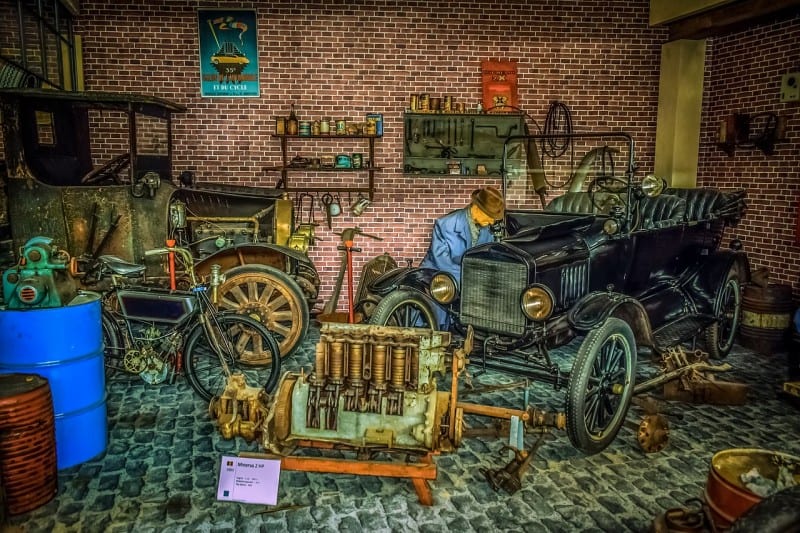
fixing old car

Our elders had the guts, know-how, stick-to-it-iveness and determination to make things work!

Today, the skill does not have as much cache; we have literal mountains of crap just waiting to be bought, waiting to replace anything whatsoever that breaks.

And we even have credit cards and financial aid that can help us get what we cannot afford! Well, that’s fine, but what it does it create an ocean of waste as well as a habit of hitting “reset” when something breaks.

You think you’ll be able to hit up repairclinic.com or Amazon during a SHTF crisis? Of course not! You had better be learning to fix things yourself.

The next time something wears out or breaks down, fix it, even if you can afford a replacement and even if it should, rightly, be thrown away. Hop on the internet while you can, or bust out a repair manual and make that old piece of equipment work again.

It might not look like new, but if you can keep it functional, even partly functional, that is going to go a long way to boosting your confidence when the chips are down and you don’t know when the lights are going to come back on, if ever.

#3. They Chose Quality

If you are very lucky, you are the recipient of one of your elders’ treasured tools or firearms. If not one of those then some other family relic that has survived, lovingly cared for, and been handed down through the generations.

And if you are not so fortunate I’ll bet you know someone, a friend or neighbor, who is. Whatever that item is, it has only survived long enough to be handed down because it was taken care of and because it is something made to last.

Buying the good stuff is not cheap, and lacks the instant gratification that Americans have so grown to love.

But while buying quality items is not cheap, it is still cheaper than buying cheap, whereby the thing you bought will invariably need to be replaced or worse, it cannot even do what you bought it to do.

Ultimately a higher quality item will provide a better return on investment since it lasts, allowing you to get more work out of it, longer, and with less downtime.

Not everything was necessarily made better back in the old timers’ day; our technology has indeed come a long way since then.

But despite our advances in materials and manufacturing the paradigm seems to be “as cheap and as often as possible” when it comes to quality. That’s a bad play.

Sharpen your pencil, save if you have to, but turn your eye toward quality in all purchases!

#4. They Made Do With Less

I think there are few preppers today who would boast of being able to get more down using less provision and less equipment than our elders.

I’m not talking about working longer hours or walking uphill, in the snow, both ways, to and from school. I am talking about the business of survival, specifically outdoor survival.

Don’t believe me? Go take a look at any old photos your grandparents might have squirreled away or an old outdoor magazine from the era. Have a gander at the size of their packs, would ya?!

You’d see people packing a bag hardly larger than a knapsack for multi-day excursions into the wild! Some of these old timers went in with loads so light they can hardly be said to have packed at all.

Now, before you call be a hypocrite for praising seeming unpreparedness, hear me out: they didn’t go in unprepared, they simply had all their info “under the hood” in their brains.

They could carry in simple tools and using a bit of woods lore and the minimum of effort produce what they needed in the field. Instead of carrying a tent, they would carry a simple tarp or lean-to and some cordage, and would supplement that with some boughs or leaves for warmth and comfort.

They would not carry half a tool chest into the wild yonder, instead relying on a small handful of had-to-have-it tools and would know a hundred different ways to use them.

In short, they would use knowledge and wisdom to best effect, relying only on what hardware and gear they had to have to get the job done.

We should learn from their example; too many preppers are as helpless as babes when separated from their BOBs and all its goodies.

You should be able to use the basics to shape the situation to your will; if you are smart enough, you can.

#5. They Forged Meaningful Relationships and Support Through Them

You can safely say we today enjoy more “friends” than any generation past thanks to our connections on social media.

The sad part is, our friends in cyberspace are often as ethereal as any relationship can be and still be called one.

We might have more, but they are worth far less, unless swapping humorous videos and spicy memes is a worthy pursuit in your eyes.

Compare that with earlier generations. They had fewer relationships all told, but many more truly deep and abiding bonds. Part of it is a cultural things, but the other half was necessity.

They often did not have anyone else they could turn to or rely on when things got rough. Your friends, family, neighbors and fellow members of your congregation were your community.

When there was trouble, those people showed up, and if they didn’t you’d likely want to know why. Those are bonds you cannot fake, and you cannot tout if all they are is electrons on a screen and a years old, dusty chat thread.

You can say “your people” all you want; if you don’t know for a fact, right now, they’d show up at 3 AM when the chips are down and you have it all on the line, you don’t have anyone.

Worse, the popular idea of the know-it-all superman survivor is increasingly infectious, and plenty of preppers not only think they can survive alone, they plan to!

This is the height of idiocy if you have any other choice. That story almost always ends with the lone survivor dead. Your elders knew, really knew, that old fashioned community, even if just a tiny village, was a vital insurance policy against the unknown.

#6. They Kept Their Cards Close to their Chests

You ever pay attention to how your granddad acts when he is talking to people, even his friends? You ever pay attention to the old heroes of movies and TV back then?

Notice how quiet and stoic they all are? There is a reason for that: the old timers sure as hell didn’t believe in over-sharing! Most of them, especially the men, were taciturn in the extreme, almost brusque.

They didn’t gush, didn’t talk at length, and didn’t babble. This accomplished a few things in one fell swoop.

First, it was considered good manners. No one wanted to be thought of a blabberer or motormouth. Second, it kept their cards, practical and emotional, close to their chests.

If you betray no weakness your weakness cannot be used against you. Our elders knew that there was always someone out there who would not hesitate to take advantage of you if they had even a tiny bit of leverage.

Plenty of modern day preppers treat prepping as a hobby in some ways; they cannot wait to tell someone, anyone, alllllll about it.

You know what your granddad would probably say? SHUT! UP!!! Shut up about your plans, your whereabouts, how much land you have, how many guns you have.

Don’t tell people about stuff that could be turned against you or taken from you unless you have serious trust built up (see #6).

The same goes for what you say, post and do online. You needn’t think anyone is truly anonymous these days.

#7. They Used Less and Made More

The concept of saving is virtually unknown to the younger generation. A huge portion of Americans cannot miss a single paycheck without going four-legs to the sky. How’s this for a disaster you aren’t prepared for?

Let your car need a major repair, or one of your kids need a surgery or your home require some correction lest you be fined into oblivion.

How long can you last? How far can you go? WHAP! You lose your job tomorrow. How long can you survive on your savings?

This is not just cash money related, either, though that is part of it. Say whatever you want about economies and this and that the other, our elders were much better at keeping more put back “just in case” than we are today.

Most of us had or have great grandparents who would religiously scrimp and save and clip coupons even if they didn’t have to. They were after just those few pennies saved.

They would can and freeze and cure and pickle to hang on to more food that would otherwise be lost. How’s that for prepared, nearly 6 months worth of ready to eat food on hand, eh?

They made it a point to live below their means. We should, too. If you don’t have a savings account or stash of cold, hard cash, start one today.

I don’t want to hear about this, that and the other thing! What can you give up? What can you sacrifice if you want to be truly prepared as you say?

Can you get out of your house and live in an apartment? Can you leave your apartment and live in a tiny home or camper? If there is a will, there is a way, and it will be too late when disaster has struck.

#8. They Did Not Rely on “I Think”

Way back when, action was valued, not talk. I didn’t say “valued much more”; talk was not worth spit. If you didn’t know what you were talking about, you had best keep your mouth closed and listen.

Experience, wisdom, that was valuable. Not theory, not hypothesis, not educated guesses. There was too much to lose back then and a lot fewer safety nets if you screwed up and fell. Speculation would get you severely rebuffed in the company of those who had already done.

If you had already done, and knew what you were talking about, you were fine. If you hadn’t, you kept quiet or you got “read in.” The only way you knew what was what was by doing. Act! Action! Act!

He who did more was not only worth more, they were the only one worth anything at all. If you failed, that was alright: you at least had the nads to make the attempt, to try, to dare and try and falter.

You need to become a doer! Stop talking and chatting about prepping this and training that! Go do it! Now!

Go to the range, scout that bug-out route, get in a workout, markup your maps. Get action! It is the only way growth occurs. Not by wishing, thinking and, bleh, more talking!

#9. They Kept in Better Shape

There is little argument that Americans today are some of the most out of shape people on the planet, with skyrocketing rates of obesity, heart disease and other fitness-preventable diseases and ailments standing in as grisly testimony to that fact.

Sadly, we are growing fatter still; our reliance and love of labor-saving technology for everything and a diet that is most often times processed, fattening, carb-o-holic garbage means that this trend will only likely continue.

While the “fat American” stereotype was certainly around during the old timers’ day it was simply not as prevalent.

The shame and stigma of obesity was sharper, and the lifestyles of the time, I’ll give you, simply had more exercise built in to it.

Many jobs and tasks of the day relied on muscle, not machines, and not electronics. But, that excuse notwithstanding, our elders knew that they had better keep in shape if they wanted to survive; believe me, they knew how hard it was!

It is easy to say you are “ready” but if you cannot make it up a flight of stairs or sprint to the end of the driveway without getting horribly winded you will probably not survive the rigors of a real survival situation. But that pie DOWN, and get the weight off!

#10. They Were Leaders

Our elders did not hem, haw and try to reach consensus. They did not consult, meditate and pace about it.

They acted. They did. And most importantly they led. They lead their families. They led the people who depended on them. They bore the burden of leadership stoically and did not shirk it or whimper.

They did not panic when the stakes were high and the other folk were screaming fit to kill. They steered into the crisis and led people out of it or through it.

It might seem like they were better leaders because they were better men and women. Maybe it’s true, but I don’t think so.

Leadership is about attitude. It is about stepping up and getting in front of the problem. It is about being the rock, the fixed point.

Start embodying that. Be decisive. Be firm. Have a plan. Have a backup plan. When something needs doing, do it. Don’t ask for permission. Don’t wait for approval. Do it.

With time, dedication and refinement, people will start seeing you as that “natural” leader and look to you in times of trouble. Then, like your elders, you will have a group of followers, not a rabble of panicky individuals.

Conclusion

We sure do have a lot to be thankful for and proud of as preppers today, but I maintain that we can still learn a lot from our elders if we choose to understand the lessons.

While it is popular, even funny, to ridicule them as out of date dinosaurs hailing from a world so far removed from our own it might not have existed at all, I can assure you they worked hard and sacrificed much for the wisdom they have.

Don’t neglect it! Give this list a thorough read and see what lessons the Old Timers can pass down to you.

old timers wisdom pinterest


via Modern Survival Online https://ift.tt/39WxRlV

Friday, February 21, 2020

Software Defined Everything with Mike Ossmann and Kate Temkin

Software defined radio has become a staple of the RF tinkerer, but it’s likely that very few of us have ever taken their software defined toolchain outside the bounds of radio. It’s an area explored by Mike Ossmann and Kate Temkin in their newly published Supercon talk as they use GNU Radio to do some things that you might find unexpected.

For most people, a software defined radio is a device. An RTL-SDR dongle perhaps, or the HackRF that a popular multi-tool for working in the radio frequency realm. But as they explain, the SDR hardware can be considered merely as the analogue front end, being just the minimal analogue circuitry coupled with a digitiser. The real software-defined part comes — as you might expect — in the software

Kate and Mike introduce GNU Radio Companion — the graphical UI for GNU Radio — as their tool of choice and praise it’s use as a general purpose digital signal processing system whether or not that includes radio. Taking their own Great Scott Gadgets GreatFET One USB hackers toolkit peripheral as an input device they demonstrate this by analysing the output from a light sensor. Instantly they can analyse the mains frequency in a frequency-domain plot, and the pulse frequency of the LEDs. But their bag of tricks goes much deeper, exploring multiple “atypical use cases” that unlock a whole new world through creative digital signal processing (DSP).

Software Defining New Uses for Existing Sensors

Analysing a baseband analogue signal is the stock-in-trade of cheap SDRs, as many readers will know a computer soundcard can form the baseband front-end into which an RF down-converter is plugged to make a software-defined receiver. Where this talk takes us is uncharted territory though, as the devices being used for inputs aren’t analogue at all but digital, with I2C interfaces.

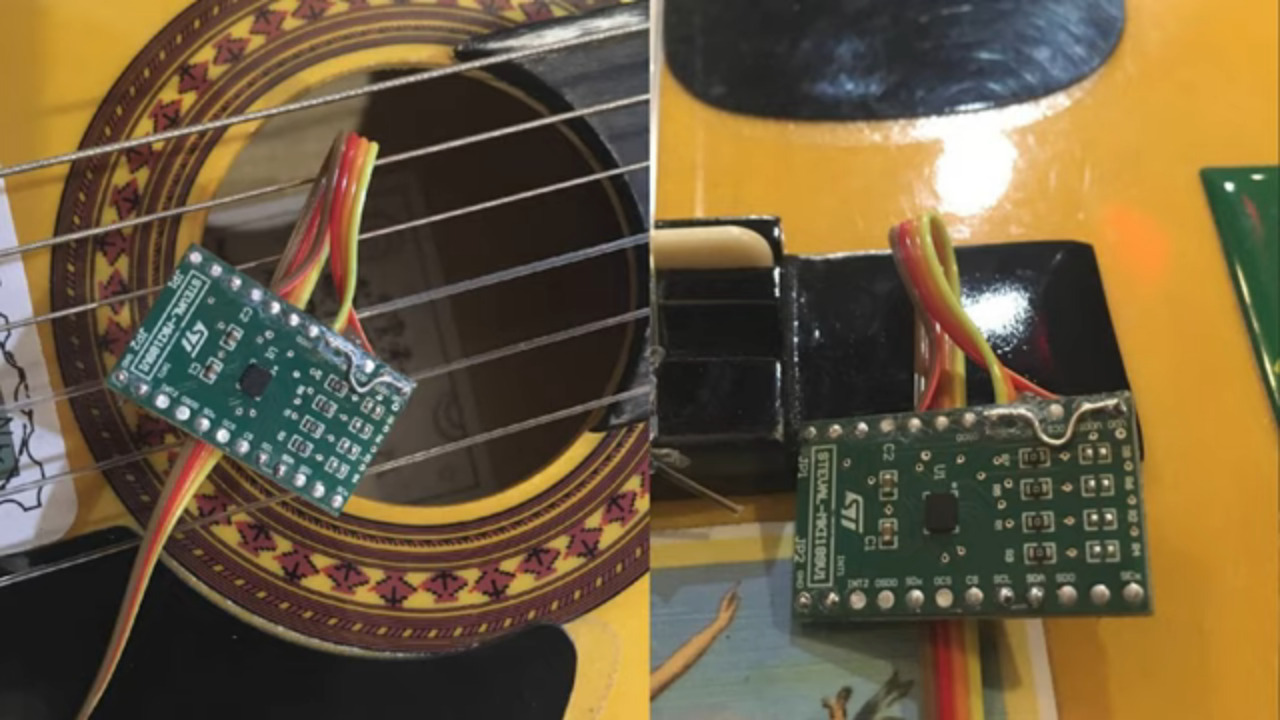
The main demonstration underlines this, using an accelerometer breakout board as an acoustic guitar pickup. This is an ideal demonstration of GNU Radio’s DSP abilities, as a range of guitar effects are simulated in software for some entertaining results. Even a cardboard box with a rubber band becomes a musical instrument worthy of a rock group, something that goes down well with the audience.

As hackers it’s our mission to push whatever medium we work with beyond its normal application, and to find exciting new uses for established pieces of tech. This talk takes the unusual step of starting with something that’s already a hacker tool, a DSP platform for software defined radio, and turning it into a more general-purpose DSP toolkit with applications far further than those we’d normally associate it with. The sheer number and variety of available blocks make it an exceptionally versatile platform, while the manageable user interface of GNU Radio Companion renders it within the reach of even the most novice of experimenters.

It’s the essence of hacking and it’s something we can all have a go it, so we hope this talk inspires a whole slew of DSP projects of a type we wouldn’t otherwise have seen. If you’re tempted, get hold of a copy of GNU Radio and GNU Radio Companion, and show us what you can do!


Hear more from Kate Temkin as she hosts next week’s Hacking USB Hack Chat.


via Radio Hacks – Hackaday https://ift.tt/2T0mfHE

Learning Morse Code the Ludwig Koch Way

Most countries have dropped the requirement for learning Morse code to become a ham radio operator. Because of that, you might think Morse code is dead. But it isn’t. Some people like the nostalgia. Some like that you can build simple equipment to send and receive Morse code. Others like that Morse code is much more reliable than voice and some older digital modes. Regardless of the reason, many people want to learn Morse code and it is still a part of the ham radio scene. The code has a reputation of being hard to learn, but it turns out that is mostly because people haven’t been taught code in smart ways.

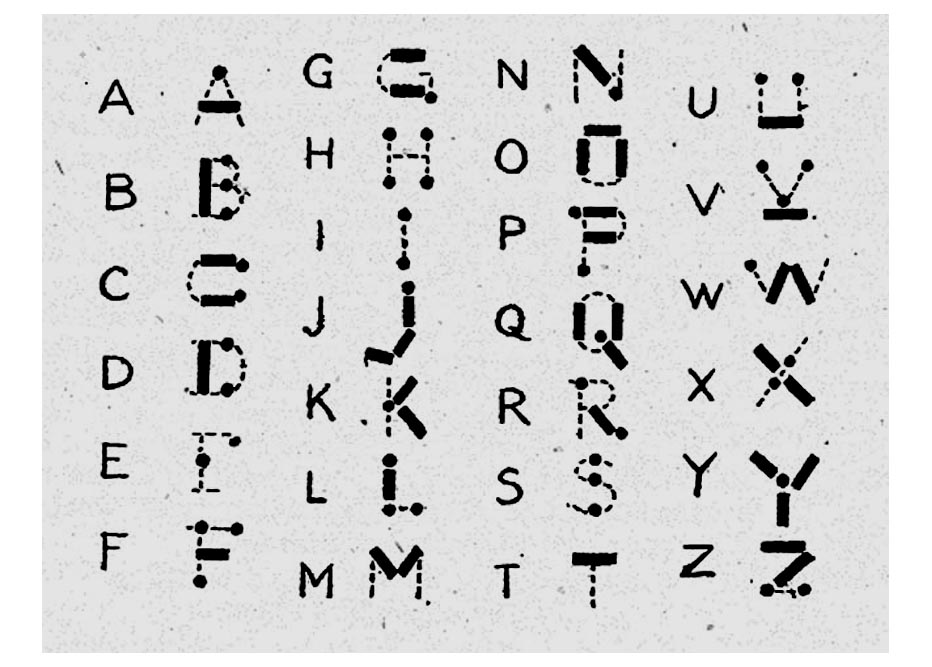
I don’t know if they still do, but some youth organizations used to promote some particularly bad ways to learn the code. The second worse way is to learn “dots and dashes” and many people did learn that way. The very worst way was using an image like the adjacent one to try to map the dots and dashes into letter shapes. This chart dates back to at least 1918 when a Girl Guides handbook printed it.

Even if you are a visual learner, this is a bad idea. The problem is, it is nearly impossible to hear sounds at 20 or 30 words per minute and map them to this visual representation. Another visual method is to use a binary tree where left branches are dots and right branches are dashes.

If you only need to master 5 words per minute to get a merit badge, you might get away with this. But for real use, 5 words a minute is very slow. For example, this sentence would take about 3 minutes to send at that speed. Just that one sentence.

So what are the better ways? Let’s take a look.

Sound It Out

When you hear someone say the word “elephant” you do not (we hope) translate that into individual letters. You might actually hear phonemes, but most people don’t even do that. You just hear a sound that your brain knows means a large grey animal with a trunk. That’s what you want to get to with Morse code. Sounds should just mean letters without having to interpret them.

That leads to what might be the third-worst way to learn and, unfortunately, a way many of us did learn. It is very common — especially in the past — to send Morse code very slowly for beginners. That’s great, but it limits you when you try to go faster.

If you consider the elephant example, it would be like if you were trying to learn English and your coach said “El….uh….phant.” It would be easy to understand her, but harder to understand people speaking normally.

Speed Up to Start: The Farnsworth Method

Today the Farnsworth method — named for Donald Farnsworth — is very common. The idea is to send the code at the target speed you would like to learn, but space it out so the average speed is much slower. For example, your coach might send at 15 words per minute but spaced out so it was really 5 words a minute.

That makes sense. You hear the sound you’ll hear when you are proficient. But you’ll have time to think about it. As you get more proficient, you reduce the gaps until you are at normal spacing.

Another Way

A less common, but very effective way to learn is the Koch method named after a psychologist Ludwig Koch (we think it was the same Koch famous for nature recordings). Like the Farnsworth method, you send characters at the target speed. What’s different is that you send only two characters. When the person copying the code can copy 90% accurately, the coach adds a third character to the mix. You continue with those three characters until the learner is back to 90%. Then a fourth character shows up and the whole process repeats until the learner can copy all characters.

This is surprisingly effective because it naturally makes you pay attention to the sound and not the dots and dashes. Koch was able to teach a class of students to copy code at 12 words per minute in under 14 hours. However, the method wasn’t often used until recently.

Digital Age Unlocks the Path Less Taken

The problem with the Koch method is that it is hard to do with standard ways code was traditionally taught. Records, audio tape, paper tape sending machines (like the Instructograph in the video below), and radio broadcasts don’t have an easy way to provide you practice with the groups of letters you know plus one additional character. It is also difficult to do in large classes because one or two slower learners will hold up the entire class.

So, ideally, you have one instructor for just a few or even one person, or you need a computer that can send Morse code. That’s easy today but it wasn’t always so simple.

Get Learning

If you want to learn the code, or if you want to learn it better than you know it now, the Koch method is pretty simple. If a bunch of students can learn code in 14 hours, you should be able to, as well. Even spending an hour a day, that’s only two weeks.

There are plenty of resources, but one we like is LCWO (Learn CW Online — CW or Continous Wave is ham-speak for Morse code). The site costs nothing and will track your progress. Once you’ve learned it, you can practice text, words, callsigns, and common ham radio exchanges.

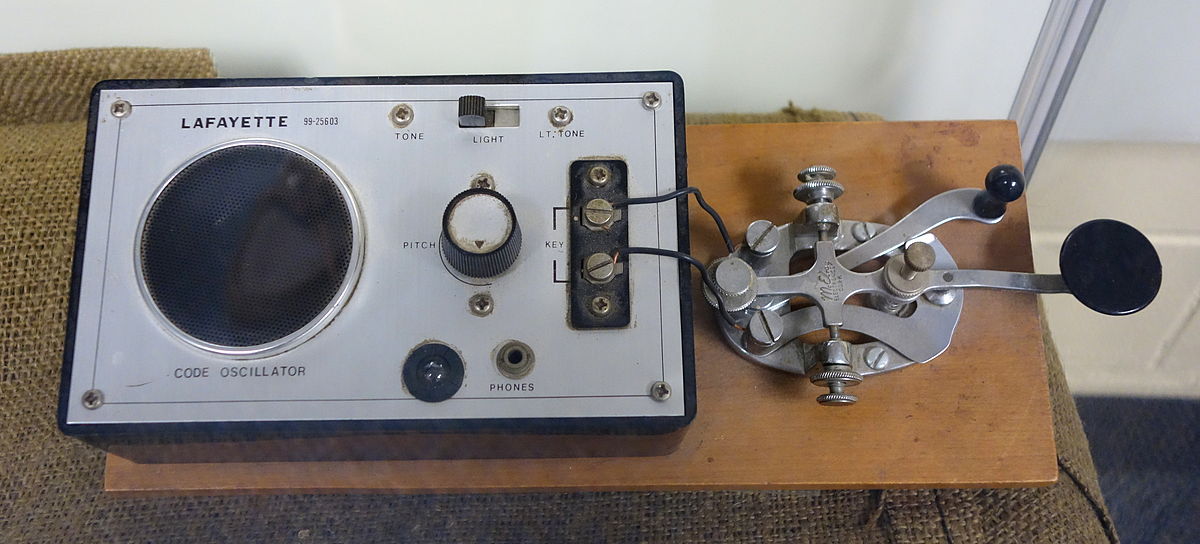
Even if you don’t need Morse for a ham license anymore, it does open up new opportunities. If you don’t want to do ham radio, think of all the Arduino projects you could do where the device could signal you with a blinking LED and you could command it with a single switch contact. Not that we’d use a scheme like that to count blackjack cards. We’d never do that. If you don’t want to use the computer and still need a coach, you could try this 1939 code trainer.


via Radio Hacks – Hackaday https://ift.tt/38N5Tst