Thursday, February 13, 2020

Top 10 Urban Survival Kit Items You Should Have

Most survival priorities apply in any kind of environment you happen to be in. You’ll always need shelter, you always need food, water and a way to protect yourself.

Urban environments offer their own share of challenges, and many of them are the equal of some of the most hostile natural environments on Earth.

The concrete jungle can be a dangerous place in the best of times, and you can bet it’ll be even more dangerous in the middle of a SHTF situation.

If you are an urban dweller or just reside in a suburban neighborhood outside of a major city, it is in your best interest to have a survival kit that is specially adapted for the challenges you’ll face in the city.

You shouldn’t be lazy or take it easy just because you’re surrounded by all the trappings of civilization. You’ll still need the right survival supplies, and the know-how to use them.

In this article I’ll provide you with 10 must-have urban survival items to include in your kit.

Urban Environment Gear Selection

Setting aside the massive population difference for a moment the single biggest difference between survival in urban areas and survival in a rural or remote area is the sheer amount of buildings and doors you’ll have to deal with.

Gates, shutters, doors, windows and turnstiles can all block progress on potential escape routes or just access to much-needed supplies. This means you’ll have to have a plan for opening, getting through or around these barriers.

I’m not saying you should go breaking into places willy-nilly, but the necessities of survival may mean that you have to bypass locked portals.

You should consider both specialized and common tools for the task. That means things like crowbars and potentially lock picks if you have the skills to use them.

Note that it is entirely up to you to learn, understand and obey your municipality’s laws on the possession of such things. Some particularly over interested governments in major cities consider things like that breaking and entering tools.

I’m not saying you are a crook or will illegally break and enter a building; I just want you to be careful that you don’t run afoul of the law pre-SHTF.

Another major problem is, as alluded to above, the population at large. And what a large population it will be in any major city! No matter what kind of disaster or crisis you are facing a significant fraction of the population will not evacuate, even if they try.

It will simply be too late, the roads will be too clogged or the situation will develop so rapidly that there is no time. That means you too will be sharing a rapidly disintegrating metrozone with hundreds of thousands or even millions I’m scared, desperate people. Oh, and a whole, whole bunch of criminals.

There’s no easy way to put it: cities simply contain more criminals per capita and attract criminals like flies to a corpse since business is much easier for them there. After all, that is where the food is…

This consideration is complicated somewhat by typically strict laws on the possession of weapons in major cities all around the country. You’ll notice that anywhere you have liberal leadership you will have eye-watering, ridiculous restrictions on weapons of all kinds.

This won’t affect the criminals, of course. Just you, or at least it will affect you prior to the collapse of law and order. So the trick is you definitely want to go armed, but you can’t risk getting caught and tossed in jail.

The way I see it, you have two options. The first, you can strictly obey the letter of the law and carry whatever weapons the law says you can carry, procuring something more substantial after the s*** has well and truly hit the fan.

The second way, you can get the right tool for the job and run the risk of running afoul of the law. You’ll have to make based on your cost-benefit analysis.

There are other urban environment-specific concerns, but I’ll cover those with the actual gear choices.

The Top 10 Urban Survival Items You Should Have

The following items are presented in no particular order. They’re all equally important if you wind up needing them. If you don’t need them, you can Monday morning quarterback it and say “it wasn’t that important”. What is important is that you have all of them on hand when disaster strikes.

Weapon

Against all odds you will hopefully not need a weapon at all. But statistically you will, especially within the confines of a city. Your choice of weapon is dependent on several factors, not the least of which are the laws where you live as discussed above.

Guns are overwhelmingly the best choice for serious self-defense, being the weapons of our era, and they confer many advantages like range, power and precision.

If you choose a firearm, you also need the training to go with it. They are not much good in the hands of an untrained user. Also make sure you carry at least a little extra ammo with you.

Knives and other cutting tools are good choices, being found in abundance in any city in almost every single building. You can come up with a knife in no time if you want one.

Knives are easy to carry, easy to hide and very fast into action. You’ll have to be at bad breath distance to actually use one and that is not ideal but knives to make for a lethal surprise attack if someone thinks they have the drop on you.

One highly undervalued defensive tool for preppers that just so happens to be non-lethal is pepper spray. A strong pepper spray blend will stop most people in their tracks, and even if it doesn’t stop them it will significantly degrade their ability to continue to fight.

Not for nothing, not all self-defense problems require lethal force to solve but you may also not actually want to get into a fist fight with someone. In that case, pepper spray is the answer.

Respirator

A unique environmental hazard present in cities is airborne contaminants created by burning or knocked down buildings. Everyone saw what happened after the 9/11 attacks.

Months and years later, people are developing all kinds of terrible cancers and other diseases from breathing that lethal smog in.

Sure, you might say but you’ll deal with that when the time comes, but you’ll also be dealing with a shortness of breath and the inability to breathe if you don’t have a mask to filter at least some of this stuff out of the air.

You can go with a disposable dust mask but a much better option is a snug fitting respirator with replaceable cartridges. Make sure you get some that are rated N95 or better so the air that reaches your lungs is free of the vast majority of contaminants.

Carry more than one filter with you. In case of a bad fire or some other calamity it is entirely possible to burn up a filter within an hour.

You might choose to carry a full face gas mask, but chances are these items will be more trouble than they’re worth. They are large and bulky and restrict your vision, and most airborne biological or chemical agents that would call for a gas mask will also require full body protection.

Whichever option you choose make sure you store the mask and the filters carefully. They are fragile, and will not survive getting wet.
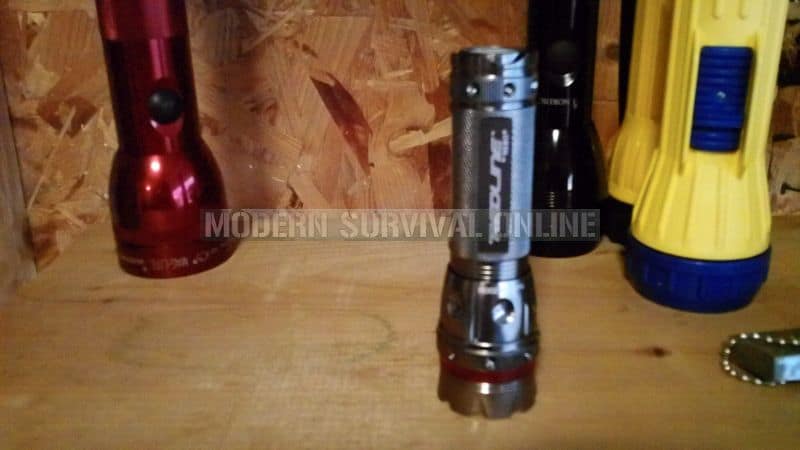
flashlights

Flashlight

No prepper worth the name should ever be without a good flashlight at any time, full stop. A flashlight is especially important in a city survival situation, since their power grids are even more vulnerable compared to other parts of the country.

They also get shockingly dark after nightfall with their hazy polluted air and towering buildings blocking out moon and star light. If you have ever had cause to be out during the night in a city experiencing a power outage, you’ll know what I mean.

Spooky stuff. The interiors of buildings might as well be filled with ink if they don’t have generator power.

Make sure you get a flashlight that uses a tailcap switch, not a side body switch, since it will be much easier to use in a variety of positions and especially during self-defense situations.

Aside from lighting up the dark, your flashlight can be used to signal other people including rescue parties. Also don’t forget that you can use your flashlight for more complex communications over longer distances using something like Morse code.

It goes without saying, but you’ll need plenty of batteries to feed your flashlight, or a power cell the top it off if it is a rechargeable model. In my urban survival kit I carry six replacement batteries for my 2-cell flashlight.

That gives me about six total hours of light on the high beam setting, and around 24 hours on low. Plenty for most scenarios if used sparingly.
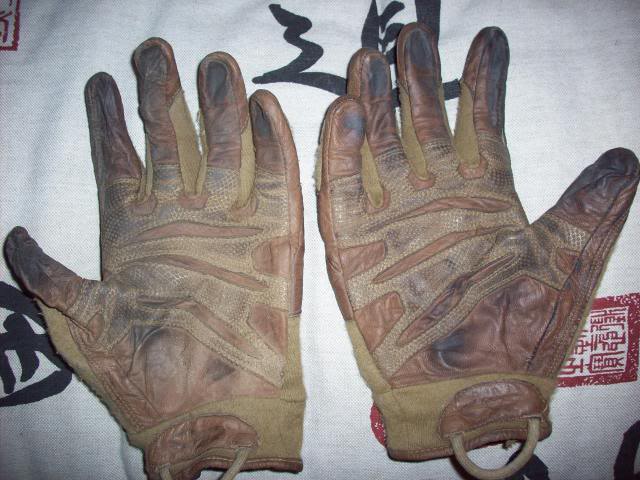
gloves

Gloves

Your hands will be in for a hell of a hard time in a city after a major disaster. Broken glass, exposed wires, twisted metal and all kinds of other sharp stuff will wait to lacerate and puncture your tender hands.

Your ability to survive is likely tied to what shape your hands are in. Debilitating injuries to the hands will severely impede your efforts. Take care of your hands by encasing them in gloves.

Preppers will argue all day long over glove selection. Some like light, thin technical style gloves as popularized by the Mechanix brand while others prefer heavy duty leather ranch gloves or work gloves.

I say why not both? You can easily nest one pair inside the other and stash them in your kit. Having backups is always good and there are situations that will call for one but not the other.

If I’m anticipating trouble, I’ll typically don the technical gloves so I can more easily manipulate weapons and tools. For general-purpose work, exploration or foraging I’ll keep the heavy leather gloves on since very little will puncture them.

Crow Bar / Pry Bar

A sturdy crowbar or pry bar is one of the most useful tools you can have in an urban environment. You can use these for lock breaking, opening doors, vehicle extrication, manhole cover removal, prying open security bars and shifting heavy objects. In a pinch, you can use it as a dead-hard close combat weapon.

A proper, full-size crowbar as one of the handiest tools you can possibly carry, but the weight and size is likely going to be a burden for most urban survival kits. Consider a smaller 12 to 16 inch pry bar; you’ll get much of the same utility at the cost of some power.

Lock Picks

There are times you’ll need to move or forage without making tracks or raising a hell of a ruckus. Unless you have the literal key to the city, you’ll need to wait to defeat locks and do so surreptitiously.

That’s where lock picks come in. Both commercial and residential locks are pathetic and easily picked as long as you have a little bit of know-how and practice.

This is not one of those items you can just pick up and go to town with. Lock picks require finesse, patience and a fine sense of touch. But once you get the knack for it and learn the ins-and-outs of the few major lock brands that are typically encountered you can let yourself in or open up a padlock in a shockingly short amount of time.

Be warned: unless you are a locksmith possession of lock picks is either frowned upon or strictly prohibited in most major cities. You definitely don’t look like a good guy if you get caught carrying these in normal times.

Multi-tool

One solid multi-tool can replace half a toolbox full of individual tools. True, it is not as efficient or as effective as those individual tools, but the weight savings, handiness and convenience more than make up for it.

You can tighten and loosen all kinds of fasteners, strip wire, connect a car battery, slice zip ties or tape and a whole lot more.

Trust me, you’ll need this thing more than you think just in your day-to-day life and is absolutely priceless in a survival situation.

This is one of those items you shouldn’t go cheap on. Cheap, flea market-grade multi-tools fall apart fast and will often break when they’re used hard for the first time. You don’t have to drop a fortune on a quality multi-tool, and if you’re on a budget you should be looking at something like a Gerber or possibly a SOG multi-tool.

Compass

Even if you were born and raised in the city you live in and know it like your own beating heart you are an absolute fool if you think you’re going to have the same easy time navigating it in the aftermath of a major disaster.

As it turns out, natural disasters and man-made catastrophes alike have a funny way of rearranging the landscape. You might not have the usual street signs. You may not have the usual street level landmarks.

A compass, and potentially a map to go with it, can make a big difference. Just knowing which way you are heading or facing can help keep you from getting lost or at best wasting valuable time.
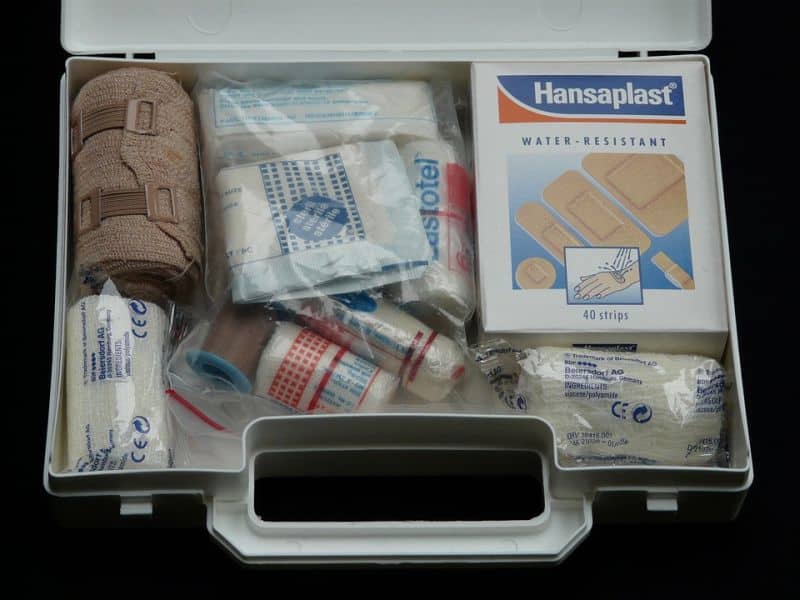
first aid kit

First-Aid Kit

You could potentially be facing all kinds of injuries during and in the aftermath of an urban disaster. That means you’ll need the gear and more importantly skills to treat those injuries, either your own or someone else’s.

A good first aid kit will have supplies to treat minor injuries and significant trauma all while remaining relatively compact and easy to carry. It won’t do you any good if you leave it behind!

The basic kit should be able to treat stuff like minor burns, small cuts and scrapes, and common ailments like nausea, diarrhea, pain and allergies.

Also, make sure to include some stuff for blister relief, chances are you’ll need that. Tweezers and a small magnifying glass are also helpful for getting splinters and glass fragments out of your hands.

The major trauma items are entirely different. You’ll need rolled gauze, gauze pads, tourniquets, nasal airways, chest seals and ace wraps for creating splints and slings to take care of broken bones.

Major pain killers and wide spectrum antibiotics are also extremely helpful. You’ll need to talk to your doctor and get on the same page to get a prescription for these if you don’t need them yourself, but it shouldn’t be too hard if your doc isn’t a complete jerk.

Remember that medicines must be rotated to maintain their potency and probably won’t keep well in extreme temperatures.

The single most important component of your first aid kit is you! None of the above items will do any good if you don’t have the training and knowledge to use them effectively. Make sure you get trained, learn best practices and then actually practice.
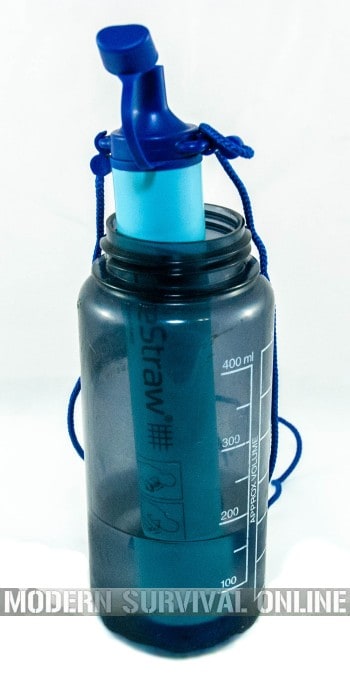
lifestraw go filter

Compact Water Filter

I am constantly shocked at how many urban preppers forgo water, or water filtration equipment, entirely. It just doesn’t make any sense. The prevailing attitude seems to be the fact that, because they are in the middle of the city, they can get water anywhere, be it from a tap or off of a store shelf.

And even if we discounted public water entirely, there has to be somewhere around a bazillion bottles of water in the average city, right?

Yes and no. There might be over 10 million bottles of water sitting around in the city, but when the public water supply either turns off or becomes hideously contaminated those bottles of water going to disappear down thirsty throats fast.

Chances are, the wheels of commerce will have stopped turning with the onset of whatever major disaster sent you running in the first place. That means no more restocked shelves and you’re right back where you started: water is indeed a finite resource.

Most preppers do not consider how vulnerable city water infrastructure is to direct attack or just damage. Need I remind you that sewage treatment plants, or sewer lines themselves will be broken or overflowing? What do you think the chances are that stuff can get in the water supply?

The point is if you want fresh drinking water you’re going to have to provide it yourself, and that means you need a high-quality, effective water filter.

For my urban survival kit I like to take a 1 liter Nalgene bottle and add an aftermarket top that has an integrated filter. That means I can fill my bottle from any old source I find, and drink on the go without breaking down movement to create clean water that I then bottle and take with me.

A Note on Carrying Your Urban Kit

Your urban survival kit won’t do you any good if it isn’t with you when things go down. Considering most urban dwellers commute via public transportation or on foot and not with a private motor vehicle this means you won’t just be able to toss your go-bag in the car and have it relatively close at hand.

You need some type of bag that you can always keep with you, and it has to be one that won’t raise suspicion about what you are planning or carrying.

Depending on your job and lifestyle a casual bag like the ever-popular urban messenger bags might be the best choice. You see these bags in ever increasing numbers in cities all around the world ad they are a popular unisex option.

A good option for executive professionals may be something like a leather satchel or doctors’ bag-style briefcase, preferably one that is convertible to a backpack when things go down.

You don’t want a handheld bag as your primary option when you need to move fast and keep your hands-free for other things.

Whatever kind of bag you choose, make sure it fits your job, the environments you are typically in and the way you are typically dressed. Remember you want to be the gray man in an urban environment, just another face in the crowd.

If you were carrying some webbed up military or tactical style bag, you’re probably going to attract the wrong kind of attention.

Similarly, a sharp-dressed professional carrying something like a college kid backpack is going to look just as out of place. Put some thought into this! Your bag is another part of your survival kit.

Conclusion

Urban environments present challenges all their own compared to more traditional wilderness environments when it comes time to survive a crisis.

The urban jungle will afford you advantages and disadvantages, and you must be prepared to take advantage of the first and minimize the latter. Having the right urban-specific tools in your survival kit will make all the difference.
urban survival kit items Pinterest


via Modern Survival Online https://ift.tt/2HlAGRd

Wednesday, February 12, 2020

All Band Radio Uses Arduino and Si4730

It is getting harder and harder to tell homemade projects from commercial ones. A good case in point is [Mirko’s] all band radio which you can see in the video below the break. On the outside, it has a good looking case. On the inside, it uses a Si4730 radio which has excellent performance that would be hard to get with discrete components.

The chip contains two RF strips with AGC, built-in converters to go from analog to digital and back and also has a DSP onboard. The chip will do FM 64 to 108 MHz and can demodulate AM signals ranging from 153 kHz to 279 kHz, 520 kHz to 1.71 MHz, and 2.3 MHz to 26.1 MHz. It can even read RDS and RBDS for station information. The output can be digital (in several formats) or analog.

The radio takes serial (I2C) commands, and the Arduino converts the user interface so that you can control it. The chip comes in several flavors, each with slightly different features. For example, the Si4731 and Si4735 have the RDS/RBDS decoder, and the shortwave mode is available on Si4734 and Si4735. Confused? Page 2 of the programming guide should help. According to [Mirko], he used a 4730, but it still did shortwave with the 4735 library.

Breakout boards with the chip are just a few bucks. It appears the chip has the technical capability to receive single sideband, but it requires a poorly documented patch. It is in recent versions of this library, though.

We always smile when we think that AM is still alive and kicking. Perhaps this is the modern take on that first crystal radio project.


via Radio Hacks – Hackaday https://ift.tt/2SFnxrh

Tuesday, February 11, 2020

Name that Unknown RF Signal with a Little FFT Magic

Time was once that the amateur radio bands were an aurally predictable place. Spinning the dial up and down the bands, one heard familiar sounds – the staccato of Morse, the [Donald Duck] of sideband voice transmissions, and the occasional flute-like warble of radioteletype signals. Now, the ham bands are full of exotic signals encoding all manner of digital signals, each one with a unique sound and unique demodulation needs. What’s a ham to do?

Help is on the way. [José Carlos Rueda] has made progress toward automatically classifying unknown signals by modifying a Shazam-like app. Shazam is a popular smartphone app that listens to a few seconds of a song, creates an audio fingerprint of it, and searches a massive database of songs for a match. [Rueda] used a homebrew version of the app to search a SQL-lite database of audio fingerprints populated not with a playlist of popular music, but with samples from every known signal type in the Signal Identification Wiki. The database contains hashes for an FFT of each sample, which can be easily searched. With a five to ten second sample of a signal, captured either live over a microphone or from a recording,  he is able to identify the signal automatically.

Whether it be the weird, dissonant wail of PSK-31 or the angry buzzing of PACTOR, the goings-on across the bands no longer have to remain a mystery. We really like the idea here, and wonder if it can be expanded upon to visually decode signals based on their waterfall signatures using TensorFlow. There are some waterfall examples in [Danie Conradie]’s excellent article on RF modulation that could get you started.

[via RTL-SDR.com]


via Radio Hacks – Hackaday https://ift.tt/2ULlcxU

What Would Happen After a Nuclear Terrorist Attack

Preppers planning to survive what would happen after a nuclear terrorist attack must consider not only the breakdown of both society and government, and the collapse of the nation’s food supply, but also the dire natural disaster domino effect that will also occur.

A nuclear terrorist attack on the United States would most likely be a targeting of major cities, but Americans living in small towns and rural areas would not escape the carnage – even though they are geographically better situated to survive it.

After the destruction that would occur in all of the cities hit during the nuclear attack our fragile power grid would most likely collapse, firestorms could materialize far outside of the blast zone, a nuclear winter could rapidly occur, and the impact of radiation sickness may be incredibly widespread depending on weather patterns at the time of the attack.

Radiation Blast

The people within a size square miles of a nuclear terrorist attack blast will be killed instantly from the gamma rays emitted from only a 1 megaton bomb.

The victims will be essentially vaporized with the only thing remaining of their bodies being a shadow style silhouette of their former selves that will be formed onto any stone or concrete material they were next to.

These nuclear attack victims may be far luckier than the folks who live just outside of the blast ground zero area. The people within a six square mile radius will be dead even before the pain inflicted on their bodily organs can reach their brains and generate a response.

The people outside of ground zero will be impacted by the light stemming from the explosion that is multiple times hotter than the sun. The bright light can both instantly and permanently blind every living thing in its path.

Anyone or any animal – or even fish, within 10 square miles of a nuclear blast site, no matter if their eyes are opened or closed, will likely experience blindness.

People who live or work within a 50 mile radius of a nuclear terrorist attack and are looking directly at the blast of a 1 megaton nuclear bomb may experience a spot being burned directly onto their retinas after permanently destroying the light receptor cells in the eyes.

The final clear image these victims will ever see clearly is the amazingly bright cloud that is formed from the human beings and structures destroyed by the nuclear attack. The cloud created from a 1 megaton nuclear bomb is roughly 10 miles wide and nearly 10 miles tall, as well.

A nuclear attack test conducted by the United States government in the South Pacific revealed a contamination area that was 60 miles wide and 340 miles long – and cigar-shaped.

The nuclear blast contamination spread 20 miles upwind from the test site and 320 miles downwind. The wind and any rain that the attack area is experiencing will greatly impact how small or large the contamination area is both initially and how it will spread.

The people and animals living within 100 square miles of a nuclear terrorist attack sight should experience any or all of the following to harm or kill them:

  1. Multi-spectral heat blast comprised primarily of ultraviolet wavelengths and X-ray wavelengths. These will happen less than one second after the initial gamma ray burst caused by the nuclear bomb.
  2. Pressure waves will sweep for up to 100 miles a few seconds after the nuclear blast. These waves will cause both humans and animals to bleed through every orifice in their bodies.
  3. Intense hurricane – or more wicked, winds will come right after the pressure wave. The velocity of the post-nuclear blast winds have the capacity to reach speeds in excess of several hundred miles per hour in the area close to the blast, and up to 70 miles per hour roughly six miles from ground zero for 1 megaton bombs. The speed and destruction area of these winds increases with the size of the bomb used in the nuclear attack.
  4. Radiation sickness will kill thousands up to hundreds of thousands of people who live far enough away from ground zero to have survived the blast, hurricanes, multi-spectral heat blast, and pressure waves. Radiation sickness will cause a thirst that is both unquenchable and extremely intense, vomiting, peeling skin and skin rashes, and hair that quickly starts to fall out in large clumps. All of these symptoms are provoked by the destruction of the internal molecular structure of body cells that have been exposed to such a massive amount of radiation.

Nuclear Firestorm

A nuclear firestorm can be sparked by the blast that will happen during a nuclear terrorist attack. The plethora of individual fires that are caused by the nuclear explosion might for into one enormous wall of flames that are commonly referred to as a “firestorm.”

The melding of the heat from the many fires as they converge and the air that causes them to grow can prompt hurricane force winds to be directed not outward but inward, effectively fanning the flames and urging an even more enormous fire to grow.

Like in many SHTF scenarios, the blazes after a nuclear terrorist attack will be allowed to rage unchecked because firefighters will not be able to respond – at least not in the immediate nuclear attack area.

By the time the firestorm has reached an area far enough away from the nuclear blast that people are still alive, any fire engine that remains ready to roll after the immediate EMP effect, will almost certainly find itself incredibly outmatched to fight the blaze.

In a typical large fire emergency, a local department could radio others in neighboring areas for mutual aid. But, after a nuclear terrorist attack, the 2-way radios and emergency dispatching systems first responders use to talk to each other, will be rendered useless thanks to the EMP effects of a nuclear blast.

Firestorm Facts

  • Conditions are ripe for a firestorm to evolve if approximately 50% of the structures in the area around the nuclear blast site are set on fire nearly simultaneously after the attack.
  • A firestorm is sparked by what is often termed the “chimney effect” once the heat of the initial fire sucks in more and more of the air surrounding the blaze. Once this updraft mushrooms, high winds are drawn in to fuel the flames.
  • A firestorm requires approximately 8 pounds of combustible materials per every square foot a blaze moves to create this nuclear domino effect.
  • An area of roughly .5 square miles must be on fire for a firestorm to develop.
  • In the formation stages of a firestorm, a wind of less than 8 miles per hour is needed for multiple fires to converge and grow.

When the nuclear bomb was dropped on Hiroshima, approximately 4.4 square miles were completely destroyed after firestorm developed. Nagasaki was not subjected to a firestorm even though multiple fires roared out of control.

The difference in this nuclear attack aftermath result is believed to be largely due to the flatness of the terrain in Hiroshima compared to the more uneven terrain that Nagasaki was built upon.

The nuclear bombs dropped on both Japanese cities are viewed as relatively small bombs when compared to modern nuclear bomb capabilities.

A nuclear bomb that weighs one megaton has the capability to cause a firestorm large enough to traverse 100 square miles. A 20 megaton nuclear bomb may spark a firestorm big enough to almost cover a 2,500 square mile radius.

It does not necessarily take a nuclear attack to cause a firestorm to evolve. During World War II firestorms were caused in Tokyo, Dresden, and Hamburg after intense conventional bombing of the areas.

Nuclear Winter

A nuclear winter could occur after the firestorm caused by the blast after a terrorist attack. Such a scenario has never occurred before, but the hypothesis involving nuclear winter predicts that the soot forced into the stratosphere form a firestorm caused by modern nuclear bombs will block such a significant level of sunlight that it will be impossible for it to reach the Earth’s surface and precipitation levels would drop dramatically.

If a nuclear winter were to materialize, it would cause an unseasonable coldness that would provoke crop failure and ultimately, famine. The term “nuclear twilight” is how scientists and researchers used to refer to this type of nuclear attack domino effect.

Scientists have been studying the potential of a nuclear winter since before the end of the Cold War era during the 1980s. Carl Sagan predicted that a nuclear winter would ndot only kill more people than the nuclear bomb attack, but ultimately cause human extinction.

EMP

All preppers, even newbies, are aware of what an electromagnetic pulse – EMP is and the total havoc it would create on society. In the blink of an eye the entire country (or world) would suddenly be jettisoned back to an 1800s era existence.

How long we would be living like our pioneering ancestors depends on a copious amount of factors. But, in the case of a nuclear attack – the situation could be permanent, or at least generational.

Not only would an EMP short circuit any sensitive electronic equipment that was plugged in or in use when the EMP happened, it would also electrify all manners of metallic structures that are only electrified if they are hit momentarily by lightning.

You could easily liken an EMP of this type to the entire United States getting struck by a lightning bolt all at once.

Metal pipes will carry the EMP charge back into the motors, pumps, gauges, etc. they are connected to – destroying them or catching them and the structures that house them on fire. Municipal water departments will no longer be able to process or pump water, for example.

Train tracks will also become electrified and send surges of electricity into whatever the locomotive engines and cargo containers are housing.

A metal cargo container could act as a Faraday cage for the contents inside, but only if those items are protected from touching the metal container itself by a non-conductive barrier – like cardboard.

Expect explosions to result from the EMP wave, especially when metal fuel carriers or containers are involved. The EMP effect that impacted earth was from a solar flare during the late 1800s and is known as the Carrington Event.

At that time, the most advanced form of technology was the telegram. Telegram operators across the United States reported being shocked, seeing sparks fly, and the papers on their desks caught on fire during the energy surge.

Depending upon the size of the nuclear bomb used in the terrorist attack, areas within 1,000 miles of a single bomb site could experience the brunt of the EMP.

The blazes caused by electronic devices catching on fire due to the power surge, and airplanes falling out of the sky, would not only cause extremely more amounts of death and destruction, but may fuel any growing firestorm that has already begun to grow.

Any rescue or relief efforts our crippled government of local civic groups want to provide, would be substantially hampered by a lack of working planes, ships, and vehicles.

Our military would could also be left immobilized wherever in the world they happened to be before the nuclear terrorist attack.

Not only will all of the lights go out at once, but fuel pumps will no longer be able to pump fuel. The stockpiled fuel emergency responders possess at the moment of impact will be all that is left to power any working vehicles or generators at police stations, fire houses, sheriff’s offices, EMS squads, and hospitals.

All of the above noted nuclear effects would happen within the first few moments after bomb detonated on American soil. Each one of these aftershocks would cause not only more immediate deaths and destruction, but lead to tens or hundreds of thousands more lives lost during the long-term disaster that would unfold.

What Would Happen Long-Term After a Nuclear Terrorist Attack

  1. WROL – We would quickly be living in either a world without rule of law (WROL) or in a world with extremely little official laws or law enforcement. This would pave the way for gangs of marauding hordes and warlords to emerge and claim control of cities or regions. Rights, including property rights, would not necessarily exist any longer. If you cannot stand over something and defend it, it won’t be yours for very long. It will not likely take long for the men and women who work at prisons and mental health facilities to understandably abandon their posts for the sake of their loved ones. If the patients and inmates are not left to rot away in their rooms – cells, they will be roaming the streets both unmedicated and unchecked – making sidewalks and roadways far more dangerous.
  2. Faminine – Unless you have stockpiled long-term storage food and drink, and are growing and raising your own groceries, you could easily starve to death. When trains and tractor-trailers are no longer rolling, the food supply chain stops.
  3. Dehydration – You can turn the faucet as much as you want, but municipal water systems will no longer work, The same dire result will apply to your rural water well if it functions on only an electric pump. You will need a solar power pump that was protected by a Faraday cage or a manual dipper to continue to get water out of the well. Rural folks will have a great edge on their suburban and urban peers when it comes to the use of water from natural resources. While many cities are built along rivers, the dangers posed and time it will take to travel on foot to get water will be massive. Once you collect the water, it will still need to be processed in order to be potable. How close you live to ground zero and the fallout zone from the attack will determine how safe both groundwater and soil are to use due to potential radiation contamination.
  4. Illness and Injury – You will have to be your own first responder after a nuclear terrorist attack happens. Pharmacies will be looted as quickly, if not more rapidly, than grocery stores. What you have stockpiled, what you are growing to naturally treat and prevent illness, and the emergency medical skills you possess will be all that stand between you and death. Folks who are dependent on oxygen, cancer treatments, prescription medications, and similar types of modern medicine offerings, like diabetics, will have substantially lower chances of surviving than otherwise healthy Americans. Municipal sanitation services will no longer be existent, prompting both the development and spread of dangerous bacteria and disease like the plague.
  5. Exposure – Unless you have a wood stove, fireplace, or solar panels that were not damaged by the EMP, you will have no way to heat your home. For folks not used to living without air conditioning and those who live in tall apartment buildings, heat exposure will also be a concern. Apartment dwellers will also be forced to traverse stairways that may turn into very dangerous places to be in the dark, because elevators will no longer be functional.
  6. Economic Collapse – The $1 trillion spent to recover from the 9/11 terror attacks would be a drop in the bucket to what would need to be spent after a nuclear terror attack. A recession would likely be caused, perhaps on a global scale, when our nation’s gross domestic product takes a devastating drop or ceases entirely for a period of time.
  7. Martial Law – If there is any semblance of government left where you live, the probability that martial law would be declared will likely be significant. The chaos that will erupt after a nuclear terrorist attack could cause authorities to declare martial law under the pretense of keeping everyone left alive safe while searching for the terrorists – who might not yet be done detonating nuclear bombs. If martial law is declared and the population allows it to be enforced, whatever supplies you have at your home at that very moment are likely the only ones you will have access to. If martial law is declared before the looting begins, perhaps the government will ration out the supplies on hand in your neighborhood or town – if they have the manpower and security force to do so. Not only would food be in short supply, so would water. The EMP effect after a nuclear bomb would render municipal plants useless. Only those Americans who have an emergency water and fuel source would be able to effectively heat their homes and prevent dehydration if martial law were declared and such resources were not handed out by the government.

Will My Bunker Survive a Nuclear Attack?

The distance you live from the epicenter of a nuclear bomb attack and the size of the bomb are the two most important variables that will determine your chances of survival. The fallout of radioactive particles will be comprised of fission materials, debris, and possibly radiated soil.

Most of the material will fall back down to ground zero mere moments after the explosion, but some of it can rise up into the atmosphere and be dispersed for hours to days, or even months after the attack.

There are two stages of nuclear fallout that a bunker will have to be designed to protect you against. The first stage happens during the initial 24 hours after the explosion and it deemed “early fallout.”

The bunker should also be hardened, and to possess the ability to sustain your during the “delayed fallout” which can last days to even years.

The bulk of the hazards posed by the radiation stemming from the nuclear bomb will be relatively short lived, and will primarily be confined to the areas directly downwind from ground zero. These radioactive fission fragments could live for only a few moments or several months.

Areas outside of the nuclear bomb blast radius could become “hot spots” that can remain radioactive for a very long time, possibly up to five years.

There are quite simply too many variables when it comes to determining how long you must remain in a bunker, but if the nuclear bomb exploded on or near ground level instead of in the air, the radioactive fallout and contamination levels will definitely be severe.

Concrete is the best material to build a nuclear bunker out of because it is thick, cheap to purchase, easy to pour, and durable. Investing in a high quality air filtration system that is graded for use during a nuclear event is essential.

For a bunker to survive a nuclear bomb it would have to be buried a minimum of three feet deep – depending on how far you live from ground zero.

The exterior of the bunker would need to be at least tightly packed with concrete or dirt that is 36 inches deep to protect the bunker and its inhabitants from the blast – if you were lucky enough to get inside before or immediately after, the nuclear blast… again, depending upon how far you lived from ground zero.

You should expect to spend at least two weeks inside of the bunker before coming outside after a nuclear blast, if you do not live within 100 miles of a nuclear bomb explosion.

Even though living in a cramped bunker that long is an unpleasant thought, coming out any earlier could kill you – miserably and quickly.

Inside of the bunker you should keep several protective suits complete with the necessary gas masks, breathing tanks, etc. to wear outside of the bunker when using a geiger counter to test radiation levels.

No matter how small the bunker is, keeping two geiger counters and multiple protective suits is essential to ensure you are prepared to exit the bunker and check to see if it is safe for the family to leave the emergency nuclear shelter.

Once you finally get to exit the bunker, do not expect waterways to be free from radiation contamination or the ground safe to harvest crops from or grow crops in.

If you are concerned about a nuclear attack when planning your bunker, making it large enough to store food and water for use in the weeks after the attack should be a top priority.

Bunkers can definitely help you survive a nuclear attack, but they must be built specifically to do so, and cannot be purchased or built cheaply.

You are not building a panic room or a bunker that will protect you from various other types of disasters, but a nuclear Armageddon. A big price tag will be attached to such an endeavor.

You should expect to spend between $5,000 to $10,000 when either building or buying a nuclear war bunker.

How Are Nuclear Bombs Made?

Thankfully, it is not easy to make a nuclear bomb. There process involves two distinct steps, creating the fissile material and then making the device that can be used to detonate it.

The fissile material is created when the nucleus of an atom is split by a neutron that is separated from another atom – making not only other neutrons in the process, but an enormous amount of energy.

The neutrons that are created ultimately split apart the other nuclei in different atoms. It is this chain reaction that causes the nuclear explosion.

Both plutonium and uranium are used to make isotopes – or specific types of atomic configurations, for nuclear bombs. Fissile isotopes are used in the making of nuclear warheads that are Pu-239 and U-235 types. The numbers after each letter are references to the weight of the warhead.

The biggest obstacle to making nuclear weapon warheads is creating enough fissile isotopes from natural elements. When making a nuclear bomb from uranium, it must first be refined and converted into a gas.

The centrifuges must spin at intensensely high speeds to separate the uranium multiple times. Only low-enriched uranium is available for nuclear power use by civilians because it is not weapons-grade, as is needed for nuclear bomb production.

When making Pu-239 nuclear bombs, irradiated uranium fuel is extracted through a nuclear reactor. Plutonium is more fissile, meaning that less of it is needed to make a nuclear warhead.

After all the necessary fissile material has been garnered and processed, the next step is to infuse the material into the warhead to make it explode.

To do this, atoms have to be forced closely enough together to spark the needed chain reaction. This is accomplished one of two ways, the most basic way is to develop a gun style warhead.

A gun style warhead is created by firing a hunk of fissile material into another hunk of fissile material at rapid speeds using conventional military-grade explosives. In Hiroshima, a gun style nuclear warhead dubbed “The Little Boy” bomb was dropped using highly enriched uranium.

In the Nagasaki attack, “The Fat Man” bomb dropped was made of plutonium. When making a more modern and sophisticated style nuclear warhead, less fissile material is needed, and plutonium is generally used. Plutonium is not an option when making a gun style nuclear warhead.

What Is a Hydrogen Bomb?

A hydrogen bomb is also known as a thermonuclear weapon. This type of second generation nuclear bomb is far more powerful than a basic fissile nuclear warhead.

Thermonuclear weapons are two stage explosive devices. The first state involves a fission bomb that compresses a bomb that is comprised of three heavy isotopes – hydrogen, tritium, and deuterium.

The isotopes are subjected to a nuclear fusion process that forces the nuclei of the atoms together so they multiply. All modern strategic weapons are now created as hydrogen, or thermonuclear bombs – and as still often referred to as “atom bombs.”

Could a Terrorist Group Really Make a Nuclear Bomb?

Osama bin Laden once issued a statement about the “Nuclear Bomb of Islam.” In it, bin Laden declared it is the “duty of Muslims” to prepare to use as much force “as possible to terrorize the enemies of God.”

According to the Belfer Center for Science and International Affairs at Harvard, a terrorist would only need 25kg of HEU to improvise a nuclear device – or IND.

A terrorist could transport an IND across the same routes that illegal immigrants and drugs are moved across the American border.

Even a crudely made nuclear bomb housing a hunk or enriched uranium about the size of a bowling bowl could easily wreak the same intensity as 10,000 tons of conventional explosives – or 10 kilotons of explosives.

A terrorist nuclear bomb of this size could easily be placed inside of a van, and parked in the heart of a densely populated area. The chosen area could be at the heart of our federal government, near a key military base, etc. to poise it to cause as much damage to our society and ability to respond as possible.

Imagine this same size nuclear bomb being placed in multiple vans at once all around the United States, or smuggled onto trains that run the breadth of the county. Now you can garner a better scope of the magnitude a terrorist made IND could cause – and the potential death toll.

The explosive fireball that would erupt from this type of bomb would span the width of four football fields, according to the Harvard report. The EMP destruction for a bomb of this magnitude would be more localized than the impact of one of the thousands of nuclear bombs many countries on our planet currently possess.

The pressure created form a bomb of this size would be approximately 20 pounds per square inch in excess of atmospheric pressure – or overpressure.

Pressure of this intensity could cause severe damage or collapse on all structures at ground zero.\Within the nuclear terrorist attack blast zone windows, wood, roofs, and utility poles would be severely damaged or broken apart entirely.

Gas lines would likely erupt and cause more spreading blazes or help in the creation of a deadlyh firestorm.

Streets and highways would be blocked by cars that no longer run due to the EMP and the wreckage and debris caused by the nuclear bomb, and the domino effect already noted.

How Safe Are You?

The map below shows the prospective nuclear attack targets in the United States. Every prepper should know how far they live from a potential ground zero for a nuclear terrorist attack.

It has long been the common wisdom that preppers should have a bugin home or bugout survival retreat at least 60 miles from the nearest large city.

Learning exactly how far reaching a nuclear attack on a major American city can spread – and how quickly. Perhaps that general rule of thumb should be edited – perhaps substantially.

US Nuclear Target Map

Reviewing a map of the United States and your home state that depicts all potential nuclear targets and well as operational nuclear plants will also help you determine the level of supplies you may need to survive on your own after a nuclear terrorist attack, and if building a bunker (and how to build it) increase your chances of not becoming a statistic.

Nuclear War Resources

Watching both highly researched documentaries about the impact of a nuclear bomb being launched and fictional accounts of the aftermath can help us form a more broad picture of what life might be like after such an attack happened – and how to prepare for the possibility.

  1. Jericho
  2. The Day After
  3. The Fall: Burning Skies Book 1
  4. By Dawn’s Early Light
  5. Shockwave: A Post Apocalyptic Survival Thriller
  6. Nuclear Weapons Documentary
  7. Hiroshima By John Hersey
  8. World War III Nuclear War Documentary
  9. Hiroshima Nagasaki: The Real Story of the Atomic Bombings and Their Aftermath
  10. The Day The World Wente Nuclear

Arming yourself with as much knowledge as you can about the impact, both immediate and long-term a nuclear terrorist attack would cause, will help you better prep to survive such a disaster.

Estimates that at least half of Americans would die in the weeks after a nuclear attack might be decidedly low. Whatever the percentage, a significant portion of our population will die during and after a nuclear attack not only because they lived to close to ground zero, but because they failed to prepare to survive any type of doomsday disaster.

nuclear attack Pinterest image


via Modern Survival Online https://ift.tt/2uttS1f

Monday, February 10, 2020

Lucid Dreaming | Clothes!

Lately anytime I remind myself to become more self aware or aware in general I focus on only the feel of my clothes. The feel of my trousers brushing my legs and tee-shirt tight or loose against me... My trainers and socks ect.
In all my dream I cannot feel my body which I'm assuming most people cannot. My question is... Doesn't anyone here try this or think it could work.... I want to be in a dream in the next month or so and trigger a dild due to not being able to feel my clothes/body.
What i like about this is that it's very easy to do and can do all throughout the day =)


via Lucid Dreaming - Dream Views - Attaining Lucidity https://ift.tt/37ibyVY

Saturday, February 8, 2020

Emergency Communications from A to Z

Having an emergency communications plan is an essential part of being prepared for short and long-term disasters. The ability to network and transmit information about changing situations and new threats is invaluable.

Establishing and maintaining communications with members of your group, your family, and emergency response personnel might just be the factor that makes the difference and keeps you alive.

In long-term or unknown duration survival situations, established, practiced communications plan will save work and energy, help you react more quickly to new threats and opportunities, and all-around stay safer.

But as preppers, we plan for the worst possible outcome, not the best case scenario. That means we’ll never count on being able to pick up the phone and call who we need to in the aftermath of a major disaster.

If land lines are cut and cell phones are down, how will you transmit the information you need to faraway people? Time to start thinking about it.

The good news is there are all kinds of ways to communicate in the aftermath of a society toppling event even if they aren’t as fast and efficient as picking up the phone to call someone. In this article, we’ll give you some ideas for starting your own emergency communications plan.

The Importance of Emergency Comms

It is hard to overstate the value and versatility of reliable, fast communications in any emergency scenario. I know we surely take it for granted.

Fast communications allow you to summon help in a moment’s notice, spread the word about an emergent threat or potential one, coordinate with the distant personnel to get everyone working towards the same goal, and gather information about the broader situation that lies beyond your scope of perception.

Consider that entire wars have been won due to clear, timely communications relaying critical information. Conversely, battles have been lost when communications failed, either arriving too late, or scrambled, or intercepted, leaving the would-be recipients grasping at straws or stumbling in the dark.

Or, even worse, reacting or anxiety information that was no longer good or planted…

Don’t think this comparison is too grandiose to be useful, either. For civilian populations, a severe disaster and other crises have very much the same effects as war on your day-to-day life.

Reacting quickly, but more importantly correctly, to a developing situation is vital if you want to stay alive or avoid injury. The old saying “look before you leap” definitely applies.

If you are on the precipice of making a major decision, one that might have serious consequences for you and yours, you want to know everything you can about the totality of the situation before acting.

On the other hand, acting when you should do nothing or when you should stay put can be just as bad. Leaving your relatively secure shelter to take off for greener pastures may prove disastrous if you are overtaken by events that you have no idea or closing in or waiting for you.

Once safe passages maybe made hazardous due to changing situations. Or you might be fleeing for Parts Unknown in the wrong direction, when help was just around the corner, unbeknownst to you, the other way.

Emergency Communications 101

Compared to a regional organization or governmental agency that’s trying to re-establish communications infrastructure over a wide area, your communications plan and priorities are somewhat simpler.

You simply need to keep in touch with the people that you need or want to keep in touch with. For most of us this means family and friends. Some serious Preppers may have Associates in a mutual assistance group or similar organization that will benefit from two-way communication.

Whoever you’re trying to raise, you simply want to keep in touch with him or her so you can both make it through the situation intact.

You will want to know about their overall status- any injuries or casualties, their supply situation, any nearby dangers, etc.- as well as anything they know that may affect you.

Things like emerging threats, worsening situations, bands of looters or marauders and so forth, even government checkpoints, crackdowns and similar threats to freedom and property. You know, “trouble coming down the turnpike” kind of stuff.

The only question is what kind of communication system will work for you. Even among the systems will be looking at today, not all of them are equal when it comes to communicating concepts.

Some are excellent for transmitting alphanumeric characters. Others are much simpler, and work better for relaying coarse, broad concepts or statuses. Other methods can translate messages of any complexity, but rely on the delivery of a complete message to the recipient.

Some are instantly sent or received, at least as fast as the sender and recipient can deliver and interpret data. Others rely on one party or the other physically leaving the message contents or signal in a predetermined location.

But fast or slow, old-school or high-tech, they all have a place in your disaster plan and prepper toolbox.

You’ll see what I mean as you read through the methods below.

6 SHTF Communications Methods

As you read through the communications methods below keep one thing in mind: you aren’t married to any single one of them. One method may be perfect for your situation, and you rely on it the exclusion of the others.

Another prepper in a different situation may need to rely on two or more depending on weather, transmission factors and the receiving party. Keep in mind the recipient gets a vote in this- if you know Morse code like the back of your own hand but your recipient is slow and clumsy with it, maybe you should try something else as a primary method and save Morse for emergencies.

Always make your communication method work for you and the people you’re communicating with, not the other way around. And if it seems silly but it works, it isn’t silly!

Text Message / Email

I have no doubt there’s some of you out there in the reading audience about to throw a flag on the play. “Internet and cell-based communications during a disaster?! We’re here to learn about communications to use during a disaster because THOSE won’t work!”

I hear you, reader, and you’re not wrong. But I am going to include texting and email on this list because it is something of a fallacy that is taken as fact when it comes to using either of these most modern comms methods during a disaster.

Yes, you should assume things like your cell phone, GPS and other modern technological marvels will be inoperable in the wake of a major disaster. Common sense tells us that these systems are extraordinarily intricate and more vulnerable to disruption.

That is true, on the surface, but somehow both also manage to survive and even operate more or less normally during disasters of all kinds under certain circumstances.

One reason we don’t recommend relying on cell phones is because the network is actually more likely to be overwhelmed with traffic than shut down due to physical damage or lack of operator interaction.

In layman’s terms there are too many people trying to place frantic phone calls at once, all the time, for the system to handle it and so there’s a commensurately smaller chance that your call will connect and go through. Sprinkle on a little bit of damage and destruction on top of this, and they can seem downright unreliable or useless.

The answer is not to throw your phone away or assume it’s out for the duration. Instead, send text messages or email messages to those you’re trying to reach instead of calling.

Both text and email go out in a comparatively small squirt of data compared to a phone call and don’t rely on a sustained connection to enable you to say what you need to say. You can type out as much or as little as required for the situation and send it.

The good thing about both systems, assuming the network can handle your request and transmit the message, is if your device is unable to get the message out immediately, so long as it has a signal from a nearby tower or an internet connection it will keep trying to send the message until it can do so successfully.

That’s pretty handy. As with texting and email in normal times the recipient can respond at their convenience or when able. Fire and forget!

Bottom line: you should at least try to get text messages and emails out, during and after a disaster situation, at least until you are certain beyond a shadow of doubt that the network is hard-bent and inoperable. You might be surprised!

Morse Code

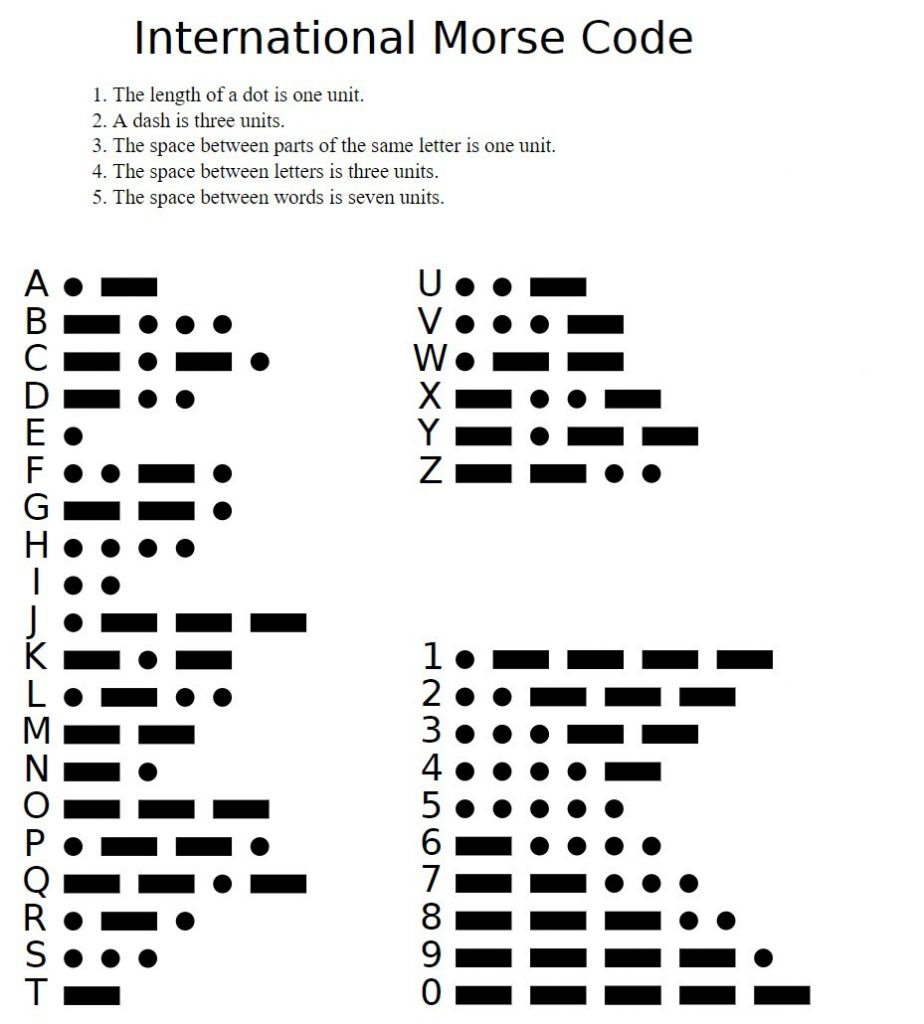
Morse code is the grandpappy of flexible, adaptable telecommunications and can be employed in all kinds of ways, from the sending of simple codes to lengthy and complex messages comprised of alphanumeric characters.

Morse code can be employed by any medium that is capable of being perceived in an on-off state, and works equally well using light, visual recognition or sound.

Morse code was originally developed for use with the telegraph, and was developed by and named for the inventor of the telegraph, F.B. Morse.

Morse code is capable of transmitting every letter of the alphabet and numbers along with a handful of punctuation marks.

Characters are transmitted using standardized sequences of two different signal duration, one short and one long; dots and dashes, or if you’re a hardcore Morse code practitioner, dits and dash.

Morse alphabet

Shorthand signals that could convey standardized messages or statuses may also be transmitted, known as prosigns, or procedure signs. The most famous and internationally-recognized of these signs is the classic SOS, which is three dots, three dashes and three more dots (…_ _ _…).

Fun fact: SOS does not stand for anything in particular; it is just a standardized emergency code.

Stringing together dots and dashes to make characters, and stringing characters together to make whole words with pauses, or breaks, in between you can convey as much or as little info as is necessary using Morse code and can do it as quickly as a receiver can interpret your transmission.

Morse code is capable of being memorized and translated instantly by someone practiced enough in it, or “translating by ear/sight.”

In an emergency, you can generate Morse code using any improvised method that will create sound or generate light that can be seen from a distance.

People trapped in collapsed buildings have banged on exposed piping so rescuers could hear the reverberations. People lost at sea or on the sides of mountains have use their flashlights or even mirrors to blink Morse code signals at hikers and Rescuers alike on land and in the air. The beauty of Morse code is its flexibility and adaptability.

You might decide to employ Morse code with others in your group to communicate across vast distances using light or sound. Bells, horns and even gunfire can be used to broadcast Morse via sound waves.

Flashlights, lanterns and any other highly visible light source can cross great distances with success and comparative ease. You can even use Morse discreetly with a faintly visible light such as a “firefly” LED to blink a short signal or message to someone who is looking for it nearby, and do so without alerting others.

You and yours will definitely have to put in some serious work and practice to master Morse code, but it is arguably the communication method that will serve you the best in the most situations of all on this list. Every prepper should know at least a little Morse code!

Semaphore

Also known as flag semaphore. Derived from the Greek word for “sign bearer” semaphore is a system of communication for conveying information in a purely visual manner at a distance.

Have you ever seen those guys standing on ships at sea waving flags around back and forth at each other? That’s semaphore in action. Using semaphore, the flags are positioned sort of like the hands of a clock, with each preset position of the two together representing a number or a letter.

The receiver simply records each character represent it when the flags come to rest before the sender moves on to the next. And this way the message is built up.

Semaphore is another old school method of visual communication, has been around since at least 1866. First used on land, is achieved major prominence as a method of communication between ships at sea.

Even if you are ground-bound prepper, semaphore can work well across vast distances even with small signals so long as the sender and receiver can both make use of optical aids like binoculars or telescopes.

One popular use for semaphore on land is communicating between the peaks of mountains when modern electrical communication systems are unreliable or down.

Semaphore works well in any conditions where visibility is good, and you don’t just have to use flags with it. Any handheld indicator or even empty hands can be used with semaphore.

You can even use something like a lighted wand to employ semaphore at night. Because it is visual only, semaphore is not quite as versatile as Morse code, but is relatively easy to learn and easy to interpret.

Semaphore is also quiet and not as visually obvious as blinking a light to employ Morse code, making it a better option for visual communication in situations where discovery may lead to trouble.

Radio

Whatever situation you might be dealing with, if electronic instantaneous communication is an option, you should probably make use of it. The stand out method for preppers to maintain telecommunications capability in the event that landline and cell phones go down is good, old radio.

Almost every prepper is familiar with common hardware store walkie-talkies but the real stuff is far more capable and also far more complicated. Learning radio theory in order to get the most performance out of your home or vehicle set is a discipline unto itself.

The most basic option is to get a NOAA one-way emergency radio, to stay up-to-date with any unfolding or looming natural disaster. These are fairly cheap on Amazon.

Once you get one of these, tune in to one of the frequency below:

Frequency WX Channel Marine Channel
162.400 MHz WX2 36B
162.425 MHz WX4 96B
162.450 MHz WX5 37B
162.475 MHz WX3 97B
162.500 MHz WX6 38B
162.525 MHz WX7 98B
162.550 MHz WX1 39B
161.650 MHz WX# 21B
161.750 MHz WX# 23B
161.775 MHz WX# 83B
162.000 MHz WX# 28B
163.275 MHz WX# 113B

You have several choices in radio as a civilian, with some of the most common and popular being CB, or citizens’ band radio, amateur radio, more popularly known as ham radio, and FRS/GMRS.

The type of two-way radio that most citizens are passingly familiar with is, naturally, CB radio. In constant use with enthusiasts, truckers, off-road enthusiasts and folks living in remote areas with poor cell phone infrastructure, CB radio is pretty capable and does not require a license to operate on like ham radio.

Below is a list with the CB radio frequencies you can use:

Channel Frequency
1 26.965
2 26.975
3 26.985
R/C 26.995
4 27.005
5 27.015
6 27.025
7 27.035
R/C 27.045
8 27.055
9 27.065
10 27.075
11 27.085
R/C 27.095
12 27.105
13 27.115
14 27.125
15 27.135
R/C 27.145
16 27.155
17 27.165
18 27.175
19 27.185

Ham radios come in all shapes and sizes with corresponding capabilities depending on the radio output, antenna specifics, repeater height and of course the vagaries of atmospherics.

To make use of ham radio you’ll need to get your license and classification (at least while the government is still concerned with such things).

The real beauty of ham radio is that there are networks of fellow ham radio operators and enthusiasts operating all across North America and much of the Caribbean.

Those local stations can serve as repeaters to relay messages across great distances and function as a fantastic, if loosely organized, backup to more modern communication infrastructure.

You can depend on it: if something ever wipes out our cell phone network can the US it will be ham radio operators that pick up the slack and get America back on the air.

FRS /GMRS is short for Family Radio Service/General Mobile Radio Service, which is simply a system of short-range two-way radio system designed for business and family communication in the US and Canada.

Like ham radio, GMRS requires a license for use, and only permits licensees to communicate among themselves and their family members for personal or business reasons.

These radios are typically hand-held, but may be vehicle mounted, and while nowhere near as powerful and capable as the larger ham radio installations, they are much more portable and can still make use of repeaters for extended range. Typical range between handhelds without use of a repeater is about 1 or 2 miles.

Radio only has two real drawbacks. First, it requires power. If you have no power you have no radio, and greater range often requires considerably more power, all other things being equal. The party won’t stop until the power is out, and then you’ll be back in the dark with a dim set.

Second, you cannot really protect anything you are transmitting with radio, even from other citizens with radio sets. Anyone who can receive the signal can hear exactly what you’re saying.

Compared to something like Morse code or semaphore which is rarely practiced and understood these days outside of specialist circles, anyone who can listen in your conversation over the radio can understand what is being said if they speak your language.

Maybe this will make a difference for you and your situation, or maybe it won’t. The variables are tough to calculate, but here are some things you should keep in mind.

First, anyone who hears you talking over the airwaves can do so without you knowing they are listening.

They can also start piecing together clues about who you are and where you are from any informational breadcrumbs dropped in your conversation, things like place names, vehicles, needed supplies that you can give to others or are looking to get yourself.

All of those little intel nuggets can add up to a fairly complete picture for a potential hostile. It would not do to advertise over the air how many guns you are sitting on next to a small mountain of ammunition, or how well stocked your stores of provisions are when famine is the new normal…

Below you can see some of the most relevant HAM radio high frequency emergency nets for the U.S.:

Mode Location
03808.0 LSB Caribbean Wx (1030)
03815.0 LSB Inter-island (continuous watch)
03845.0 LSB Gulf Coast West Hurricane
03862.5 LSB Mississippi Section Traffic
03865.0 LSB West Virginia Emergency
03872.5 LSB Mercury Amateur Radio Assoc ad hoc hurricane info net (0100)
03873.0 LSB West Gulf ARES Emergency (night)
03873.0 LSB Central Gulf Coast Hurricane
03873.0 LSB Louisiana ARES Emergency (night)
03873.0 LSB Mississippi ARES Emergency
03910.0 LSB Central Texas Emergency
03910.0 LSB Mississippi ARES
03910.0 LSB Louisiana Traffic
03915.0 LSB South Carolina SSB NTS
03923.0 LSB Mississippi ARES
03923.0 LSB North Carolina ARES Emergency (Tarheel)
03925.0 LSB Central Gulf Coast Hurricane
03925.0 LSB Louisiana Emergency (altn)
03927.0 LSB North Carolina ARES (health & welfare)
03935.0 LSB Central Gulf Coast Hurricane
03935.0 LSB Louisiana ARES (health & welfare)
03935.0 LSB Texas ARES (health & welfare)
03935.0 LSB Mississippi ARES (health & welfare)
03935.0 LSB Alabama Emergency
03940.0 LSB Southern Florida Emergency
03944.0 LSB West Gulf Emergency
03950.0 LSB Hurricane Watch (Amateur-to-National Hurricane Center) (altn)
03950.0 LSB Northern Florida Emergency
03955.0 LSB LSB South Texas Emergency
03960.0 LSB North East Coast Hurricane
03965.0 LSB Alabama Emergency (altn)
03967.0 LSB Gulf Coast (outgoing traffic)
03975.0 LSB Georgia ARES
03975.0 LSB Texas RACES (altn)
03993.5 LSB Gulf Coast (health & welfare)
03993.5 LSB South Carolina ARES/RACES Emergency
03995.0 LSB Gulf Coast Wx
07145.0 LSB Bermuda
07165.0 LSB Antigua/Antilles Emergency and Weather
07165.0 LSB Inter-island 40-meter (continuous watch)
07225.0 LSB Central Gulf Coast Hurricane
07232.0 LSB North Carolina ARES Emergency (Tarheel) (altn)
07235.0 LSB Louisiana Emergency
07235.0 LSB Central Gulf Coast Hurricane
07235.0 LSB Louisiana Emergency
07240.0 LSB American Red Cross US Gulf Coast Disaster
07240.0 LSB Texas Emergency
07242.0 LSB Southern Florida ARES Emergency (altn)
07250.0 LSB Texas Emergency
07254.0 LSB Northern Florida Emergency
07260.0 LSB Gulf Coast West Hurricane
07264.0 LSB Gulf Coast (health & welfare)
07265.0 LSB Salvation Army Team Emergency Radio (SATERN) (altn)
07268.0 LSB Bermuda
07243.0 LSB Alabama Emergency
07243.0 LSB South Carolina Emergency
07245.0 LSB Southern Louisiana
07247.5 LSB Northern Florida ARES Emergency (altn)
07248.0 LSB Texas RACES (pri)
07268.0 LSB Waterway
07273.0 LSB Texas ARES (altn)
07275.0 LSB Georgia ARES
07280.0 LSB NTS Region 5
07280.0 LSB Louisiana Emergency (altn)
07283.0 LSB Gulf Coast (outgoing only)
07285.0 LSB West Gulf ARES Emergency (day)
07285.0 LSB Louisiana ARES Emergency (day)
07285.0 LSB Mississippi ARES Emergency
07285.0 LSB Texas ARES Emergency (day)
07290.0 LSB Central Gulf Coast Hurricane
07290.0 LSB Gulf Coast Wx
07290.0 LSB Louisiana ARES (health & welfare) (day)
07290.0 LSB Texas ARES (health & welfare)
07290.0 LSB Mississippi ARES (health & welfare)
07290.0 LSB Traffic
14185.0 USB Caribbean Emergency
14222.0 USB Health & Welfare
14245.0 USB Health & Welfare
14265.0 USB Salvation Army Team Emergency Radio (SATERN) (health & welfare)
14268.0 USB Amateur Radio Readiness Group
14275.0 USB Bermuda
14275.0 USB International Amateur Radio
14300.0 USB Intercontinental Traffic
14300.0 USB Maritime Mobile Service
14303.0 USB International Assistance & Traffic
14313.0 USB Intercontinental Traffic (altn)
14313.0 USB Maritime Mobile Service (altn)
14316.0 USB Health & Welfare
14320.0 USB Health & Welfare
14325.0 USB Hurricane Watch (Amateur-to-National Hurricane Center)
14340.0 USB Louisiana (1900)

Lastly, a more technologically savvy enemy could actually start to home in on your broadcast site using various methods if you actively transmit consistently.

That’s a scary thought. But, flaws and all, civilian radio systems are among the best for after-SHTF communications so long as you can keep them powered. Nothing else comes close in effectiveness or convenience.

Below you can see the US maritime VHF channels:

Channel Number Ship Transmit MHz Ship Receive MHz Description
01A 156.050 156.050 Port Operations and Commercial, VTS. Available only inNew Orleans/Lower Mississippiarea.
05A 156.250 156.250 Port Operations or VTS in theHouston,New OrleansandSeattleareas.
06 156.300 156.300 Intership Safety
07A 156.350 156.350 Commercial
08 156.400 156.400 Commercial (Intership only)
09 156.450 156.450 Boater Calling. Commercial and Non-Commercial.
10 156.500 156.500 Commercial
11 156.550 156.550 Commercial. VTS in selected areas.
12 156.600 156.600 Port Operations. VTS in selected areas.
13 156.650 156.650 Intership Navigation Safety (Bridge-to-bridge). Ships >20m length maintain a listening watch on this channel in US waters.
14 156.700 156.700 Port Operations. VTS in selected areas.
15 156.750 Environmental (Receive only). Used by Class C EPIRBs.
16 156.800 156.800 International Distress, Safety and Calling. Ships required to carry radio, USCG, and most coast stations maintain a listening watch on this channel.
17 156.850 156.850 State & local govt maritime control
18A 156.900 156.900 Commercial
19A 156.950 156.950 Commercial
20 157.000 161.600 Port Operations (duplex)
20A 157.000 157.000 Port Operations
21A 157.050 157.050 U.S.Coast Guard only
22A 157.100 157.100 Coast Guard Liaison and Maritime Safety Information Broadcasts. Broadcasts announced on channel 16.
23A 157.150 157.150 U.S.Coast Guard only
24 157.200 161.800 Public Correspondence (Marine Operator)
25 157.250 161.850 Public Correspondence (Marine Operator)
26 157.300 161.900 Public Correspondence (Marine Operator)
27 157.350 161.950 Public Correspondence (Marine Operator)
28 157.400 162.000 Public Correspondence (Marine Operator)
63A 156.175 156.175 Port Operations and Commercial, VTS. Available only inNew Orleans/Lower Mississippiarea.
65A 156.275 156.275 Port Operations
66A 156.325 156.325 Port Operations
67 156.375 156.375 Commercial. Used for Bridge-to-bridge communications in lowerMississippi River. Intership only.
68 156.425 156.425 Non-Commercial
69 156.475 156.475 Non-Commercial
70 156.525 156.525 Digital Selective Calling (voice communications not allowed)
71 156.575 156.575 Non-Commercial
72 156.625 156.625 Non-Commercial (Intership only)
73 156.675 156.675 Port Operations
74 156.725 156.725 Port Operations
77 156.875 156.875 Port Operations (Intership only)
78A 156.925 156.925 Non-Commercial
79A 156.975 156.975 Commercial. Non-Commercial inGreat Lakesonly
80A 157.025 157.025 Commercial. Non-Commercial inGreat Lakesonly
81A 157.075 157.075 U.S. Government only – Environmental protection operations.
82A 157.125 157.125 U.S.Government only
83A 157.175 157.175 U.S.Coast Guard only
84 157.225 161.825 Public Correspondence (Marine Operator)
85 157.275 161.875 Public Correspondence (Marine Operator)
86 157.325 161.925 Public Correspondence (Marine Operator)
87 157.375 157.375 Public Correspondence (Marine Operator)
88A 157.425 157.425 Commercial, Intership only.
AIS 1 161.975 161.975 Automatic Identification System (AIS)
AIS 2 162.025 162.025 Automatic Identification System (AIS)

Simple Signals

Simple signals comprise one of the most discreet and multi-purpose methods of communicating changes in status between two informed parties.

Simple signals can be almost anything: it could be a colored or specially-shaped of a flag that is flown from a flagpole. It could be the absence of a flag on a flagpole.

It could be a light, or lights left on. A small pile of seemingly innocuous rocks might be a signal. A piece of furniture on a porch on one side of the door or the other might be a signal. The use of simple signals is limited only by your imagination.

Naturally, simple signals only work for people who are in the know: those who know what to look for, and furthermore who know what the signals mean.

If you don’t write down what the signals are, and don’t reveal it to anyone else, simple signals are a sort of self keeping cipher. Even an outsider who suspected something for purposes of notifying someone else won’t know what it means.

And what it means could be anything. A certain color of flag or sheet flown from a high place might indicate all okay, assistance requested, or an SOS. A specific pattern of flag might indicate general danger.

One might even request a meeting for real-time communication to the receiving party at the earliest possible convenience.

You can also use simple symbols to leave messages that are not easily deciphered by others. A series of colored potted plants left out near a planter could tell someone who came looking for you that you were forced to evacuate, what the condition of your family members are, and to which bug-out location you headed to.

The only real weakness of simple symbols is that the very nature of them makes them a little more vulnerable to disruption if they are not attended to.

Someone might not think anything of moving a piece of furniture for instance. Anything might happen that can break or knock over pots, or they could simply be stolen.

Even so, in times of trouble it is a great idea to establish at least a few sets of simple signals with your family, friends and fellow group members so you can discreetly tip them off that something may be wrong with no other action from you.

Dead Drop

A dead drop is a traditional spy skill that you can add to your own prepping toolbox to leave messages for or transmit messages between two parties that you don’t want to be found.

A dead drop is simply a message left in a hidden area by one party that will be picked up separately, without the first party being present, at a later time.

Spies use dead drops to maintain operational security. You can do the same thing order communicate discreetly when two parties find it difficult to meet up for any reason.

Dead drops are certainly effective in some niche situations but rely completely on both parties being in the loop, and the messages being retrieved by each in turn, preferably without being spotted by bystanders as this will compromise the hiding place and any future communications.

Typically, a dead drop will be hidden within, under or around any commonplace, everyday item or sometimes within a natural environment.

You can make almost anything a dead drop. Everyone has at least a little experience with hiding places and these hiding places furnish ample ideas for dead drops.

You can hide a message inside a ziplock bag beneath the soil in a planter. You could take a sealed, waterproof tube and stash it underneath the joists of a deck.

In urban settings, holes in brick walls, the undersides of benches and countless other hiding places await those who would make clever use of dead drops for communications with other parties.

Nature herself also furnishes plenty of good hiding places. Hollow trees, large rocks and even ponds and creeks can all be used as great opportunities to hide your messages.

A couple of classic tradecraft tricks are sinking a message tube into a pond and connecting it to a particular rock or stick on the shore by thin, almost imperceptible fishing line. The recipient will know which one to look for, and can reel it in using the fishing line.

Another classic technique is to take a hollow tube with a spike on the end and a sealed cap and simply stick it in the soft soil of a yard or riverbank at a designated pick-up point.

The only real disadvantages of dead drops are it both the sender and the recipient must be playing from the same page, as with simple signals.

Compared to simple signals, a dead drop is far less likely to be detected or tampered with unless one party or the other is observed accessing it. That’s the other downside: it is very difficult to play off accessing a dead drop. That usually looks suspicious.

Nonetheless, if you have a family member or a friend that is “written in” to your survival plan you should make them aware of a couple of dead drops where you might leave messages or instructions in case you cannot be contacted.

Some folks decry such emergency communication contingency plans as fantastical, but this is short-sighted.

You might not be able to get in touch with someone in the immediate aftermath of a disaster, and still have to react to your problems as they come. This might mean your friend, family member or associate comes along later looking for you, only to find you missing.

Instead of guessing or fearing the worst, their next course of action can be to check one of several pre-designated, pre-discussed dead drops for messages or instructions from you, typically accessed in ascending order of how much time you had to leave a message.

Even if it is only a tertiary or emergency method of relaying a message, dead drops are an important insurance policy for maintaining continuity of communication with important people in your family or group when things are dicey.

Conclusion

You cannot afford to for you and yours to be left in the dark in the aftermath of a disaster. Timely, reliable communications, even if they’re not electronic, often spells the difference between success and failure, life and death, in a SHTF situation.

Take the time to learn and more importantly implement at least a couple are these emergency communication methods in your survival plan. You can’t stop the signal!

emergency communications Pinterest


via Modern Survival Online https://ift.tt/2usPPNC

Friday, February 7, 2020

Lucid Dreaming | Omnilucidity - And my journey to high LD frequency

Hello there,
I want to share with you my findings/thoughts about the phenomenon of Omnilucidity or being lucid in almost every dream. I would define it as having more than 730 LDs per Year / 2 LDs per night. Over at least 6 months at that frequency. These numbers are arbitrary, but I want to set limits here. But I know quantity is not everything. We must consider the different levels of lucidity and the length of the LDs.
To be in the category of omnilucid, I would suggest a lucid level at least in the middle. But the length should be almost the whole dream not just short fragments.
I myself want to dedicate myself to achieve this or to work towards it. I don’t know if it’s possible for everybody, but in my opinion, this is a great way to learn something about oneself and develop a mind which is self-aware, present and lucid, even if you don’t succeed.
I will use this thread to track my journey and experiences. Maybe some of you will find this helpful or want to join me, so feel free to post your ideas and experiences around this topic.

But in order to compare I will write my former experiences with the dream world.
In my childhood and teenage years, I never had a lot of nightmares or could remember dreams good or at all. My first LD was after I read something about this topic in a psychology book.
The last 5 years I tried on and off, to induce lucid dreams with all the techniques out there. And I had some great LDs. But the last 8 Month I stopped completely. And so, did my dream recall.
I have 6 years of mediation experience which helped me a lot with my lucid dream induction.
So, keep that in mind when you compare yourself with others. Everybody has some different background.


Now the “Techniques” or threads I found about this topic:
Of course, I have to mention Hukifs Gravity-RC. He reached daily lucidity after some months.
He had several years of trying other methods and insanely good recall before that:
https://www.dreamviews.com/induction...real-time.html
https://www.dreamviews.com/attaining...rc-recall.html

-Azul reached daily lucidity with Hukifs technique. Here is his guide:
https://www.dreamviews.com/induction...-tutorial.html

-Here they talk about some guy who reached this by constantly checking the breath and blinking. When you don’t have to do one of them, then you are dreaming:
https://www.dreamviews.com/attaining...0%25-time.html

-Skippers MILD. He reached lucidity in every dream with a form of MILD:
https://www.dreamviews.com/attaining...pers-mild.html

-Here an interesting Article from Robert Waggoner on LD4ALL. There he mentions some other people who reached lucidity in almost every dream, and how they do it. And his opinion about this topic.
https://ld4all.com/forum/viewtopic.php?t=39438

And at last I found an article on a German forum. They call it Dream Yoga. Two of them reached lucidity in every dream with that. It is basically seeing everything as a dream and feel it like they are in a lucid dream. Sounds crazy but it worked for them. I can translate this, when someone wants to read the full guide.

I’ve come across two studies about the frequency of lucid dreams:
Here they investigated the differences of the brain between high frequent lucid dreamers and non lucid dreamers, but with good recall:
https://www.nature.com/articles/s41598-018-36190-w

Here is a German study, which shows a positive correlation about 0.57, which is quite high but not surprising, between frequency of dream recall and frequency of lucid dreams:
https://www.researchgate.net/publica..._German_sample

But all in all I have to say, that there is not much out there about the frequency of Lucid dreaming. Especially about how to train oneself to have them every night/every dream.

But I want to sum up, what in my opinion all these techniques above have in common:
Continuously connecting every moment of your live to the dream world, with the intention to be lucid. I think some naturals achieved this through checking for monsters as a child, in order to be lucid in nightmares. Until it gets in the unconscious.
This is a new way to live.

This will also change your brain like the first study suggests. So in my opinion it is like learning an instrument. There a people who have the right genes or started early in childhood, but everybody can learn to play an instrument at expert level, if he put the right effort and time into it.
But I know lucid dreaming is also like meditation a very personal thing, and a kind of art form.
So we have to personalize it and be cautions what works and what not for oneself.

My regimen will be the following:
I will focus on three things.
Like Sageous wrote in his Thread “Lucid Dreaming Fundamentals” :
“In a sense, LD’ing is a 3-legged stool. The first leg is the state of dreaming itself, and the second and third legs are self-awareness and memory. The absence of any one of these legs means the stool topples and poof! No lucidity. It’s that simple. All the machines, gurus, techniques, and supplements in the world would do nothing.”

Memory:
- Good Dream Recall is positive related to frequent lucid dreaming. So a DJ is a no-brainer for me, because my dream recall sucks at the moment.
- I will review my day every night before I go to sleep. I try to visualize my whole day.
- Autosuggestion in the beginning to kickstart my dream recall until its natural.
- If I have a lucid dream, I will try to remember some real-world things.

Self-Awareness:
-I will try Hukifs Gravity-RC. Because my Body felt quite different in my previous LDs. And I like the meditative side of it.
-I try to feel the dream like state of reality. That everything is basically created and interpreted from my brain. Like in a dream
-Meditation

Dreaming:
-Get enough sleep.
-No Drugs.

Let’s see how it goes. Please let me know what you think about this and if you know other people who trained themselves to be lucid in almost every dream.


via Lucid Dreaming - Dream Views - Attaining Lucidity https://ift.tt/31EzQZ5