Sunday, January 13, 2019

The Top Bartering Skills to Have Post-Collapse

by Tara

When preparing for a doomsday disaster, we must also prep to survive (perhaps even thrive) during what comes next. Stockpiling items for bartering purposes is a common prepping practice, but thinking beyond what might be needed after an apocalyptic event,
could vastly enhance the chances of long-term survival.

Eventually, society will begin to reform, and a new normal will emerge. Exactly how long that will take and what it will look like will depend on both the type of SHTF incident, and where you live.

There are numerous articles floating around the internet that provide lengthy lists detailing what items preppers should stockpile for bartering during a SHTF scenario. Some of those articles even discuss quality bartering items, but none go into great detail or really thinking outside the box – like we are about to do right here.

Seed packets, canning supplies, socks, gloves, and similar items will make good bartering materials both during and after an apocalyptic event, but the most valuable bartering item takes up no space at all… knowledge. The tools that might be necessary to help you apply your knowledge will require some storage  space, but not nearly as much as a gross of toilet paper rolls.

What you know and what you can do will be the most profitable prep you can possess when striving to rebuild the life of your family after surviving a long-term disaster.

The more pioneer, off grid living, survival, homesteading, and bushcraft skills you have (at least a working knowledge of, and the manual tools necessary to accomplish the tasks) the greater the odds you will be able to not only provide for your family, but carve out a significant niche for then in the emerging new world.

Where you live will play a significant role in the type of skilled services that will be in demand after a long-term disaster, but some skills will have a nearly universal demand.

Top 6 Bartering Skills

1. Medical Training – Doctors, nurses, paramedics, emergency medical technician, nurse’s aides, veterinarians, vet assistants, military medics, and others who have engaged in professional first aid and emergency aid training will be able to barter their skills both during and after a SHTF scenario.
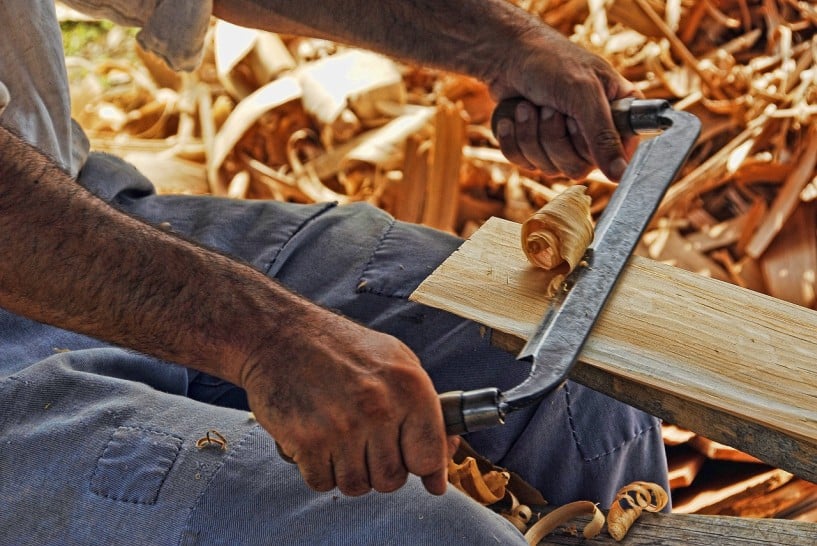
woodworking

2. Construction – Carpentry– Skilled craftsmen (and women) will also be in high demand during the societal rebuilding phrase. Structures, furniture, and roadways will need to be both repaired and entirely rebuilt after a doomsday disaster.

3. Mechanic – Depending upon the type of disaster, modern equipment might still be able to be repaired. In the case of an EMP, solar flare, or cyber attack that takes down the power grid, antiqui and non-sensitive motors and similar equipment will become highly sought after commodities – as will people who can work on them.

4. Water Treatment – If you know how to purify water and have the supplies to do so, you also possess a powerful bartering skill. If you have supplies to collect and store water in small containers for barter after purifying, your family will have a solid post-SHTF “business” plan – especially if you were able to ride out the apocalypse in an urban or suburban area where natural water sources and a self-reliant populace are definitely not in great abundance.

5. Farmer or Rancher – People need food to survive. If you can grow or raise food – and held onto your breeders during the doomsday disaster, you now have a market of survivors who will be eager to not only barter for food, but for livestock to cultivate their own eggs, milk, meat, and transportation.

Even in a non-rural environment it is possible to grow crops and typically, to at least raise a few chickens. As I always recommend, all preppers should live in a rural environment. The impact in doing so will enhance the families’ chances of survival more than anything else you can do to prepare.

6. Transportation – During a disaster, people will only be on the road if doing so is absolutely essential. But, once a new normal emerges and society begins rebuilding itself, survivors will eventually be going to trading posts, children will be attending a revamped version of the old one-room schoolhouse, and engaging in both bartering and social contact with nearby communities.

Horses, horse-drawn wagons, ATVs, and trucks that can run on biodiesel fuel could eventually be the only modes of transportation left. People who own horses and working vehicles, as well as being able to grow and make their own biodiesel ingredients, could become a post-apocalyptic millionaire.
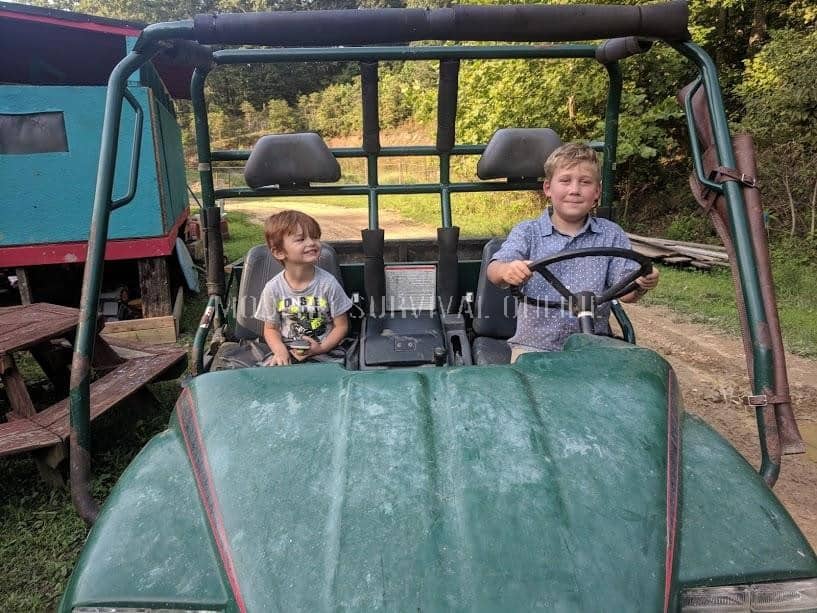
boys driving an atv on the homestead

Top 15 Self-Reliant Skills That Double As Prime Bartering Skills

1. Butchering – Meat will no longer come in carefully wrapped little packages from a grocery store after a doomsday disaster. Even in rural areas where most men and many women know how to hunt, far less than many know how to butcher their own meat – or own either the modern or non-electric tools to do so.

2. Grain Milling – Like meat, bread won’t be packaged and sold in stores anymore either.Learn how to not only grow, but harvest and grain your own wheat and and traditional wheat substitutes that can be used to bake bread.

3. Dairy – If you have cows and/or dairy goats, learn how to make butter, cheese, and other dairy products that will be otherwise unavailable. Pygmy or dwarf goats, as well as miniature cow breeds like Dexters, are small enough to be kept on low acreage parcels of land – the little goats could even be kept in a spacious suburban backyard.

4. Composting – Cultivating rich compost and bartering pots or bags of it for other goods and services

5. Blacksmith – The ability to fabricate tools, knives, and parts for machinery, as well working with horseshoes will once again become a lucrative career choice.
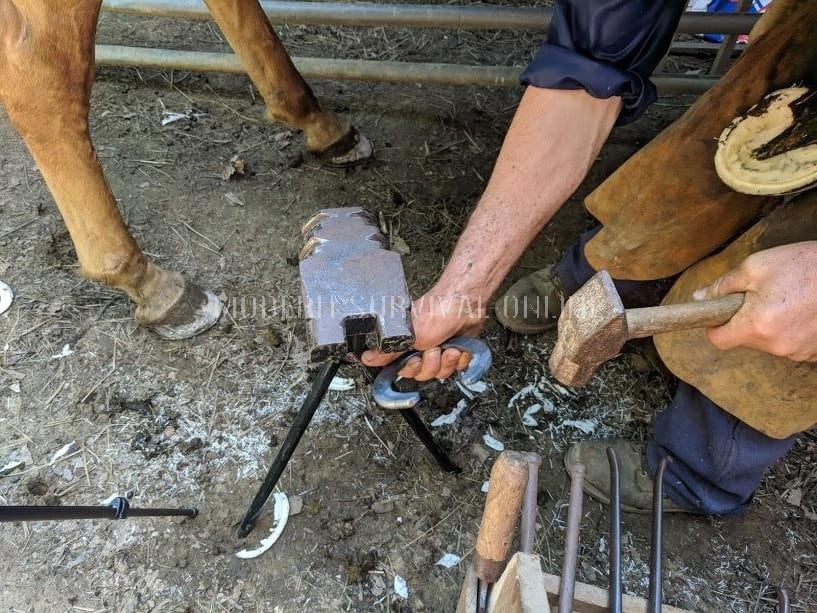
farrier in action

6. Farrier – A horse’s health depends largely upon its hooves and legs. A quality farrier will be in high demand in rural – and possibly even suburban, areas. Running a livery stable along with working as a farrier, or partnering with a blacksmith, could further enhance bartering opportunities.

7. Seamstress – Clothing will need not only to be mended or darned, but made from scratch as it once was. A survivor who can sew, knit, crochet, and spin cotton and wool, will be able to not only provide the materials necessary for others to make and repair their own clothing, but sell finished products as well.

8. Gunsmith – Helping a fellow survivor repair their firearm or reload ammunition during the SHTF event could come back to haunt you, but once society is on the rebound and rebuild, a gunsmith, especially one that can also make or repair bows, could become a bartering kingpin.

9. Teacher – Children will need to learn at least the survival and homesteading basics if the new society is going to be a success. It’s doubtful a teaching degree will be required to educate children after a SHTF event, but a background in an educational, counseling, or homeschooling field would be a plus.

10. Firefighter – Fire engines might not still be rolling after the SHTF event, but that does not mean fires cannot be fought.

Creating a fire department, even one that functions via an old-fashioned bell ringing system using buckets and low-tech pumpers hauled by wagons, can help prevent flames from destroying the communities run by survivors during the rebuilding phase.

Firefighting knowledge and protection services can be bartered for food, clothing, and other valuable tangible goods.

11. Engineer – A survivor with engineering skills will be able to help his or her fellow community members not only repair and rebuild structures, but devise off the grid energy systems.

12. Basket Weaver – Baskets will be used to tote crops, fish, small game, and general wares from place to place.

13. Potter – Plates, cookware, and storage pots will need to be replaced and there will not likely be factories still in existence making and shipping them to a local Walmart.

14. Cobbler – If you can learn to make and repair shoes, and tan animal hides to make moccasins and boots, these would make sound post-SHTF careers, or at least in-demand bartering skills.

15. HAM Radio Operator – Having the skills and necessary equipment to communicate with the outside world (which can mean locales even only 40 miles away) will allow you to help keep the emerging community safe from roving hordes, fires, and spreading diseases.

The sharing of news and relaying of messages could be used as a philanthropic bartering skill to help put food on your table.

16. Chimney Sweep – This is yet another job from the 1800s era that will be useful again in a post-apocalyptic world. Although it is not skilled labor (as many of the bartering skills on this list are), a person with the tools and ability to climb onto a roof and free a chimney of soot to prevent fires, will still have something of value to trade in exchange for a meal or a gently used coat.

17. Lathmaker – Sawmill Operator – A survivor who can cut wood into boards and operate an off the grid (especially portable) sawmill, can help rebuild homes, a trading post, and provide the means to make furniture in the new society.

18. Logger – Firewood will become far more valuable than precious gems in a burgeoning society that is now living off the grid. Cutting, splitting, and hauling firewood to both neighbors and nearby communities will offer a prime bartering service in a post-SHTF world.

19. Brickmaker – Raw building materials and skilled laborers who know how to lay them will be in high demand as well.

20. Spirits Maker – Many preppers stockpile alcohol for medicinal use, as a morale booster, and for bartering. Instead of just boxing up fifths of Jack Daniels and Rum, learning how to distill your own spirits, and perhaps planning to become a post-SHTF saloon keeper, will open up multiple avenues for bartering.


Bartering of services could be conducted on either a larger or small scale, depending upon your capabilities, means of transportation, and the level of safety present during the societal rebuilding phrase.

While this list of bartering skills highlights some of the most in demand services that can be bartered, it is by no means exhaustive. To learn more about what skilled trades that mesh with your own interests, readily available materials, and will be in demand in your region by researching 1800s era occupations and trades.


via Modern Survival Online http://bit.ly/2VMiI0l

Friday, January 11, 2019

No Moving Parts: Phased Array Antennas Move While Standing Still

If you watch old science fiction or military movies — or if you were alive back in the 1960s — you probably know the cliche for a radar antenna is a spinning dish. Although the very first radar antennas were made from wire, as radar sets moved higher in frequency, antennas got smaller and rotating them meant you could “look” in different directions. When most people got their TV with an antenna, rotating those were pretty common, too. But these days you don’t see many moving antennas. Why? Because antennas these days move electrically rather than physically using multiple antennas in a phased array. These electronically scanned phased array antennas are the subject of Hunter Scott’s talk at 2018’s Supercon. Didn’t make it? No problem,  you can watch the video below.

While this seems like new technology, it actually dates back to 1905. Karl Braun fed the output of a transmitter to three monopoles set up as a triangle. One antenna had a 90 degree phase shift. The two in-phase antennas caused a stronger signal in one direction, while the out-of-phase antenna canceled most of the signal and the resulting aggregate was a unidirectional beam. By changing the antenna fed with the delay, the beam could rotate in three 120 degree steps.

Today phased arrays are in all sorts of radio equipment from broadcast radio transmitters to WiFi routers and 5G phones. The technique even has uses in optics and acoustics.

There are two broad categories of phased arrays: passive, where one transmitter feeds a bunch of antennas and phase shift networks, or active where each antenna generates its own signal. The active antennas generally perform better but are much more expensive and Hunter focuses on the passive ones. But in both cases, the directionality depends on some signals canceling others out, and some signals reinforcing others.

One of the things we’ve always found interesting is that mathematically there is no difference between an antenna receiving and one that is transmitting. Hunter uses this to explain how the phased array receives a signal since that’s a little easier on the intuition.

The explanation covers some reasonably simple math with some helpful graphics. However, due to the complexity of math for practical examples, Hunter suggests using a Python tool called ArrayTool that does a nice job of handling the real math and shows you a nice graphical output.

Towards the end, Hunter points out a few ways to make your design cheaper or simpler, although — of course — not at the same time. That’s always the case though.

Hunter also had two interesting observations. First, if you are working on the usual frequencies, you can probably recycle an existing antenna design and save yourself some trouble. Second, the use of electrically-steerable antennas in 5G phones means there are now chips that will do most of the work for you. Today they are expensive, but as 5G phone production scales up, you can expect the price will plummet just like other mass-produced cell phone components. One other observation he had is that if you get into RF you’ll spend your days staring at test equipment wondering why nothing works. Sounds about right to us.

If you missed Supercon, you missed a lot. But you can catch up thanks to the magic of video. Why not find out how to turn a PCB into a motor? Or maybe you’d rather build your own vacuum tube.

Slides for Hunter’s talk are available on his website.


via Radio Hacks – Hackaday http://bit.ly/2AJtfAj

Wednesday, January 9, 2019

Morse Code Keyboard 1939 Style!

If you want to learn Morse code and you don’t have a teacher, you’d probably just head over to a website or download a phone app. Before that, you probably bought a cassette tape or a phonograph record. But how did you learn Morse if you didn’t have any of that and didn’t know anyone who could send you practice? Sure, you could listen to the radio, but in 1939 that might be difficult, especially to find people sending slow enough for you to copy.

Wireless World for August 3rd, 1939, has the answer in an article by [A. R. Knipe] on page 109. While you probably wouldn’t use it today, it is a great example of how ingenious you can be when you don’t have an Arduino and all the other accouterments we take for granted today.

A Little Help From Your Friends

The idea was to build something so that your friend, your mom, or your little sister could be imposed upon to send code to you even though they didn’t know it. From the article:

The greatest handicap to the learning of Morse is undoubtedly the lack of a skilled operator to work the key so that proper receiving practice may be obtained.

The device contained a buzzer and a battery along with terminals for a key. Across the key though were two connections. One went to a “signal plate” made of brass or tin. This plate sat on a baseboard and above the plate were strips of wood. The other connection goes to a stylus which could be nothing more than a piece of wire wrapped up.

Under the strips of wood is a stencil made of paper or empire cloth which is — apparently — some sort of oil-treated cloth used as an insulator. The stencil has holes in it corresponding to each letter. The person sending you the practice code simply moves the stylus over the right part of the stencil using the wood strips as a guide.

Pros and Cons

Almost anyone could build something like this. You could probably use scrap wood, wire, and metal. You’d have to buy the battery and maybe the buzzer. But this would have been well within the technical capabilities of even a young person in 1939. With the proper use of screws you probably didn’t even need to solder.

Obviously, there are some limitations to this method. The speed could be spotty if you don’t do a nice steady glide across the stencil. The spacing between characters is probably going to be erratic as your accomplice searches for the next letter.

However, what a clever solution! Sure, today you could devise many other ways to have people send you Morse code or write (or download) a program to send your favorite website or RSS feed. There’s also plenty of code practice resources around. But if you didn’t have that, this would solve your problem.

Other Training Aids

This reminded us of the Omnigraph which was a common way to learn code way back in 1904 and beyond. These used a clockwork spring and a metal disk (effectively a cam) to operate contacts.

The military had a great interest in training Morse code operators at one time. They had machines that used inked paper tape like the TG-34-A in the video below. There was also the Instructograph (second video).

It is hard to remember when knowing Morse code was a hot job skill and not just a hobby. Then again, if telegraph faxing had caught on, all those operators would have been out of work even sooner. Of course, Morse might still come in handy if you get kidnapped. If you want to learn the sending part, the military film below might not be your best bet, but it is entertaining.


via Radio Hacks – Hackaday http://bit.ly/2RhxeOJ

Tuesday, January 8, 2019

Lucid Dreaming | Problem with WILD Induction

I have been lucid dreaming for a couple of years now and the majority of my dreams have been WILDs or supplement induced crazy WILDs. I seem to have trouble when doing it correctly and under control though, I lay in bed sometimes for a couple of hours waiting and it would eventually happen. The problem is I don't see any sleep hynagogia I just feel for it in my mental state which isn't that good of a gauge, and what I see is usually all darkness the entirety until I get in. Sometimes I fall asleep for ten minutes wake up then have insomnia and sleep paralysis which assists the process but this way is unreliable. I'm always able to enter the WILD once I concentrate enough and at the very last moment let it all go as if I was skydiving falling backwards through my bed and it tends to create these literal wild WILDs.

The question is I can't really rely on this method as there is no gauge when I have to let go, I just attempt the action of letting go many times and eventually there is a point of no return where the WILD happens, I then either start spiraling in my bed, get flung out of bed, feel like I'm being shot out of cannon, or falling. I don't see any images or hear sounds and I would like some advice on how to make this method work from any similar experiences as I really don't know how to induce the hypnagogia to ease myself into a lucid dream.


via Lucid Dreaming - Dream Views - Attaining Lucidity http://bit.ly/2LZPcPX

Monday, January 7, 2019

All About Ham Satellites

How hard is it to build a ground station to communicate with people via a satellite? Probably not as hard as you think. [Modern Ham] has a new video that shows just how easy it can be. It turns out that a cheap Chinese radio is all you need on the radio side. You do, however, benefit from having a bit of an antenna.

It isn’t unusual for people interested in technology to also be interested in space. So it isn’t surprising that many ham radio operators have tied space into the hobby. Some do radio astronomy, others bounce signals off the moon or meteors. Still others have launched satellites, though perhaps that’s not totally accurate since as far as we know all ham radio satellites have hitched rides on commercial rockets rather than being launched by hams themselves. Still, designing and operating a ham radio station in space is no small feat, but it has been done many times with each generation of satellite becoming more and more sophisticated.

While it is true you’ll get better results with a directional antenna, it is possible to make some contacts with a fairly modest one. Back in the 1970s and 1980s, tracking when the satellite was overhead was a major task, but the modern ham just needs a cell phone app.

If you have images of hams sitting at their radios having long-winded discussions, you haven’t seen a typical satellite pass. You don’t have much time, so the contacts are fast and to the point. In fact, this video dispels a lot of ham stereotypes. A young guy shows how you can do something exciting with ham radio for very little investment and it doesn’t matter if you have deed restrictions because all the gear would fit in your garage when you aren’t using it.

The downside is that [Modern Ham’s] demo didn’t show him making any solid contacts although he was clearly hearing the satellite and people were hearing him. He admits it wasn’t his best pass. The second video below shows a much more typical pass with the same kind of setup. If you want to see what results you can get with a more modest antenna, check out this video.

In addition to satellites built by hams, some have started life doing a different task and been taken over by hams later. If you don’t have a ham license (and, by the way, they are easier to get than ever), you can still listen in to some very interesting space communications.


via Radio Hacks – Hackaday http://bit.ly/2CWiMTC

Lucid Dreaming | Meditation?

I haven't tried lucid dreaming in quiet a while just relying on d.i.l.ds but without any practise which of Course doesn't go too well.
Afternoon time today I meditated whilst bieng tired and of Course outcomes the hypnotic imagery.I blocked it out because I wanted to meditate.I then decided to lay on my bed...read abit about lucid dreaming and then decided to meditate again to the point where I got hypnotic imagery.When I felt close enough I may down and went to sleep....I then became lucid quiet quickly in my dream.

My question is....does falling to sleep quick mean that you have more awareness when entering a dream? I didn't bother trying to wild I just went to sleep.....thanks =D I'll let people know if it happens again


via Lucid Dreaming - Dream Views - Attaining Lucidity http://bit.ly/2Tu7ewi

Saturday, January 5, 2019

Google Assistant, Now Available On Ham Radio

Depending on who you talk to, Google Assistant is either a tool capable of quickly and clearly answering audio queries in natural langauge, or a noisier and less useful version of Wolfram Alpha. [William Franzin] decided it would be particularly cool to make the service available over ham radio – and that’s exactly what he did.

[William] got the idea for this project after first playing with the Internet Radio Linking Project, a system which uses VoIP technologies to link radio networks over the internet. Already having an IRLP node, it seemed only natural to make it into a gateway to the wider internet through integration with Google Assistant. Early work involved activating the assistant via DTMF tones, but [William] didn’t stop there – through the use of Picovoice, it became possible to use the system with the custom wakeword “Bumblebee”.

[William]’s project could prove particularly useful for when he’s out of cell coverage, but needs a little information like a weather report or a piece of trivia to settle an argument round the campfire. Additionally, it’s even possible to control the IRLP node through voice commands, too.

If you’re just getting started with ham radio, check out this build to get you started for under $100. Video after the break.


via Radio Hacks – Hackaday http://bit.ly/2C4tVjJ