Sunday, June 30, 2019

The Comforting Blue Glow Of Old Time Radio

When you think of an old radio it’s possible you imagine a wooden-cased tube radio receiver as clustered around by a 1940s family anxious for news from the front, or maybe even a hefty 19-inch rack casing for a “boat anchor” ham radio transmitter. But neither of those are really old radios, for that we must go back another few decades to the first radios. Radio as demonstrated by Giulielmo Marconi didn’t use tubes and it certainly didn’t use transistors, instead it used an induction coil and a spark gap. It’s a subject examined in depth by [The Plasma Channel] and [Blueprint], as they come together to build and test a pair of spark gap transmitters.

This is a collaboration between two YouTube channels, so we’ve put videos from both below the break.They both build simple spark gap transmitters and explain the history behind them, as well as running some tests in RF-shielded locations. The transmitters are fairly crude affairs in that while they both use electronic drives for their induction coils they don’t have the resonant tank circuitry that a typical early-20th-century transmitter would have had to improve its efficiency.

They are at pains to remind the viewer that spark gap transmitters have been illegal for nearly a century due to their wideband interference so this is definitely one of those “Don’t do this at home” projects even if it hasn’t stopped others from trying. But it’s still a fascinating introduction to this forgotten technology, and both videos are definitely worth a watch.


via Radio Hacks – Hackaday https://ift.tt/31Xo385

Differences Between Rural and Urban EDC

Wednesday, June 26, 2019

A Work of Art That Also Receives AM and SSB

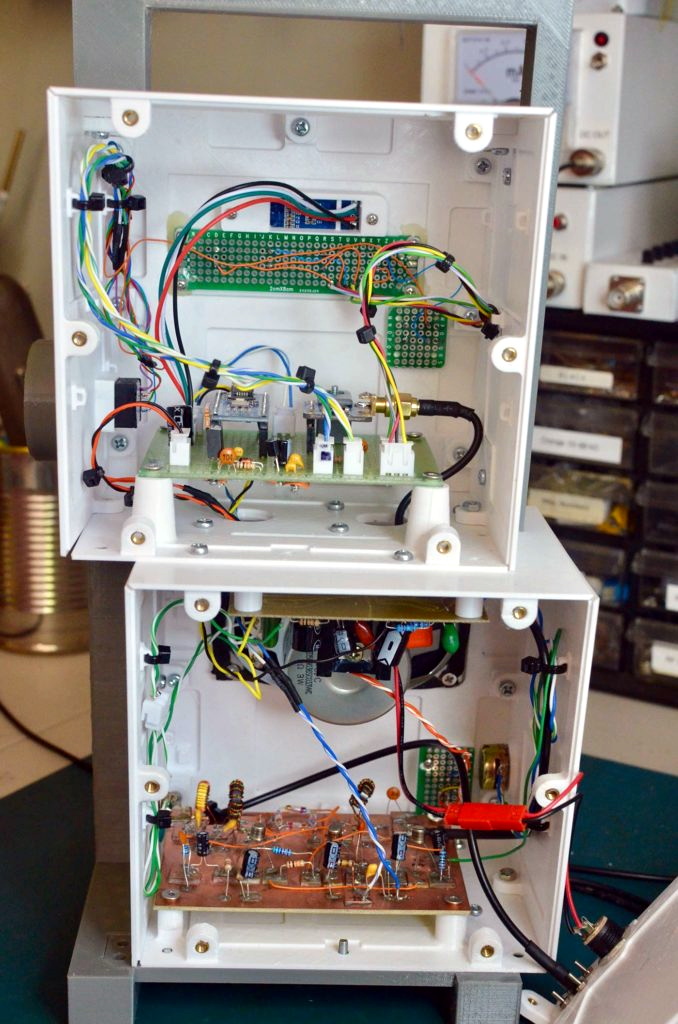
Over the winter, [Michael LeBlanc] thought a good way to spend his time during those long dark nights would be to scratch build his own direct conversion receiver. He was able to find plans for such a project easily enough online, but where’s the fun in following instructions? The final result incorporates what he found online with his own unique tweaks and artistic style.

[Michael] based his receiver on a modified approach to the DC40 created by [Ashhar Farhan], a name likely familiar to readers involved in amatuer radio. He further modified the design by swapping out the audio amplifier for a TDA2003A, and bolted on a digital tuner by way of an Arduino and a Si5351 clock generator. There’s a small OLED to show the current frequency, which is adjusted with a high-quality Bourns EM14 optical encoder so he can surf the airwaves in the comfort and style.

The digital tuner mated to the analog DC40 receiver gives the radio an interesting duality, which [Michael] really embraces with his enclosure design. Obsensibly he wanted to keep the two halves of the system in their own boxes to minimize any interference, but the 3D printed case exaggerates that practical consideration into a fascinating conversation piece.

The analog and digital compartments are askew, and their rotary controls are on opposite sides. The radio looks like it might topple over if it wasn’t for the fact that the whole thing is bolted together, complete with brass inserts for the printed parts. The integrated carry handle at the top somehow manages to make it look vintage and ultra-modern at the same time. Rarely do you see a printed enclosure that’s both meticulously designed inside and aesthetically pleasing externally. [Michael] earned his 3D Printing Merit Badge for sure with this one.


via Radio Hacks – Hackaday https://ift.tt/2xgPQly

Saturday, June 22, 2019

A Two Metre Bridge Across The Atlantic For The First Time

Amateur radio is a pursuit with many facets, some of which hold more attention than others for the hacker. Though there have been radio amateurs for a century it still has boundaries that are being tested, and sometimes they come in surprising places.

A recent first involved something you might consider a done deal, a transatlantic radio contact. On June 16th, for the first time ever a contact was made between the operators [D41CV] and [FG8OJ] at 3867 km across the Atlantic ocean from the Cape Verde Islands to Guadeloupe, on the 2 metre (144 MHz) band. If this means little to you it’s worth explaining that the 2 m band is a VHF band, with a range normally similar to that you’d expect from an FM broadcast station. Nobody has ever done this before, so it’s a significantly big deal.

Before you dismiss this as merely some radio amateur chasing grid squares and thus not particularly impressive, it’s worth talking about both the radio mode used and the unusual atmospheric conditions that were carefully sought for the achievement. The attempt was made to coincide with a prediction of transatlantic tropospheric ducting, and the mode employed was [Joe Taylor K1JT]’s FT8. This is a digital mode designed especially for weak-signal and long-distance work. It is theorised that the propagation was so-called surface ducting, in which the signal travels and is reflected between the surface of the sea and a relatively low-level reflective layer of atmosphere. The contact really pushed the limit of what is possible with radio, and while you wouldn’t use it for a voice conversation, proves that there are new tricks in an old hobby for the hardcore experimenter.

We’ve talked about [K1JT] modes crossing the Atlantic before, but of course not at such a high frequency.


via Radio Hacks – Hackaday http://bit.ly/2Y97Udo