Wednesday, May 12, 2021

Wisconsin State Knife Laws

Since a 2016 revision of Wisconsin’s existing legislation governing knives, it is now an excellent, pro-knife state which is sure to thrill knife owners of all stripes. There is no category of knife that is expressly forbidden based on its action, features or any other characteristics, and you can carry any kind of knife at all openly or concealed.

Wisconsin now has strong preemption laws covering knives, and that means you won’t have to contend with the oftentimes treacherous legal landscape that arises when municipalities can enforce their own laws on weapons that are in excess of state standards.

Wisconsin is definitely a pleasant surprise for knife owners and we will provide you with a usable summary of everything you need to know below along with specific legal statutes that cancer knives at the end of this article.

Wisconsin flag

What You Need to Know

  • What Kind of Knives Can I Own?: Any kind of knife.
  • Can I Carry a Knife Concealed Without a Permit?: Yes, any knife.
  • Can I Carry a Knife Concealed With a Permit?: Yes, any knife.
  • Can I Carry a Knife Openly?: Yes, any knife.

General Ownership

Wisconsin does not explicitly forbid any category of knife based on its type, action or any other features, and furthermore no knife is included in the category of dangerous weapon which would otherwise introduce restrictions and caveats when it comes to the possession and carry of them.

Wisconsin is predominantly concerned with the intent behind the carrying of a knife, or the use of the same. So long as you are not using your knife in any criminal capacity, or to further the commission of a crime, you aren’t going to have any issues.

Wisconsin now has strong preemption laws governing knives so towns and cities will not be able to enact their own regulations on knives that are more restrictive than the states extremely relaxed laws on the same.

Concealed Carry, No Permit

Wisconsin allows its citizens and visitors to carry any kind of knife they please concealed with no permit required, so long as the knife is being carried for any lawful purpose, and not used in the furtherance or commission of any crime.

It is worth repeating that there is no category of knife explicitly banned from possession or carry in the state of Wisconsin.

Concealed Carry, With Permit

Wisconsin makes no distinction between the carry of knives with the benefit of a permit as opposed to without, and you will gain no additional privileges should you have a permit issued by Wisconsin or a permit from another state that is recognized by Wisconsin.

Open Carry

The open carry of all legal knives is legal in Wisconsin so long as it is not done for any criminal purpose.

Prohibited Places

You may not carry any knife into any building that is owned by the state, or onto the grounds or within any structure owned or operated by any school, and this includes grade schools as well as colleges and technical schools. There is no exemption for any particular kind of knife, so don’t bring them!

Assessment

Since 2016 and the attendant overhaul of Wisconsin’s knife legislation, it is now an excellent state in all regards for knife owners, with no types of knives being banned from position or carry, unless one is carrying a knife with criminal Intent.

Strong preemption laws means there is only one set of rules throughout the state and you will not run afoul of any surprisingly restrictive local laws that could get you in trouble.

Important Wisconsin State Statutes

939.22 Words and phrases defined.

“In chs. 939 to 948 and 951, the following words and phrases have the designated meanings unless the context of a specific section manifestly requires a different construction or the word or phrase is defined in s. 948.01 for purposes of ch. 948:

…

(4) “Bodily harm” means physical pain or injury, illness, or any impairment of physical condition.

…

(6) “Crime” has the meaning designated in s. 939.12.

…

(10) “Dangerous weapon” means any firearm, whether loaded or unloaded; any device designed as a weapon and capable of producing death or great bodily harm; any ligature or other instrumentality used on the throat, neck, nose, or mouth of another person to impede, partially or completely, breathing or circulation of blood; any electric weapon, as defined in s. 941.295 (1c) (a); or any other device or instrumentality which, in the manner it is used or intended to be used, is calculated or likely to produce death or great bodily harm.

(…)

(14) “Great bodily harm” means bodily injury which creates a substantial risk of death, or which causes serious permanent disfigurement, or which causes a permanent or protracted loss or impairment of the function of any bodily member or organ or other serious bodily injury.

(…)

(18) “Intentionally” has the meaning designated in s. 939.23.

…

941.23 Carrying concealed weapon.

(1) In this section:

(ag) “Carry” has the meaning given in s. 175.60 (1) (ag).

(ap) Notwithstanding s. 939.22 (10), “dangerous weapon” does not include a knife.

(ar) “Destructive device” has the meaning given in 18 USC 921 (a) (4).

(b) “Firearm silencer” has the meaning given in s. 941.298 (1).

(c) “Former officer” means a person who served as a law enforcement officer with a law enforcement agency before separating from law enforcement service.

(d) “Law enforcement agency” has the meaning given in s. 175.49 (1) (f).

(e) “Law enforcement officer” has the meaning given in s. 175.49 (1) (g).

(f) “Machine gun” has the meaning given in s. 941.25 (1).

(g) “Qualified out-of-state law enforcement officer” means a law enforcement officer to whom all of the following apply:

1. The person is employed by a state or local government agency in another state.

2. The agency has authorized the person to carry a firearm.

3. The person is not the subject of any disciplinary action by the agency that could result in the suspension or loss of the person’s law enforcement authority.

4. The person meets all standards established by the agency to qualify the person on a regular basis to use a firearm.

5. The person is not prohibited under federal law from possessing a firearm.

(2) Any person, other than one of the following, who carries a concealed and dangerous weapon is guilty of a Class A misdemeanor:

(a) A peace officer, but notwithstanding s. 939.22, for purposes of this paragraph, peace officer does not include a commission warden who is not a state-certified commission warden.

…

(d) A licensee, as defined in s. 175.60 (1) (d), or an out-of-state licensee, as defined in s. 175.60 (1) (g), if the dangerous weapon is a weapon, as defined under s. 175.60 (1) (j). An individual formerly licensed under s. 175.60 whose license has been suspended or revoked under s. 175.60 (14) may not assert his or her refusal to accept a notice of revocation or suspension mailed under s. 175.60 (14) (b) 1. as a defense to prosecution under this subsection, regardless of whether the person has complied with s. 175.60 (11) (b) 1.

(e) An individual who carries a concealed and dangerous weapon, as defined in s. 175.60 (1) (j), in his or her own dwelling or place of business or on land that he or she owns, leases, or legally occupies.

…

948.60 Possession of a dangerous weapon by a person under 18.

(1) In this section, “dangerous weapon” means any firearm, loaded or unloaded; any electric weapon, as defined in s. 941.295 (1c) (a); metallic knuckles or knuckles of any substance which could be put to the same use with the same or similar effect as metallic knuckles; a nunchaku or any similar weapon consisting of 2 sticks of wood, plastic or metal connected at one end by a length of rope, chain, wire or leather; a cestus or similar material weighted with metal or other substance and worn on the hand; a shuriken or any similar pointed star-like object intended to injure a person when thrown; or a manrikigusari or similar length of chain having weighted ends.

(2)

(a) Any person under 18 years of age who possesses or goes armed with a dangerous weapon is guilty of a Class A misdemeanor.

(b) Except as provided in par. (c), any person who intentionally sells, loans or gives a dangerous weapon to a person under 18 years of age is guilty of a Class I felony.

(c) Whoever violates par. (b) is guilty of a Class H felony if the person under 18 years of age under par. (b) discharges the firearm and the discharge causes death to himself, herself or another.

(d) A person under 17 years of age who has violated this subsection is subject to the provisions of ch. 938 unless jurisdiction is waived under s. 938.18 or the person is subject to the jurisdiction of a court of criminal jurisdiction under s. 938.183.

(3)

(a) This section does not apply to a person under 18 years of age who possesses or is armed with a dangerous weapon when the dangerous weapon is being used in target practice under the supervision of an adult or in a course of instruction in the traditional and proper use of the dangerous weapon under the supervision of an adult. This section does not apply to an adult who transfers a dangerous weapon to a person under 18 years of age for use only in target practice under the adult’s supervision or in a course of instruction in the traditional and proper use of the dangerous weapon under the adult’s supervision.

(b) This section does not apply to a person under 18 years of age who is a member of the armed forces or national guard and who possesses or is armed with a dangerous weapon in the line of duty. This section does not apply to an adult who is a member of the armed forces or national guard and who transfers a dangerous weapon to a person under 18 years of age in the line of duty.

(c) This section applies only to a person under 18 years of age who possesses or is armed with a rifle or a shotgun if the person is in violation of s. 941.28 or is not in compliance with ss. 29.304 and 29.593. This section applies only to an adult who transfers a firearm to a person under 18 years of age if the person under 18 years of age is not in compliance with ss. 29.304 and 29.593 or to an adult who is in violation of s. 941.28.

…

66.0409 Local Regulation of Weapons

(3)

(a) Nothing in this section prohibits a county from imposing a sales tax or use tax under subch. V of ch. 77 on any knife or any firearm or part of a firearm, including ammunition and reloader components, sold in the county.

(b) Nothing in this section prohibits a city, village or town that is authorized to exercise village powers under s. 60.22 (3) from enacting an ordinance or adopting a resolution that restricts the discharge of a firearm. Any ordinance or resolution that restricts the discharge of a firearm does not apply and may not be enforced if the actor’s conduct is justified or, had it been subject to a criminal penalty, would have been subject to a defense described in s. 939.45.

(c) Nothing in this section prohibits a political subdivision from enacting or enforcing an ordinance or adopting a resolution that prohibits the possession of a knife in a building, or part of a building, that is owned, occupied, or controlled by the “political subdivision”, which is a $10 word for a city, town or county.

…

66.0409 Local Regulation of Weapons.

(1)  In this section:

(a) “Firearm” has the meaning given in s. 167.31 (1) (c).

(b) “Political subdivision” means a city, village, town or county.

(c) “Sport shooting range” means an area designed and operated for the practice of weapons used in hunting, skeet shooting and similar sport shooting.

(2) Except as provided in subs. (3) and (4), no political subdivision may enact or enforce an ordinance or adopt a resolution that regulates the sale, purchase, purchase delay, transfer, ownership, use, keeping, possession, bearing, transportation, licensing, permitting, registration, or taxation of any knife or any firearm or part of a firearm, including ammunition and reloader components, unless the ordinance or resolution is the same as or similar to, and no more stringent than, a state statute.


via Modern Survival Online https://ift.tt/3vYErTW

Tuesday, May 11, 2021

So, Are Bison Really Dangerous?

Have you ever seen a bison before? You might know them by their other name, buffalo. Whatever you call them, these huge, shaggy animals are one of North America’s most iconic species.

They’re one of the main attractions at many national parks, particularly Yellowstone, where teeming throngs of tourists and nature lovers line up to try to get a photo with the charming beasts. But that is the last thing you should do, as these huge critters are monumentally strong, and interactions with people in the wild usually end badly.

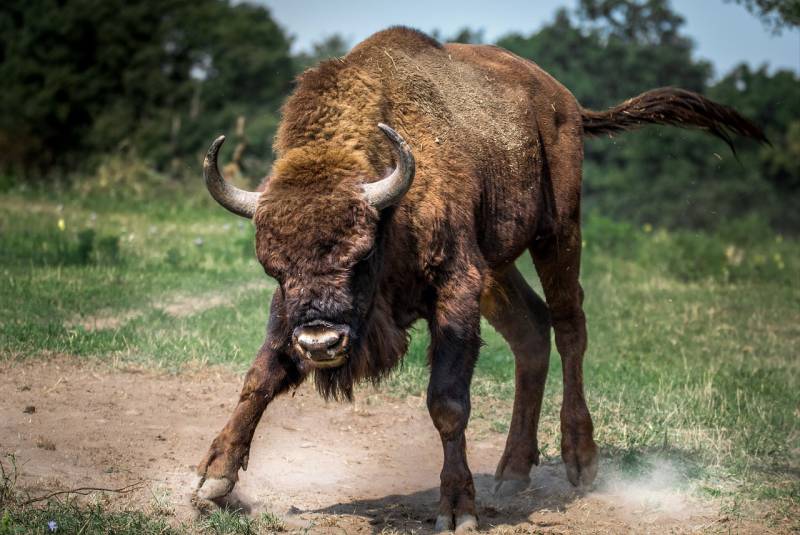
bison

Are bison really that dangerous? Yes. The North American bison is one of the largest land mammals on the continent, and is possessed of both frightening strength and a surprising amount of speed and agility. When antagonized or defending young, bison can trample, gore, and generally smash humans with ease.

Just because bison appear sluggish, gentle and generally like big, fuzzy cows does not mean you can treat them with familiarity.

Wild animals must be treated with respect at all times, and when a particular wild animal weighs more than a short ton and stands six feet tall, you had better be on your best behavior.

You can learn more about bison and their potentially dangerous interactions with humans below.

Where Are Bison Encountered?

Once upon a time in North America, bison were encountered quite literally all over the place, with a natural range stretching from coast to coast as far North as present-day New England and as far south as the panhandle of Florida.

That isn’t the case in our era, obviously, because bison are only now making a big comeback after being hunted nearly to extinction.

Today, you’re only likely to encounter wild bison in one of our many national parks, particularly Yellowstone National Park, or in wild ranges where they have been reintroduced in number.

Considering how popular they are among all the many attractions in national parks, it is a bit surprising that there are not more bison encounters with people that result in a negative outcome.

Though hundreds of thousands of people view and admire them safely from a distance, there are still plenty of people who get too close to these impressively massive beasts, way too close.

Bison Interactions with People

Some bison are raised as livestock, generally for their meat, but excepting these instances where they are farmed or very rarely raised as massive, bovine pets, bison prefer not to interact with people out in the wild. When interactions do occur, they are usually frightening, and often injurious.

A bison will typically be enraged to attack when it is antagonized by the approach of a person. As with all wild animals, people should keep their distance, but they choose not to.

Coming too close for a selfie opportunity or, in some misguided attempt to make contact with the large and seemingly gentle bison the animal becomes frightened or territorial and attacks. More on that in a minute.

These animals are typically encountered in herds as most bovine creatures are, and compared to bears or other predators it is a rarity that a lone bison will be surprised or attack from ambush.

Males in the rutting season and females that are raising young are also particularly sensitive to intrusion. Whatever the case, misguided or foolish people who provoke a bison to attack will very likely find themselves in a life or death struggle. A very one-sided struggle…

What Does a Bison Attack Look Like?

All bison, at least the adults, have horns that are short, sturdy and pointy. These horns are not just for threat displays, or mating rituals. They work as intended, and are employed on defense as goring weapons, more than capable of skewering an adult human.

Compared to humans, bison are positively massive, standing at least 6 feet tall at the top of the shoulder, and weighing in excess of 1,700 pounds regularly.

Their tremendous size is often a surprise for those who have never seen them in person, but even people who have only seen them in pictures that will notice the slabs of muscle that typical examples of this species pack on.

This tremendous physical capability combined with their strength and size is even more dangerous because their typical behavior lulls their would-be victims into a false sense of security.

Bison appear to move around in a sluggish manner, meandering from place to place, grazing, or trotting along in a sizable herd while traveling.

Most bison are only active for a couple of hours at a time before settling down to rest or lounge the day away. How could such a placid and seemingly lazy beast pose such a threat?

As it turns out, when agitated or provoked to defense, a bison will prove frighteningly athletic, capable of tight, pinpoint maneuvering, tremendous acceleration and a high top speed that it can sustain for miles at a stretch.

Average bison can reach top speeds of 35 miles an hour on flat, level terrain, with speeds and excess of 40 miles an hour far from uncommon. Even an Olympic runner could not hope to get out of the way of a bison once it decides to charge.

Injuries typical of a bison attack include trampling, goring and slamming. Most victims come away with serious broken bones, organ damage, various internal injuries, and puncture wounds from the aforementioned horns.

Thankfully most bison run-ins are not fatal, but bison are more than capable of inflicting fatal damage. Take these big critters seriously!

Are Bison Really That Dangerous?

Are bison dangerous? Absolutely, I assert that they are. But in case you need more convincing, consider the data. Among wild animals, mammals in particular and mammals that are found overwhelmingly in our national parks extra particularly, bison are by far the most dangerous.

Even more concerning, they cause many more injuries, serious ones, compared to other large mammals that are traditionally encountered in such places like grizzly bears.

In fact, one 20 year study that collated all of the animal attacks occurring in and around our national parks determined that bison were responsible for more than three times as many injuries as bears were in the same time period, and caused pretty much an identical amount of deaths.

How can this be so? Bison are big, furry cows essentially, while grizzly bears are impressively deadly predators.

The reasoning is that people don’t take bison as seriously, despite their intimidating stature. Most people know enough to be justifiably afraid of bears, but since most people don’t fear cows, even ones with horns, people do stupid things in an attempt to get close to the bison or to touch them. This leads to provocation, and subsequently a defensive attack.

In short, all things being equal, you are far more likely to be injured by a bison than any other wild species of mammal.

Avoiding Bad Bison Encounters

As you might have predicted, all that is required to avoid a bad run-in with a burly bison in a bad mood is to simply avoid it. Keep your distance, don’t approach them and always give them a wide berth when they are on the move.

Bison don’t want anything to do with people in the wild, and the ones that do have probably been regrettably acclimatized to the presence of people and associate that presence with food. Chalk that up as reason number one why you shouldn’t feed the animals.

At any rate, so long as you do not get close to the bison they shouldn’t bother you and unprovoked attacks on people are exceedingly rare.

Also, if you are at a national park and notice bison that seem comfortable close to people, don’t assume and definitely don’t take it for granted; these are still wild animals, and if the animal is startled or angered by a noise, sudden movement or even a particular color the result is going to be pain and maiming.

In short, unless they are domesticated bison that have been raised by you personally don’t get close to these powerful and majestic beasts!

Conclusion

The North American bison is one of the largest and most impressive mammals on the continent, and though they presently have only a fraction of their historic numbers they remain a regular site in various national parks and other open areas of the country.

However, these massive and powerfully built animals are dangerous and must be treated with the respect that their size and strength demands. Close encounters with people usually end in tragedy. So long as you keep your distance you should not have much to fear.


via Modern Survival Online https://ift.tt/3higkeP

Monday, May 10, 2021

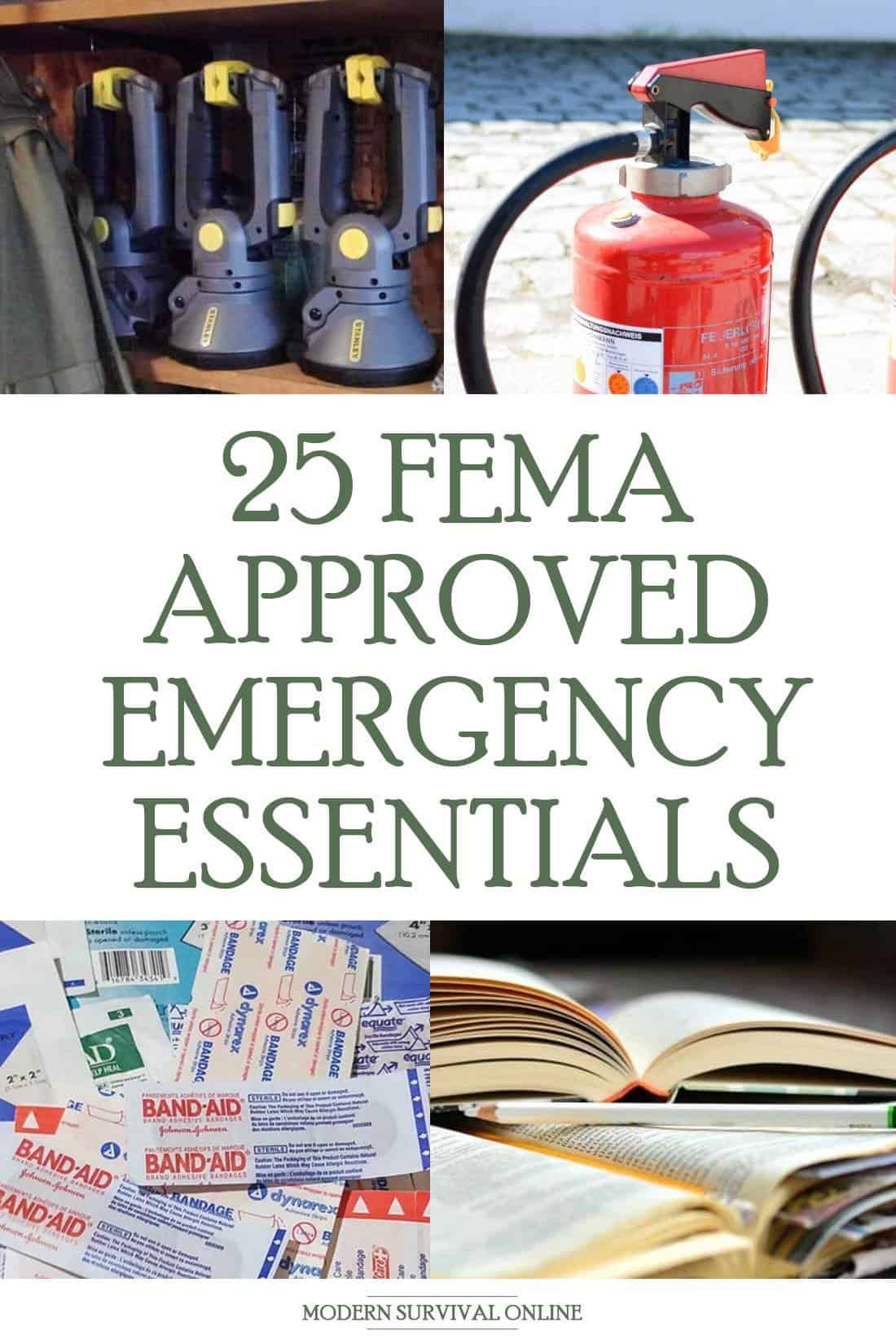
25 FEMA-Approved Emergency Essentials

For preppers who are just taking their first, tender steps into the lifestyle change that is serious personal preparedness, it is easy to run into information overload. Where should you start? How do you begin? What is most important when it comes to material acquisition?

The internet, boundless mine of knowledge that it is, is simultaneously helpful and befuddling. With one click of the mouse, you can find hundreds upon hundreds, even thousands of opinions on the matter, each of them claiming expert knowledge.

However, if there is one organization that John and Jane Doe can turn to for clear-cut, easy to understand advice concerning disaster preparedness, it is FEMA.

FEMA logo

The Federal Emergency Management Agency is one of the largest and best funded agencies of its type, and even though they (like everyone else) have dropped the ball in the past, they have still done the vast majority of the groundwork for us when it comes to our shopping list, and there is no reason we shouldn’t use it.

Accordingly, we have brought to you in this article a list of 25 emergency preparedness essentials recommended by FEMA, derived from an incredible amount of research and inquiry into the subject.

For newbie preppers this list will prove invaluable, as the items featured below, though seemingly basic, form the core of anyone’s survival stash, and are almost always universally helpful in a crisis.

The Basics Matter

If you are already a seasoned, veteran prepper you might think there is nothing for you on this list. Even if you are a beginner, but a hard-charger, you might not want to concern yourself with this list of survival supplies for “babies”.

At least, it’s understandable that you might think that. You didn’t come here for baby steps; you came here for insightful, hard-hitting expert knowledge on the subject! Right? Right!

Before you close this window in a huff, tap your brakes.

Though this list is hardly what you might call a long-term survival checklist (at least as far as materials are concerned, and some categories of tools, provisions and other supplies are notably absent), there is no denying that the items below are genuine necessities in pretty much every situation and every environment that someone would find themselves in.

Not for nothing, statistically the following items are all that will be required in the overwhelming majority of disaster scenarios.

Think natural disasters, man-made catastrophes and other curveballs of civilized life that sometimes make our day today existence anything but civilized. At least in the short term…

At the end of the day, having all of the high-end, esoteric equipment in the world won’t help you if you don’t have your basics covered.

It is helpful, every now and then, to remind yourself of that fact, even if you are a veteran or gung-ho beginner. Sermon over, let’s get to the list!

food stockpile

25 FEMA Approved Emergency Essentials

3-Day Supply of Food

The business of survival is often hard work, and hard-working bodies need fuel to keep operating at peak output.

Even if you aren’t working very hard during a survival situation and are simply waiting for help to arrive, a rumbling tummy is very hard on morale, and we’ll make a comparatively short wait seem like a lot longer. Accordingly, FEMA recommends you have a 3-day supply of food for every member of your household.

What is a three day supply of food though? Is that three meals a day per mouth to feed? Is it a certain amount of calories? Everyone has their own idea and that regard, but FEMA goes with the latter metric, recommending you have about 2,000 calories per day on hand for each adult member of the family.

Good options include trusty staples such as canned food, which is durable, easy to store and easy to open, but some folks prefer dedicated emergency food like dehydrated meal options and MREs. Whatever you pick, make sure it has a long shelf life!

Plates, Cups, Utensils, Napkins

It stands to reason if you have a supply of food on hand for eating you also need the utensils, place settings and other accoutrement required for having a proper meal.

If you are at home, you might be able to use the dishes you have in your cabinets, but consider that they could be broken, lost or otherwise unavailable, and even if they are you might not have the water to spare for washing them.

Many disasters will result in a total loss or contamination of public water supplies, so keep that in mind.

One way to avoid this outcome entirely is to keep a ready stash of disposable picnic supplies, including plastic utensils, paper plates, cups, napkins or paper towels and so forth.

Once you prepare your food and eat all you’ll have to do then is throw your dishes away and forget about them. Don’t worry about counting out specific meal settings at this stage, simply get a sizable package of each, and store them away for a rainy day.

3-Day Supply Water

Water is one of the single most precious survival provisions, as you’ll only be able to live for a handful of days at most with nothing at all to drink. Even this short time span can narrow dramatically if you start out dehydrated or are sweating profusely from exertion.

Hot, arid, environments exacerbate this risk even further, but no matter where you live a supply of drinking water that is not dependent on public resources is absolutely vital.

FEMA once again recommends a 3-day supply of water per person in your household, per day, with a one-day supply for a single individual consisting of a gallon of water for an average, temperate environment.

This water supply is intended to cover not only drinking, but also basic food preparation and minimal hygiene concerns.

Hot environments or high activity levels will demand considerably more water than that though, so always err on the side of a substantial surplus.

Pet Food/Supplies

Pets are members of the family, too, and that means you must prepare for their needs the same as you prepare for your own.

While some folks assume that their pets will be okay during a short-term situation, eating what their owners are eating is not ideal. It’s easy to make the mistake feeding your pets people food that will result in them getting an upset stomach or even falling gravely ill. That’s no good!

You won’t have to worry about any of those outcomes if you stock up on your pet’s usual food, medicines and any other supplements or items they need for the duration.

In keeping with the trend of minimalistic preparation, a 3-day supply is a good start. Also keep in mind you’ll need to store extra water just for your pets’ consumption, so adjust your water budget accordingly!

Garbage Bags

Garbage bags are an item that is easy to forget when preparing for a disaster scenario. There will be lots to clean up, for starters, and additional household trash including human waste going out so you must be prepared.

Letting garbage and other nastiness pile up here and there when it could be contained and disposed of, even if it is just being thrown outside, will make you and your family members far more vulnerable to illness, and even if you don’t get sick you’ll be miserable putting up with it.

If you are wise, you will select the extra-large and extra-heavy duty garbage bags that are typically used for lining 55 gallon drum-type trash cans, the kind commonly used on construction sites.

The thickness and strength of these bags will be welcome when you are disposing of debris or trying to contain nasty, smelly contents like human waste.

Beyond their obvious and intended usages, you can use clean garbage bags for catching water, creating improvised ponchos, or even sealing up broken windows or holes in roofs.

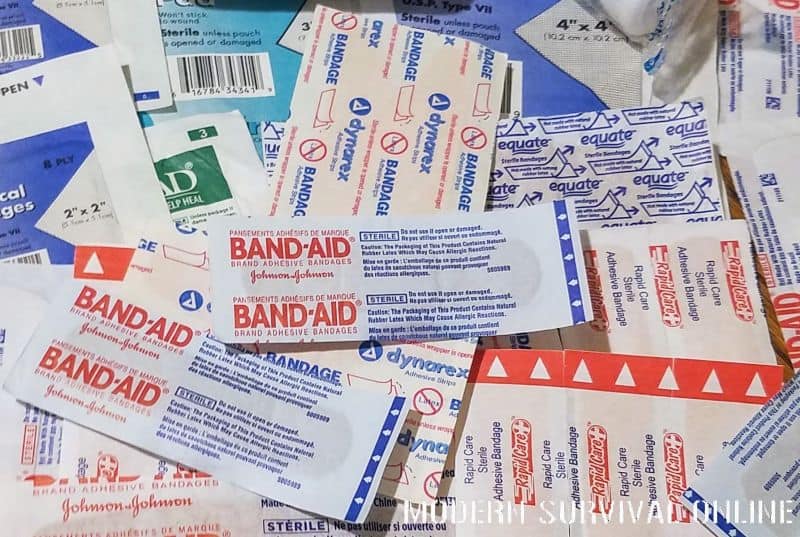
Band-Aids

First-Aid Kit

One of the first tenets that any prepper learns on their quest to personal readiness is that you won’t be able to count on typical first responders during a disaster, and that includes doctors and EMTs.

This is not a slight to these people, but it is a cold observation of reality. They will be completely overwhelmed in the course of any disaster worth the name, and they might even be dealing with their own problems, having been caught up in the disasters effects themselves.

If you get hurt, it is up to you to take care of it. Considering that sources of injury will be in no short supply during any major disaster, FEMA recommends you keep a well-provisioned first aid kit in your home and handy at all times.

This first aid kit should contain at the minimum everything you need to treat basic injuries, including lacerations, minor punctures, minor burns, and sprains as well as fractures.

You’d be smart to include a significant supply of over-the-counter medications for all kinds of conditions, also. So long as you have the training, your first aid kit should include supplies for trauma treatment, also.

Prescription Medicine Supply

Buffing up your emergency stash of required prescription medicines is something that is easy to forget, and if you for any of your family members require prescription meds for the treatment or management of ongoing conditions and diseases you will rue the day it ever slipped your mind.

This is another one of those items that you can only depend on obtaining prior to the onset of a situation.

Talk to your family doctor, and explain to them what you want and why, and they should be able to provide you with a discretionary prescription that can help you lay in enough drugs for a short-term event, easily.

Keep in mind that medicines go bad over time, so you’ll need to rotate your supply.

Baby Food and Diapers

Babies are incredibly vulnerable in the best of times, and you’ll find they are only more dependent on you in the middle of a survival situation.

It’s for this reason that FEMA recommends you heavily stock up on baby formula, diapers and any other needed supplies well before the outbreak of any disaster, as these are among the first items to disappear from store shelves.

Consider diapers, formula, supplemental vitamins (if required), baby food and more mandatory. Some seasoned peppers prefer reusable diapers to reduce logistical strain and make their dollars go farther, but don’t worry about that right now as any soiled disposable diapers can just go out with the trash, which also helps cut back on water use.

Hygiene Kit

The vaguely romantic notion that you’ll be roughing it during a survival scenario without benefit of baths or showers is only vaguely romantic for a reason.

Attempt this, and in no time flat you will be intolerably smelly, and soon after that ripe for all sorts of skin ailments, sicknesses and other maladies.

You must make plans for keeping your hair, mouth and rest of your body clean, even during a crisis and that is why FEMA advises you have on hand a hygiene kit.

Note that this will be somewhat compressed compared to your usual bathroom routine that you enjoy every day. Soap, body powder, toothbrush, toothpaste and deodorant along with any needed feminine hygiene items are going to be mainstays of this kit.

Baby Wipes

Just because you might not have access to running water, or any other reliable source of water for that matter, during a disaster does not mean you won’t be able to take a bath. Bath, in this case, stands in for “some value of sponging off” and for quick touch-ups of the dirtiest and smelliest parts of your body baby wipes are tops.

Baby wipes are self-contained and include mild cleansers as well as a pleasant fragrance and are perfect for wiping down after you get dirty or just begin to stink.

So long as you keep their container closed and sealed they will also remain moist, meaning you won’t need to add any water, and that will stretch what water you do have even further.

Spare Clothing

Having spare clothing for every member of the family is a great idea when it comes to disaster preparedness, because as sure as the sun will set in the west you can count on the clothes you are wearing at the onset of the event coming hideously soiled, damaged or otherwise unusable.

Even if they aren’t, wearing the same set of clothes for days is only going to exacerbate hygiene concerns.

FEMA would tell you the same thing that I would tell you, specifically that you should keep at least one spare set of clothing on hand that is suitable both for helping to protect you from the environment you are in as well as any risky tasks you might have to undertake during this event.

Sturdy footwear, pants, shirts, gloves and headgear should all be included along with plenty of socks and underwear. Don’t forget your overgarments if you live in a particularly wet or cold environment.

Chlorine Bleach and Dropper or Pipette

Chlorine bleach is a survival item that is plainly excellent, and it has so many uses it is a wonder they don’t charge a fortune for it.

We use it every day when it is time to do a load of whites in the laundry, but it can do so much more for you, including sterilizing surfaces, reliably killing germs that might be lurking on your hands, and even purifying questionable water sources of any biological contaminants.

It is this final characteristic that makes it so precious for preppers, and FEMA agrees. You should keep on hand at least one gallon of unscented, non-thickened and otherwise undoctored, straight chlorine bleach, and also obtain a dropper or lab pipette that will allow you to precisely meter out controlled drops of the bleach.

It only takes a few drops to treat an entire gallon of water, but you must know your ratios and be accurate when administering it.

Dust Mask or Respirator

One potential threat many newbie preppers often forget about during disasters of all kinds is the likelihood of seriously contaminated air resulting from smoke, dust, etc.

Breathing in these contaminants will at the least potentially cause long-term health effects, and in the case of substantial air quality deterioration could even asphyxiate you.

An easy way to hedge your bets against this threat is to obtain high efficiency disposable dust masks, or purpose-made half face respirators with appropriate cartridges.

This is unofficially important prep for urban dwellers but everyone should make use of these devices for safety whenever called for.

Keep in mind that these items wear out, as dust masks themselves will become clogged, and useless and filter cartridges for respirators, they will eventually wear out with use, so have some spares on hand just in case.

Wrench, Pliers or Valve Key

FEMA advocates that all families have as part of their survival supplies a heavy duty set of wrenches, pliers or appropriate valve keys for shutting down water or gas mains in case a disaster results in damage that causes a leak.

Either can make a bad situation worse, and in the case of a gas leak create an extremely dangerous explosive atmosphere hazard.

When either becomes a problem in the immediate aftermath, you do not want to be scrambling looking for just the right tool that can turn off the appropriate valve. Make sure you have the tool handy in a dedicated place among your survival supplies and that it is previously tested for sureness.

flashlights and lanterns

Flashlights with Spare Batteries

In almost all disaster situations you can depend on the power going out, and that means when the sun goes down you’ll be facing darkness the likes of which that most people in the developed world don’t encounter on a regular basis.

The darkness hides many dangers and will make taking care of the business of survival extremely challenging, and so accordingly you will need a personal lighting solution so that you may safely navigate and work even in periods of darkness.

Heck, even in the daytime the interiors of large buildings or basements might become oppressively dark.

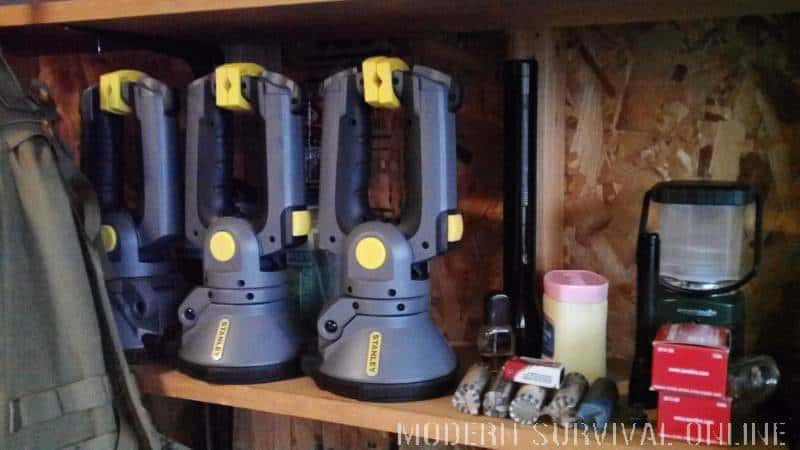
No survival checklist is complete without a stash of flashlights and a healthy supply of spare batteries to feed them. Clever preppers will make sure that all of their flashlights use the same type of battery so they can share the same supply.

Whichever flashlights you choose, make sure you test them and inspect them periodically if you keep them loaded with batteries since they can corrode over time, ruining your tool.

Emergency Whistle

It is hard to overstate all the various bad outcomes that could result from a disaster, of any sort. Many natural disasters can potentially damage or even topple buildings, trapping you inside.

This could make signaling to potential rescuers extremely difficult if not impossible, and for that reason you need an emergency whistle capable of producing an ear-piercing blast, a blast capable of being heard over the din and noise of the aftermath.

But beyond that unhappy scenario, it does not take much imagination to think of a context or signaling to potential rescuers, family members or other people during times of low or occluded visibility could make the difference between a happy reunion and frustrated, anxiety inducing wondering.

Matches with Waterproof Container

You will not be able to count on modern methods of climate control still functioning in the aftermath of a deadly disaster. Electricity could be knocked out, gas mains broken or shut down and so forth.

The ability to produce fire on demand for heat, cooking and light is essential, and is a skill most humans have enjoyed since time immemorial.

However, the traditional skills of fire starting are becoming rarer and rarer all the time. Chances are you aren’t too swift at doing so, but even if you are there is no reason you should struggle to get a fire going when you can just strike a match.

FEMA has long advocated keeping a sizable quantity of sturdy matches in a waterproof, crush-proof container as part of your survival kit.

When starting a cooking or signal fire, lighting your fireplace, your grill, or your torch a match will do it with a flick of the wrist.

fire extinguishers

Fire Extinguisher

If a fire gets out of control, or your home catches fire, you’ll have precious little time to put it out before it turns into a fully involved blaze incapable of being stopped by your puny efforts. If this happens to you during a disaster scenario, your house is as good as gone, just one of many structures destined to be incinerated by the crisis.

Your first, and perhaps only, hope of putting such a fire out is with a proper, functioning fire extinguisher.

Only modern fire extinguishers have the reliability and effectiveness to completely snuff a fire of a given size before it gains strength and goes completely out of control.

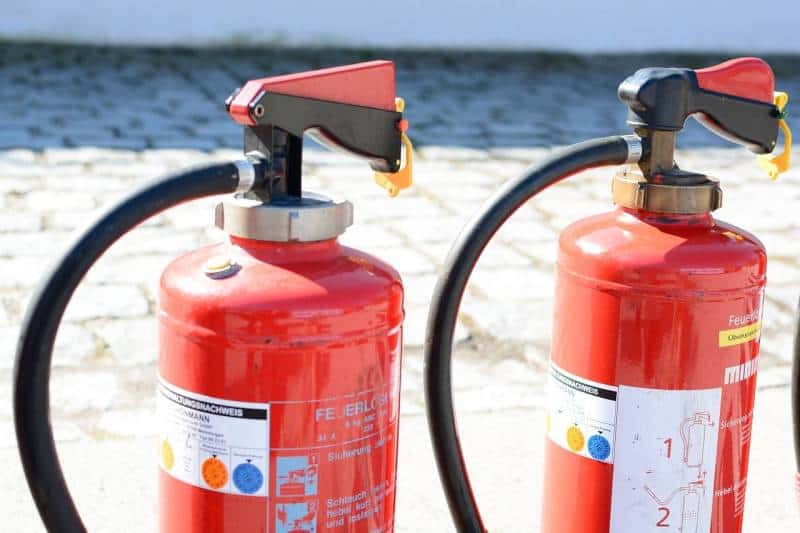
You should choose a fire extinguisher that is ABC rated and intended for residential use, and be sure to get the largest one that you and your partner can effectively control. There is no such thing as too much fire fighting capability when the chips are down!

Pad and Pen or Pencil

There will be plenty of reasons to record important information during a disaster. Maybe you need to take a note, or leave one.

You might be writing down the location or address of an evacuation zone or supply drop. Perhaps you are writing down the locations of various hazards they have emerged as a result of the event.

Whatever the reason, you shouldn’t count on having your cell phone or some other electronic note-taking device handy. It could be lost, damaged or just out of power.

But paper will remember what the mind cannot, or will not, and for that reason a good, old fashioned analog tablet and pen or pencil should be included as a dedicated part of your survival kit, not something you have to go fishing for, potentially among the wreckage of what used to be your home.

Local and Regional Maps

Depending on what has occurred, you might emerge from your shelter to a landscape that looks entirely different compared to the last time you saw it, even a few short minutes or hours ago.

All sorts of disasters are powerful enough, and widespread enough, to reshape entire towns, obliterating buildings, signage and other landmarks that people rely on for navigation. This can be shockingly disorienting if you are unprepared for it.

But whether or not you have to deal with such a scenario, you’ll always be better off having local and regional maps for your area.

Even if the landscape has not been half-obliterated, you’ll be able to rely on paper maps to figure out where you are going and how you can get there safely should you need to evacuate. It is no wonder that FEMA strongly recommends every citizen include these as part of their survival complement.

Sleeping Bag

Believe it or not, across the widest possible variety of survival scenarios it is simple exposure that is the most consistent killer. Not dehydration, not starvation and not traumatic injury.

Exposure, particularly to cold, is capable of killing and as little as 3 hours if conditions are just right. You cannot afford to take the chance of being exposed to the elements, and unable to warm up should your shelter become compromised or otherwise uninhabitable.

FEMA advises us to obtain sleeping bags with full bedding sets for every member of our family or group, as this insures that people to stay warm, or at least warm enough, even if they do not have any other shelter, and a sleeping bag in conjunction with a shelter will typically keep you comfortable so long as your clothing is otherwise rated for the environment.

Cash or Traveler’s Checks

So many systems of modernity will fail us in the aftermath of a disaster, and among these many technological casualties will be the intricately complex and interconnected web of networks responsible for the functioning of credit and debit cards.

As the old saying goes, when the chips are down cash is king, and you must have a stash of cash, or at worst travelers checks, as part of your survival supplies in order to ensure you can still purchase what you need when you need it.

I have little doubt you probably come across many articles already advocating alternatives to typical paper currency, and some particularly smart cats will recommend stocking up on precious metals and other trade goods that will be genuinely valuable even when propped up paper money is only good for kindling.

That attitude has merit, but for our purposes, the vast majority of people will still deal in cash in the aftermath of a disaster since they know it is only a matter of time until the lights come back on and things go back to normal.

open books on table

Survival Manual

If you are just starting out as a prepper, there is probably an awful lot you don’t know about the nuts and bolts of survival unless you came from a background and medicine, soldiering or law enforcement. Even that, very few people have all the answers, and are a total systems provider for their family.

To help you make good decisions and potentially shore up weaknesses in your personal database, you should obtain a comprehensive, easy to reference survival manual.

Depending on the type of book you get, these handy-dandy manuals can show you everything from indoor or outdoor shelter creation, purification of water, tending to common wounds and how to signal for help from rescuers who are on the ground, on the water or in the air. Invaluable reference texts, and a great way to start self-directed learning.

Emergency Alert Radio

One clever piece of gear you might not have thought of acquiring is an emergency alert radio, sometimes called a severe weather radio or NOAA radio.

These compact, energy efficient radios are designed to pick up special government disaster broadcasts on emergency notification frequencies, and the majority even have built-in hand cranked dynamos to ensure you can always power them up and receive instructions and additional information no matter the situation.

Radio communications are surprisingly robust and redundant compared to cell phone communication and bad situations, so you’ll want to obtain one of these for your stash as a backup to your cell phone.

Even better, many modern iterations of these radios feature other handy built-in survival technology, including flashlights, USB charging ports, emergency strobes and more. These are sort of a survival multi-tool among your preps!

Important Docs Package

Preparing to survive a disaster is one thing, as is preparing to endure the aftermath.

Sweeping away the rubble and picking up all the pieces of your former life is another thing entirely, and the wise prepper will follow FEMA’s advice for including a paper file or flash drive with electronic copies of all of the most important documents in your life, including social security cards, driver’s licenses, passports, deeds, titles, mortgages, diplomas and so forth.

Basically, anything that has an impact on the day today nuts and bolts of your life should be included in this file and weatherproofed.

For a paper file, that means lamination and then inclusion in a sturdy binder or portfolio. A flash drive is fine so long as you take care to insert it in a waterproof, crush proof container that you will not misplace.

Whatever option you choose keeping this vital prep secure is paramount, as a thief will have the literal keys to your life should they obtain it. Conceal or otherwise hide a paper version, and password encrypt an electronic version.

Conclusion

You might say that the Federal Emergency Management Agency knows a thing or two about getting civilians ready and able to survive and sustain in the aftermath of disasters of all kinds.

After all, it is in their name! If you are new to prepping you can rejoice that they have done all the leg work for you when it comes to assembling your basic survival kit, and even if you are a little farther along on your prepping journey, you shouldn’t ignore what they have to say because the contents included here form an excellent basis for any hardcore prepper’s survival stash.

FEMA survival items pin image


via Modern Survival Online https://ift.tt/3tydwwI

Friday, May 7, 2021

Should I Use a Small Pocket Knife for Self-Defense?

Most preppers carry a knife for a variety of purposes, and any knife, no matter why it is carried, can be pressed into service as a defensive weapon. However, some prefer to carry a small, lightweight knife for utility chores only, eschewing the weight and bulk of a larger folding or fixed blade knife. Could this get them into trouble in a self-defense situation? Is a small knife inherently bad for self-defense purposes?

Should you use a small pocket knife for self-defense? No, if you have a choice, as they do give up some functionality to larger blades. Small knives are inherently lacking when it comes to self-defense, and don’t show as much efficacy as larger ones when cutting. However, compact pocket knives are much easier to conceal and may be the only option in certain places.

But there is much more to consider when it comes to small pocket knives on defense. Keep reading to get the rest of the story.

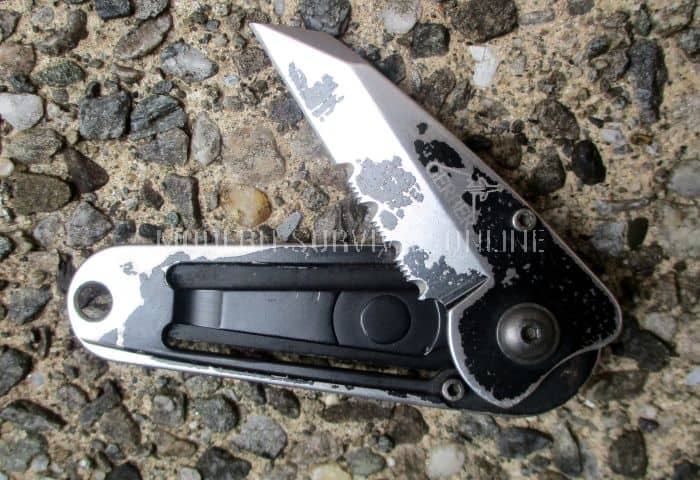
Gerber folder

Does the Size of the Knife Matter?

It might seem like a silly question, but there are plenty of people who would prefer to carry whichever knife they prefer and not give it any more thought. After all, if a knife can cut flesh it can work for self-defense right? Not really. Except, maybe. It is complicated, and since self-defense is serious business the subject deserves to be expanded upon.

First things first, the size of the knife does matter, but perhaps not in the way that you think. A small knife might not be effective enough in a hardcore fight for your life, but on the other hand a supersized, movie villain fixed blade knife could also prove to be too cumbersome for carry and also clumsy to wield. read more on the pros and cons of fixed vs. folding knives here.

Generally speaking a longer blade makes for a better stabbing weapon, because it ensures more penetration and a better chance of striking vital structures within the body. A short knife will not penetrate as deeply, obviously. But how about when it comes to cutting and slashing attacks? That answer is not so simple.

We have seen time and time again the tiniest of knives deliver positively devastating cutting attacks.

Box cutters are a notorious improvised weapon for this reason, and the common surgical scalpel has a blade that is merely three quarters of an inch long, but can nonetheless open up an adult human being with scarcely any effort. When it comes to cutting, blade geometry and sharpness are more important than length.

Small knives do have other advantages and disadvantages to consider attendant with their diminutive stature. Keep reading and we will get into them.

Advantages of Small Knives

Small knives have some advantages all their own. Small pocket knives are especially easy and convenient to carry, and they may be easier to deploy, especially when you don’t have as much clearance as you’d like.

The ability of small knives to go unnoticed makes them excellent for deep carry environments where any detection could spell consequences. Also, the fastest knife to draw is the one you already have in your hand.

Small pocket knives can be easily palmed, ready for instant deployment so long as your knife’s closure mechanism is suitable for the task.

Whether you are pressing a common pocket knife or gentleman’s knife into service as a defensive weapon, or have chosen a particularly compact variety of pocket knife designed for self-defense, you won’t give up much in the way of cutting power so long as the knife is kept sharp, and its compact nature makes it devastating when employed with the element of surprise.

Disadvantages of Small Knives

Small knives do have some inherent disadvantages. The short blade length does not lend itself well, as mentioned above, and this can be problematic because it is thrusts, not slashes, that are far more likely to be fight-stopping strikes.

Additionally small pocket knives are usually small all the way around, blade and handle. This can compromise a secure grip on the knife by affording you less purchase, or one that is less ergonomic.

It does not take a genius to see that a full, secure grip on a knife is paramount if you want to use it effectively in a self-defense encounter.

Also, it is worth mentioning that small knives are working with less material, particularly the surfaces of locking components.

The most could be considered to be adequately strong for defensive use, particularly if they are made to a high standard by a reputable manufacturer using top quality materials, small pocket knives generally will not withstand as much abuse as larger ones before failing.

Last Resort, or Only Choice?

Often the most salient factor concerning the use of a small pocket knife for self-defense is whether or not any other knife is even an option.

Being forced to rely on a pocket knife that was never carried for the explicit purpose of self-defense is one thing, but being prohibited by law from carrying anything more substantial is another thing entirely. This consideration alone might significantly influence the choice of knife.

Take Chicago and New York for instance, two cities with stringent knife laws, particularly concerning blade length. If you may only carry a knife with a blade measuring 2 inches or less, what kind of pocket knife will fit the bill, particularly if you want to carry it for self-defense since guns are even more severely curtailed?

In such locales you would be well served to seek out and choose a pocket knife specially made for self-defense in such political climates.

Some makers, like Spyderco, produce knives with tiny blades married to larger handles and substantially beefy locking systems. Knives like this try to make the best of a bad situation while sticking to the letter of the law for those who live in such places that have them.

Now, if all you have to defend yourself is a tiny pen blade featured on an equally tiny Swiss army knife, then you have to do what you can with what you have. This is an example of a small pocket knife being a genuine weapon of last resort.

Handle and Locking System Matter Most

Perhaps more than the length of the blade, it is the size of the handle and in particular the locking system that matter the most when employing a small pocket knife for self-defense. It is unfortunate that the vast majority of small pocket knives lack any substantial locking system, with most relying on the classic slip joint.

The slip joint is an elegant and simple locking system for light duty work, but it does not lend itself well at all to the chaos and rigors of combat.

It does not take any imagination to see how the blade could be pressed or whacked from the spine side disengaging the lock and closing the blade on the fingers of the wielder. This, you might say, is not good.

Even the liner lock, so derided by aficionados, affords dramatically more security and certainty than a slip joint.

If you are choosing a small pocket knife as your one-and-done-do-everything utility tool plus a genuine last-ditch weapon, you might be best served to find one that has some sort of sturdy lock if you are able.

Also, the size of the handle matters considerably, with many compact knives being so small that they only afford a two and a half finger grip.

This is far from ideal, and one can make the argument that the grip is becoming so compromised that a fumble or loss of the knife is a virtual certainty in the fight. If you cannot retain the knife in use it is not going to do you much good!

Anyone who is considering carrying a small pocketknife for any reason (but particularly as an additional weapon in their self-defense arsenal) would be well served to consider all of the factors we have listed above before making their final choice.

Small knives can perform much better than you might be thinking in a self-defense role, but certain design features are critical to maximize performance.

Conclusion

Small pocket knives can be adequate performers in a self-defense role, but they give up considerable effectiveness when stabbing and their diminutive profile can make deployment, handling and security challenging.

However, there is an increasingly popular category of small and ultra compact pocket knives that are designed with superior ergonomics and locking systems in mind.

For those who are limited to legal carry of only the smallest pocket knives or who desire the smallest possible defensive weapon these knives are excellent choices.


via Modern Survival Online https://ift.tt/3b9HL6G

Wednesday, May 5, 2021

Lucid Dreaming | Help on improving my dream journal

Hello, I would like to ask for some help about my dream journal entries, and how I feel that they are kinda bland.

So, whenever I remember a dream, I write it down, but I don't think I'm putting on that much detail, and I can't help but cringe whenever I re-read my entries, given how poor they are in terms of writing. I also feel that my dream recall is dropping as well, because I've been remembering fewer and fewer dreams recently.
How can I make more detailed entries, which are also more pleasant to read?


via Lucid Dreaming - Dream Views - Attaining Lucidity https://ift.tt/2RpwwQH

South Dakota State Knife Laws

South Dakota is an exemplary state for the carry and ownership of knives of all kinds, hampered only by the fact that the state lacks any preemption laws to help keep the legal playing field level across the board as you travel from place to place.

As it turns out several towns and cities in South Dakota have their own regulations on knives that will affect you more than the state’s laws.

But, so far as the state is concerned, you are allowed to carry any kind of knife you want to openly or concealed. From the most tricked-out tactical switchblade to the heftiest fixed blade fighting knife, it is a 100% A-OK in South Dakota.

Below you will find our assessment that contains everything you need to know about carrying a knife in the state as well as a selection of the most important state statutes at the end of this article.

South Dakota flag

What You Need to Know

  • What Kind of Knives Can I Own?: Any kind of knife.
  • Can I Carry a Knife Concealed Without a Permit?: Yes, any kind of knife.
  • Can I Carry a Knife Concealed With a Permit?: Yes, any kind of knife.
  • Can I Carry a Knife Openly?: Yes, any kind of knife.

General Ownership

The state of South Dakota hardly has any mentions of knives at all on their law books. No type of knife is banned from ownership or possession.

Unfortunately, as mentioned above there is no statewide preemption law on the books in South Dakota, and that means local laws will take precedence when it comes to the possession and carry of weapons including knives.

Several major towns and cities have laws of their own that are significantly more restrictive than the state’s own laws, including prohibitions on concealed carry, blade length and more.

Concealed Carry, No Permit

South Dakota allows the carry of any kind of knife whatsoever without benefit of a permit within its borders, though as mentioned you will have to contend with whatever local county and city laws apply in the place you are traveling through or stay. Sad to say, but some of them are significantly more restrictive than the state standard.

But back to the states laws themselves, South Dakota is fairly unique in that the definition of concealed as it applies to the statutes concerning weapons only applies to firearms in particular.

If you care to look up the definition below on your own you will see it is quite simple in this regard. South Dakota defines “dangerous and deadly weapons” as knives which are calculated or designed to inflict death or serious bodily harm according to the manner in which it is used.

This could of course be any knife used in the commission of a crime, but no particular category, class or feature of knife is named in the definition.

Additional South Dakota statutes make it clear that the concealed of said deadly or dangerous weapon is only a crime if it is done with the intent to commit a felony, in which case it is a felony itself.

This is so simple you might be forgiven for thinking this is some kind of deception on part of the lawmakers, but it is not. South Dakota is and remains a staunch pro-second Amendment state, and has no concerns whatsoever with its citizens carrying knives about.

Concealed Carry, With Permit

South Dakota makes no distinction at all when it comes to carrying a knife with a permit as opposed to without.

What is worth mentioning is that the statute regarding the concealed carry of a pistol while obtaining a concealed weapons permit specifically states that being issued a permit by the state, or obtaining a permit from another state that has reciprocity with South Dakota does not impose any general prohibition on the carrier of a pistol without a permit.

Though the permit statute is referring specifically to pistols, it is highly illuminating concerning South Dakota’s attitude towards the Second Amendment and its citizens. This is one of very few times where it is shown to be overwhelmingly positive!

Open Carry

The open carry of knives is completely permissible in South Dakota, though once again some cities have their own restrictions concerning open carry particularly. Make sure you stay on top of those local laws!

Prohibited Places

You cannot carry a knife into any courthouse or court room, into any state capitol building or into any public school or public school grounds. There are exceptions, see the statutes below.

Assessment

South Dakota is an excellent state for knife owners concerning possession and carry, but unfortunately has one major shortcoming in the form of a lack of statewide preemption.

Several towns and cities have taken advantage of this gap and oversight to enact their own laws that are significantly more restrictive than the state standard, and that might hamper your travel plans depending on what you prefer to carry.

Pay attention to the local laws, avoid taking your knife into a courthouse or school, and you should not have much in the way of problems in South Dakota.

Important South Dakota State Statutes

22-1-2. Definition of terms.

Terms used in this title mean:

(1) If applied to the intent with which an act is done or omitted:

(a) The words, “malice, maliciously,” and all derivatives thereof import a wish to intentionally vex, annoy, or injure another person, established either by proof or presumption of law;

(c) The words, “knowledge, knowingly,” and all derivatives thereof, import only a knowledge that the facts exist which bring the act or omission within the provisions of any statute. A person has knowledge if that person is aware that the facts exist which bring the act or omission within the provisions of any statute. Knowledge of the unlawfulness of such act or omission is not required;

(d) The words, “reckless, recklessly,” and all derivatives thereof, import a conscious and unjustifiable disregard of a substantial risk that the offender’s conduct may cause a certain result or may be of a certain nature. A person is reckless with respect to circumstances if that person consciously and unjustifiably disregards a substantial risk that such circumstances may exist;

(e) The words, “neglect, negligently,” and all words derived thereof, import a want of attention to the nature or probable consequences of an act or omission which a prudent person ordinarily bestows in acting in his or her own concerns;

(f) If the section defining an offense provides that negligence suffices to establish an element thereof, then recklessness, knowledge, intent, or malice also constitutes sufficient culpability for such element. If recklessness suffices to establish an element of the offense, then knowledge, intent or malice also constitutes sufficient culpability for such element. If knowledge suffices to establish an element of an offense, then intent or malice also constitutes sufficient culpability for such element. If intent suffices to establish an element of an offense, then malice also constitutes sufficient culpability for such element;

(2) “Actor,” the person who takes the active part in a transaction;

(3) “Affirmative defense,” an issue involving an alleged defense to which, unless the state’s evidence raises the issue, the defendant, to raise the issue, must present some credible evidence. If the issue involved in an affirmative defense is raised, then the guilt of the defendant must be established beyond a reasonable doubt as to that issue as well as all other elements of the offense;

(b) The words, “intent, intentionally,” and all derivatives thereof, import a specific design to cause a certain result or, if the material part of a charge is the violation of a prohibition against conduct of a certain nature, regardless of what the offender intends to accomplish thereby, a specific design to engage in conduct of that nature;

(…)

(6) “Concealed,” any firearm that is totally hidden from view. If any part of the firearm is capable of being seen, it is not concealed;

(…)

(10) “Dangerous weapon” or “deadly weapon,” any firearm, stun gun, knife, or device, instrument, material, or substance, whether animate or inanimate, which is calculated or designed to inflict death or serious bodily harm, or by the manner in which it is used is likely to inflict death or serious bodily harm;

(…)

(44A) “Serious bodily injury,” such injury as is grave and not trivial, and gives rise to apprehension of danger to life, health, or limb;

…

22-14-8. Concealment of weapon with intent to commit felony—

Felony. Any person who conceals on or about his or her person a controlled or dangerous weapon with intent to commit a felony is guilty of a Class 5 felony.

…

23-7-7. Permit to carry concealed pistol–Background investigation–Carrying pistol without permit not prohibited.

A permit to carry a concealed pistol shall be issued to any person by the sheriff of the county in which the applicant resides. The permit shall be valid throughout the state and shall be issued pursuant to § 23-7-7.1. For purposes of verifying the qualifications of an applicant, prior to issuing a permit, the sheriff shall execute, and the applicant shall pass, a background investigation, including a computer check of available on-line records and the National Instant Criminal Background Check. The issuance of a permit to carry a concealed pistol under this chapter, or the recognition of nonresident permits to carry a concealed pistol under § 23-7-7.4, does not impose a general prohibition on the carry of a pistol without a permit.

…

13-32-7. Possession of firearm or dangerous weapon on public elementary or secondary school premises or in vehicle or building as misdemeanor—Exceptions.

Any person, other than a law enforcement officer or school sentinel under § 13-64-1, who intentionally carries, possesses, stores, keeps, leaves, places, or puts into the possession of another person, any dangerous weapon, firearm, or air gun, whether or not the firearm or air gun is designed, adapted, used, or intended to be used primarily for imitative or noisemaking purposes, on or in any public elementary or secondary school premises, vehicle, or building, or on or in any premises, vehicle, or building used or leased for public elementary or secondary school functions, whether or not any person is endangered by any action under this section, is guilty of a Class 1 misdemeanor. The provisions of this section do not apply to;

(1) Use of a starting gun at an athletic event;

(2) Any firearm or air gun at a:

(a) Firing range;

(b) Gun show;

(c) Supervised school or session for training in the use of firearms; or

(d) Ceremonial presence of unloaded weapons at color guard ceremonies;

(3) Any nonpublic school;

(4) Any church or other house of worship; or

(5) Any nonpublic school located on the premises of a church or other house of worship.

…

22-14-23. Possession in county courthouse or state capitol—Misdemeanor.

Except as provided in § 22-14-24, any person who knowingly possesses or causes to be present any firearm or other dangerous weapon, in any county courthouse or in the state capitol, or attempts to do so, is guilty of a Class 1 misdemeanor.


via Modern Survival Online https://ift.tt/2PQuaK9

Monday, May 3, 2021

12 Survival Items to Score at Home Depot

If you are a prepper, or just know a prepper, you’ll know that there is always something that is needed. A piece of equipment, a certain item of gear, provisions, something that is missing from the ever-growing mountain of stuff in the survival stash.

It is such a time-worn idea that is becoming something of a cliché; preppers acting like magpies, always bringing in some new shiny to add to the collection.

Home Depot Canada

But, jokes aside there is a lot to be said about being well and truly prepared for the unexpected. Improvisation is fine, but you don’t want to be forced to improvise during a major SHTF event.

Accordingly, it pays to always be on the lookout for that one item that is going to better prepare you to handle those situations.

This means you’ll probably spend a lot of time shopping on the internet, and at the big box outdoor stores looking for gear. But certain things you can find in the most unexpected places… like the hardware store, for instance!

In today’s article will be sharing with you 12 survival items that you can score at the Home Depot on your next visit. Whether you are buying incidentals or just in a mad rush to get prepared there are quite a few items you can find there that will help when the shit hits the fan.

Anywhere You Go, There’s Always Something That Can Help You

If you have been prepping for any length of time you probably have your favorite “stomping grounds” when it comes to scoring gear and other supplies you need.

Maybe it is the Army-Navy surplus store, if one still exists in your area. Maybe it is your favorite online repository of prepper-centric survival gear.

Perhaps it is even your local big box camping, hunting and outdoor store, stuffed to bursting but the newest, shiniest, and most expensive apparel and gear around.

That’s all well and good, and I have my favorites too, but don’t fall into the trap of thinking you could only get genuine survival gear from stores and retailers that brand themselves as sellers of survival gear.

Survival gear is as survival gear does, and the only metric for suitability, for your purposes, is your assessment of what is best for you and your context, and whether or not the gear or tool in question can hold up to use. That’s it.

Accordingly, you should keep your eyes open for suitable gear wherever you are. You might find an excellent backpack worthy of service at your local Goodwill. Your standard large department store might carry knives of excellent quality at a very affordable price.

Don’t get wrapped around the axle thinking you got a shop somewhere to rate a certain lifestyle, or to call yourself by a certain title. When you fall into that trap you’ll know that all the slick, multi-bazillion dollar marketing has gotten its hooks into you.

Anyway, here are 12 examples of worthwhile survival gear you can score at the Home Depot.

10 Survival Items to Score at Home Depot

Escape Tool

Your local Home Depot will typically carry at least two varieties of automobile escape tools.

If you are unfamiliar with the concept, these are small tools that typically feature a pointed glass breaking punch, and an integrated cutter designed to slice off a stuck seat belt in the blink of an eye, all without posing a cut or stab hazard to the occupants of the vehicle.

They are furthermore intended to be securely mounted to the seats, near the dashboard or even on the sun visors for rapid access by either front seat occupant.

My favorite version that is commonly available at HD looks like a small, orange mallet with a pronounced conical point on one side, and a flat hammerhead on the other.

The handle of the hammer contains the integrated seat belt color and the whole thing is rendered even more highly visible by an integrated glint strip it will help you find it in dark conditions or times of reduced visibility.

I keep one handy for the front seat, as well as the back seat in my personal vehicles and they are worth every penny.

Work Gloves

There is one thing you’ll be sure of finding at the Home Depot it is work gloves, because no matter what kind of work you are doing, chances are you’ll have cause to wear some type of glove to protect your hands from damage.

Preppers need gloves too, because the business of survival is both hard and often hazardous. Any kind of disaster can result in a landscape that is littered with sharp, dangerous debris that will easily lacerate tender flesh. A good set of gloves will form your first layer of defense against such an unhappy outcome.

When you click an external link on this page and then make a purchase, I may earn a commission.

Matter of fact, you can make a good case for getting two kinds of gloves, the heavy, overbuilt leather work gloves like your granddad used to wear and the lighter, thinner so-called technical work gloves as popularized by the Mechanix brand, though other good brands exist.

The first kind offers maximum protection against bumps, scrapes and punctures, while the second kind affords you a degree of protection while also preserving your dexterity when it comes time to use tools or weapons.

Axe

No man should go through life without an axe, and one of mankind’s oldest tools still remains viable even necessary for survival today when the chips are down.

Simply stated, there is no better manual tool for chopping down most trees and then processing the trunks. Once you have reduced a tree to a more manageable size, you can then split what remains into suitable firewood.

It is a heck of a workout to be sure, but that is why the old timers used to say that chopping your own wood would warm you twice: the first time when you chop down the tree, and then when you throw the logs into your fireplace!

But axes are good for more than just chopping wood. They are capable demolition tools for wooden structures, and naturally serve as positively ferocious close combat weapons that still afford you some reach.

Compared to more specialized weapons, even if you screw up a swing with an axe you are still slamming someone with a massive chunk of steel and that is going to have some effect on target. A direct blow with an axe will inflict a grievous wound that is likely to be fatal.

Wrecker Bar

A wrecker bar can be thought of as a more specialized form of crowbar, often consisting of a thin, protruding beak-like attachment that is intended to be driven into smaller spaces or gaps when swung, or hammered in conjunction with a mallet.

This long beak provides a big “bite” on whatever you are attacking and consequently greater leverage. They are ideal for prying open doors, windows, locked containers and more.

Wrecker bars oftentimes include a more traditional nail puller and pry bar head on the opposite end and sometimes include a small, spike like protrusion on one side or the other for puncturing.

Generally, everything you need to know about these tools is in the name. They are designed for wrecking stuff, demolition, or dealing with things that are already wrecked.

These tools can prove invaluable when the time comes to interact with damaged vehicles or damaged structures, so I recommend you nab one while you’re at Home Depot.

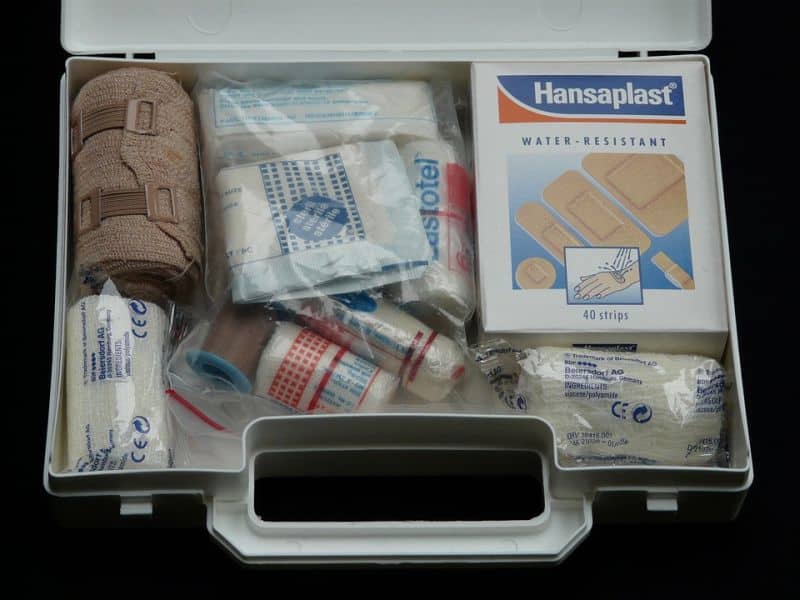
first aid kit

First-Aid Kit

The business of survival often entails fixing the various boo-boos you’ll incur along the way, and occasionally dealing with some pretty significant injuries.

Since you are now your own paramedic and doctor for the foreseeable future, you’ll need to obtain the supplies required for treating various injuries, and also have the know-how. Dealing with someone who is seriously injured is not the right time to play “I’ll figure it out”.

As is appropriate for a store that sells a variety of power tools that can remove digits or limbs in the blink of an eye, they will usually have a small selection of first-aid supplies as well. Usually this takes the form of an OSHA compliant first-aid box that has a variety of band-aids, antiseptics, gauze and common medications inside.

Nicer variations will have eyewash, burn cream and a first-aid manual. Even if you are planning on grabbing major trauma supplies for adding to your kit, and you should be, you’ll never go wrong by starting the core of your kit with these basic supplies.

Beef Jerky

Survival isn’t just all about having the right tools for the job. You’ll also need fuel for your body.

You’ll need plenty of fuel for your body if you’re actually out getting things done, and trying to improve your situation in the aftermath of a major disaster, and not just lounging around in your shelter watching dust motes float on sunbeams.

Home Depot is not renowned for its culinary section, but every, single register has a good supply of beef jerky on hand for the taking.

Beef jerky is tasty, protein-dense and most importantly for our purposes it lasts a really long time.

Grabbing a couple of big bags of the stuff and a handful of Slim Jims will at least let you rest a little easier knowing you have a good stash of calories that will be there when you need them.

Tarp

I love tarps. If you are a prepper worth the name you should love tarps too, because despite their innocuous purpose in everyday life these are another multi-use item that clever preppers can employ in all kinds of different ways.

Tarps can be used to patch a hole in your roof, cover a busted window, as a ground cover, set up as a tent or shelter, or even used as a rain catching system to collect fresh drinking water in quantity.

Your local Home Depot will have a positively smashing collection of tarps on hand, everything from cheapskate light-duty lawn mower covers to extra large, ultra-heavy duty tarps designed for commercial construction site use.

You can get tarps in a variety of materials with a variety of options, like reinforced grommets, high-visibility or low-visibility colors and more. Grab several, you won’t regret it. Trust me.

Lighter

Mastery over fire is one of those requirements that any survival plan must include, and any prepper must obtain. There are all kinds of ways to start a fire, and since time immemorial mankind has relied on friction to get the job done in a natural setting.

Learning how to start a fire in the primitive way is seen as something of a rite of passage for Boy Scouts and preppers alike, but when time is life and you are already dealing with some serious pandemonium you don’t want to resort to that unless you have to.

For that reason, it is far better to simply click a lighter, and put it to your kindling than struggle with starting a fire the hard way.

Consider that you might already be freezing cold, losing both energy and dexterity, when you need that fire and you can see the wisdom and relying on a modern tool for the purpose.

Home Depot will have a wide variety of lighters for sale, everything from classic Bics to the long-nozzle grill lighters that activate with the press of the trigger. I don’t care what you prefer, get several and make sure they stay fueled up.

Propane

Propane is an invaluable fuel source for survivors, since it offers consistent, reliable function for a variety of devices that use it. Propane grills are lifesavers in the aftermath of a disaster because they are efficient and easy to regulate, stretching your fuel supply.

This can help you cook food or boil water just outside of your home, or the ruins of your home, in the aftermath of a disaster.

Propane is also the typical fuel source for portable personal heater units, units that might make all the difference and whether or not you survive exposure to harsh conditions after SHTF.

Most of these heater units use the smaller sized bottles of propane, but an inexpensive adapter kit allows you to hook them up to the large, 20 lb. cylinders that are so common. Get at least two of those cylinders the next time you’re at Home Depot.

Batteries

If you are a prepper that relies on walkie-talkies, flashlights, headlamps, personal radios, wireless cameras, and countless other modern gadgets, you are going to need a small mountain of batteries to make it through a long-term disaster.

That means you need to buy them cheap and stack them deep, and you should be grabbing a pack or two of whatever batteries your devices require pretty much every time or every other time you walk into a store.

Home Depot keeps plenty of batteries in stock because they sell plenty of electronic gadgets that consume them. Much of the time they sell batteries at a small markup, but you’ll also regularly find large contractor packs of batteries for excellent prices and that means you can save a pretty penny on building your backup battery supply.

Disposable Gloves

Just like working on any number of projects, you’ll have plenty of cause to get filthy dirty when dealing with the aftermath of all sorts of disasters.

You might be fishing your possessions out of murky water that has been contaminated by sewage, or trying desperately to stop someone you care about from bleeding to death.

Whatever the case, you’ll want to keep various biohazards and chemical contaminants off of your skin while you work, and that means you’ll need different gloves then your standard issue work gloves we discussed above.

Luckily, Home Depot sells every imaginable kind of disposable glove you could want, from heavy duty rubber chemical resistant gloves to the latest and greatest nitrile blends that are far more resistant to tearing and puncturing than gloves from years past.

You can swoop by the paint department and get any kind you want. I particularly like the Venom brand black nitrile gloves. Tough, and priced right.

sand bags on grass

Sandbags

Sandbags are a crucial survival tool that is easily forgotten about, and they have multiple uses so long as you have a strong enough backbone to fill them.

They are obviously vital for protecting your home and property against rising flood waters, and in grave extremes of social unrest or outright civil war you’ll be filling these up by the dozens to fortify your home or create dedicated fighting positions that provide cover against small arms fire.

But sandbags have more mundane uses, specifically when it comes to construction, repairs, and improvising various heavy lifting contractions using simple machines.

The good news is you can buy a big old stack of these things for pennies on the dollar and leave them in a compact bundle until you need them. And it is far, far better to have them and not need them than to need them and not have them.

Conclusion

If you need survival gear you aren’t limited to buying it from the usual suspects that sell it. What is or is not survival gear is determined by your requirements and nothing else, and many common, universally useful tools and pieces of gear can be found in the most unsuspected places, and one of the best is your local hardware store.

Among hardware stores, Home Depot typically has the best selection on the best variety of tools and other supplies, so if there is one in your area make sure you hit them up the next time you’re looking for an item featured on this list.

home depot pin image


via Modern Survival Online https://ift.tt/3vHW89Y