Tuesday, September 15, 2020

Arizona State Knife Laws

Arizona is a generally easygoing state when it comes to knife ownership and the carry of knives, with one small point of contention: only pocket knives are legal to concealed carry without a permit if you are under the age of 21, and the word “pocketknife” is not confidently defined within the state’s laws.

As written, the law almost certainly forbids the concealed carry of fixed blade knives in the same circumstances as well, but the good news is that open carry of any kind of fixed blade knife you want is legal!

Arizona flag

So long as you are not breaking any other laws you can concealed carry all kinds of knives in Arizona.

Arizona also exercises rigorous statewide preemption of local knife laws that are more stringent than the state standard, and that means you can carry your knife that is otherwise legal confidently as you travel and move about the state.

What You Need to Know

  • What Kind of Knives Can I Own?: Any kind of knife at all.
  • Can I Carry a Knife Concealed Without a Permit?:Yes, but only a “pocketknife” if under 21 years of age.
  • Can I Carry a Knife Concealed With a Permit?: Yes.
  • Can I Carry a Knife Openly?: Yes, any kind of knife at all.

General Ownership

Arizona is a state with very few restrictions on what type of knife you can own, as well as any other essential characteristics pertaining to the knife.

You can have any kind of folding knife, automatic knife, dagger, bowie, gravity knife, machete and so on. pretty much every kind of knife is legal to own, legal to carry (with few exceptions) and legal to sell or transport.

This is one of the few states where pretty much any kind of knife qualifies as a potentially deadly weapon, but the carry of deadly weapons is explicitly allowed under the state constitution and state statutes.

As such, this will only be an issue if you are a restricted person, try to transfer a knife to a restricted person, lie to a cop about what you are carrying, or are carrying anything except a pocket knife while under the age of 21.

We will get into a little more detail on all of these in the sections below.

Concealed Carry, No Permit

Concealed carry of knives in the state of Arizona while lacking a concealed weapons permit is entirely legal so long as you follow a few restrictions.

First, only a common pocket knife may be carried on or about someone’s person concealed if they are under the age of 21.

This also applies to in one’s vehicle. If underage any knife meeting the definition of deadly weapon would not be legal to carry concealed.

This might be a little problematic for people living and traveling in Arizona because “pocket knife” is not readily defined in the state statutes. Is a common stockman knife or trapper knife considered a pocket knife or a deadly weapon?

Certainly any knife may be used as a deadly weapon, so this is not as easy a question to answer as one might think. If this sounds like nitpicking, it definitely is, but these legal definitions are critically important to understanding and staying on the right side of the law.

Aside from the age restriction, if you are carrying any knife concealed on or about your person or within your vehicle you must disclose the fact truthfully to a law enforcement officer if he or she asks. Failing to do so is a crime.

Aside from that, only people who are a prohibited person, typically meaning a felon, are forbidden from carrying knives and other deadly weapons in the state of Arizona.

One must also not transfer any deadly weapon to a prohibited person lest they commit a crime by doing so.

Concealed Carry, With Permit

There is nothing to add to the above section on the concealed carry of knives without a permit except that having a concealed weapons permit does not alleviate the responsibility to disclose the presence of any concealed deadly weapon to a law enforcement officer if you are asked

It also does not give you carte blanche to carry in a restricted area if specifically asked by the operator, the owner of the establishment, or the event to secure your weapon.

Open Carry

Open carry of knives, all kinds of knives, is legal in Arizona.

Prohibited Places

Arizona does not forbid weapons in many places but it does grant wide latitude to the operators of public businesses to control what weapons are allowed on premises, and if they seek to disarm people entering the premises they must provide secure storage for any weapons checked.

Be sure to check out the legal statutes at the end of this article for more details on that.

Besides that, you may not carry your knife on to any school or school grounds, into or onto any place where polling is taking place on Election Day, and onto the grounds of any nuclear or hydroelectric power plant.

Assessment

Arizona is among the very best states when it comes to citizens’ rights to carry weapons of all kinds, knives certainly among them.

The only thing you can really take away from Arizona is the fact that “pocket knife” is ill-defined in the state statutes, and it is the only category of knife that may be safely and legally carried concealed on or about someone’s person if they are under the age of 21.

This might sound like a small issue, but it does open up the possibility that a humble folding knife that appears too large, too long or just looks aggressive might get someone in trouble.

But, assuming you are over the age of 21, and you make sure to always tell a law enforcement officer that you are carrying if you are asked, you won’t have any trouble carrying whatever you want in the state.

Important Arizona State Statutes

It is never fun getting into the fine print of any law books, but it is the fine print that will hurt you, especially when it comes to weapons.

Below is a selection of Arizona’s most important and most relevant statutes regarding the carry of knives, but this is in no way a completely comprehensive list.

Make sure you read all of these statutes, understand them and consult with an attorney if you have any questions:

13-3101 Definitions

A. In this chapter, unless the context otherwise requires:

1. ” Deadly weapon” means anything that is designed for lethal use. The term includes a firearm.

8. ” Prohibited weapon”:

(a) Includes the following:

(List removed for brevity. No kind of knife is specifically forbidden in the state of Arizona.)

13-3102 Misconduct involving weapons; defenses; classification; definitions

A. A person commits misconduct involving weapons by knowingly:

1. Carrying a deadly weapon except a pocket knife concealed on his person or within his immediate control in or on a means of transportation:

(a) In the furtherance of a serious offense as defined in section 13-706, a violent crime as defined in section 13-901.03 or any other felony offense; or

(b) When contacted by a law enforcement officer and failing to accurately answer the officer if the officer asks whether the person is carrying a concealed deadly weapon; or

2. Carrying a deadly weapon except a pocket knife concealed on his person or concealed within his immediate control in or on a means of transportation if the person is under twenty-one years of age; or

3. Manufacturing, possessing, transporting, selling or transferring a prohibited weapon, except that if the violation involves dry ice, a person commits misconduct involving weapons by knowingly possessing the dry ice with the intent to cause injury to or death of another person or to cause damage to the property of another person; or

4. Possessing a deadly weapon or prohibited weapon if such person is a prohibited possessor; or

5. Selling or transferring a deadly weapon to a prohibited possessor; or

6. Defacing a deadly weapon; or

7. Possessing a defaced deadly weapon knowing the deadly weapon was defaced; or

8. Using or possessing a deadly weapon during the commission of any felony offense included in chapter 34 of this title; or

9. Discharging a firearm at an occupied structure in order to assist, promote or further the interests of a criminal street gang, a criminal syndicate or a racketeering enterprise; or

C. Subsection A, paragraphs 2, 3, 7, 10, 11, 12 and 13 of this section shall not apply to:

1. A peace officer or any person summoned by any peace officer to assist and while actually assisting in the performance of official duties; or

2. A member of the military forces of the United States or of any state of the United States in the performance of official duties; or

3. A warden, deputy warden, community correctional officer, detention officer, special investigator or correctional officer of the state department of corrections or the department of juvenile corrections; or

4. A person specifically licensed, authorized or permitted pursuant to a statute of this state or of the United States.

13-3102.01 Storage of deadly weapons; definitions

A. If an operator of a public establishment or a sponsor of a public event requests that a person carrying a deadly weapon remove the weapon, the operator or sponsor shall provide temporary and secure storage. The storage shall be readily accessible on entry into the establishment or event and allow for the immediate retrieval of the weapon on exit from the establishment or event.

B. This section does not apply to the licensed premises of any public establishment or public event with a license issued pursuant to title 4.

13-3102 Misconduct involving weapons; defenses; classification; definitions

10. Unless specifically authorized by law, entering any public establishment or attending any public event and carrying a deadly weapon on his person after a reasonable request by the operator of the establishment or the sponsor of the event or the sponsor’s agent to remove his weapon and place it in the custody of the operator of the establishment or the sponsor of the event for temporary and secure storage of the weapon pursuant to section 13-3102.01; or

11. Unless specifically authorized by law, entering an election polling place on the day of any election carrying a deadly weapon; or

12. Possessing a deadly weapon on school grounds; or

13. Unless specifically authorized by law, entering a nuclear or hydroelectric generating station carrying a deadly weapon on his person or within the immediate control of any person; or

2. ” Public establishment” means a structure, vehicle or craft that is owned, leased or operated by this state or a political subdivision of this state.

3. ” Public event” means a specifically named or sponsored event of limited duration that is either conducted by a public entity or conducted by a private entity with a permit or license granted by a public entity. Public event does not include an unsponsored gathering of people in a public place.

4. ” School” means a public or nonpublic kindergarten program, common school or high school.

5. ” School grounds” means in, or on the grounds of, a school.

13-3120 Knives regulated by state; state preemption; definitions

A. Except as provided in subsections C and D, a political subdivision of this state shall not enact any ordinance, rule or tax relating to the transportation, possession, carrying, sale, transfer, purchase, gift, devise, licensing, registration or use of a knife or knife making components in this state.

B. A political subdivision of this state shall not enact any rule or ordinance that relates to the manufacture of a knife and that is more prohibitive than or that has a penalty that is greater than any rule or ordinance that is related to the manufacture of any other commercial goods.

C. This section does not prohibit a political subdivision of this state from enacting and enforcing any ordinance or rule pursuant to state law, to implement or enforce state law or relating to imposing any privilege or use tax on the retail sale, lease or rental of, or the gross proceeds or gross income from the sale, lease or rental of, a knife or any knife components at a rate that applies generally to other items of tangible personal property.

D. This section does not prohibit a political subdivision of this state from regulating employees or independent contractors of the political subdivision who are acting within the course and scope of their employment or contract.

E. A political subdivision’s rule or ordinance that relates to knives and that is inconsistent with or more restrictive than state law, whether enacted before or after the effective date of this amendment to this section, is null and void.

F. For the purposes of this section:

1. ” Knife” means a cutting instrument and includes a sharpened or pointed blade.

2. ” Political subdivision” includes any county, city, including a charter city, town, municipal corporation or special district, any board, commission or agency of a county, city, including a charter city, town, municipal corporation or special district or any other local public agency.


via Modern Survival Online https://ift.tt/2ZEI1oD

Monday, September 14, 2020

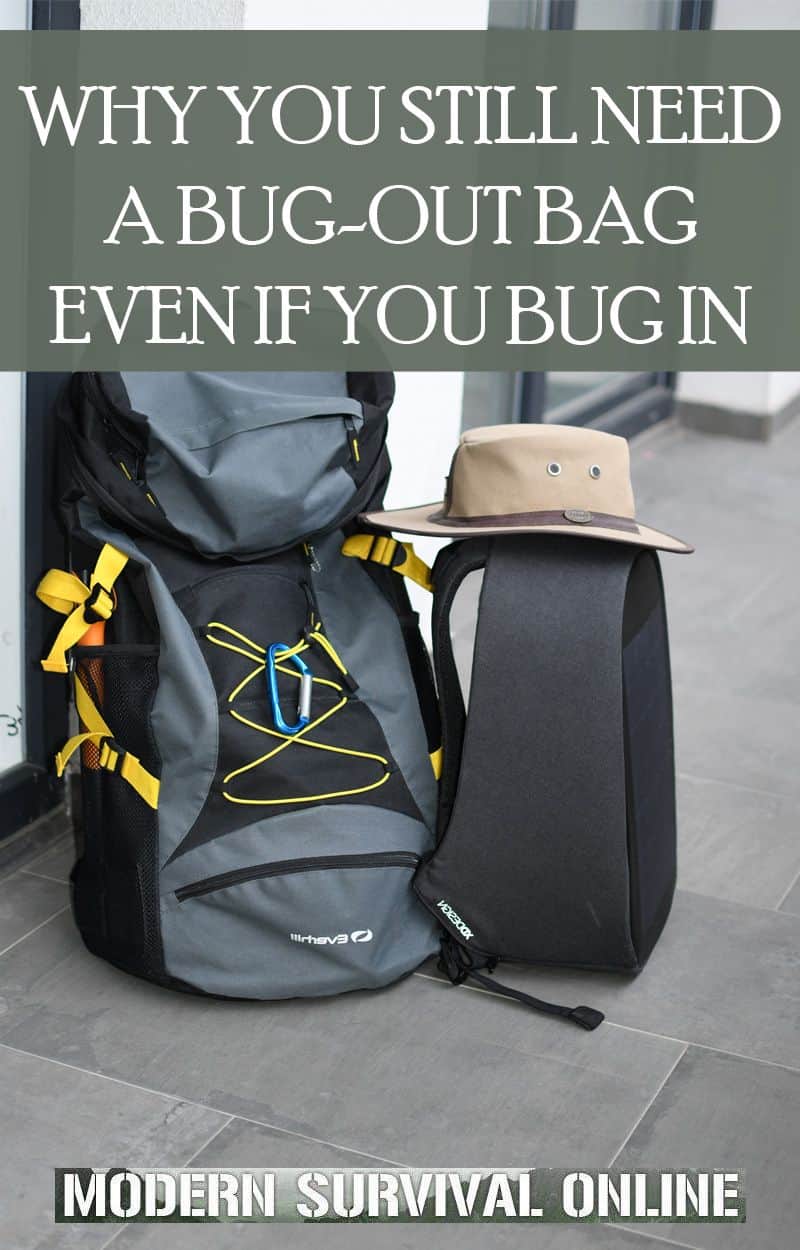
Why You Still Need a Bug-Out Bag Even if You Bug In

Unless you are a complete newbie to prepping, you are probably familiar with the concept of the bug out bag, seemingly every prepper’s favorite piece of equipment.

You can think of a bug-out bag as your survival parachute, a survival scuba tank if you will, representing that one prep that will let you survive an incredibly hostile situation and come out the other side.

green bug out bag

A bug-out bag (BOB) contains all of the equipment, provisions, and other gear that one would anticipate needing when the time comes to get the hell out of dodge like your life depends on it. Spoiler warning: it might!

But as it turns out, some preppers have decided to bet everything on bugging in instead of bugging out.

This does make a lot of sense, due to the fact that having a home-field advantage provided by an actual structure, thorough knowledge of the surrounding terrain and ideally plenty of food, water and other supplies close at hand seems a lot better than taking off for parts unknown hauling your pantry, arms room and shelter on your back in the form of a BOB.

In fact, the idea is so appealing that preppers who plan to begin to the exclusion of everything else actually omit having a bug out bag in the first place. After all, you don’t need a backpack if you aren’t carrying anything anywhere!

This makes a certain amount of logical sense, but I assert that it is still a bad idea, and in this article I will make a case for having a bug-out bag even if all you plan on doing in response to a SHTF event is bugging in.

You Should Bug-In If You Can

Before we get too far down the rabbit hole, I do want to clarify that I believe you should bug in during an emergency or disaster if at all possible.

It just makes the most sense for all the reasons I mentioned above:

  • you’ll have the home-field advantage,
  • you should nominally have other people nearby in the form of friends and neighbors you can reach out to for help
  • you’ll be in a defensible position that will provide shelter and at least the opportunity to fortify,
  • and, perhaps most importantly, if you have been doing your job as a prepper you will have a ton of supplies on hand in the form of water, food, tools, ammo and everything else you need to take care of business.

I don’t think I need to explain the difference in capacity between a dwelling of any size and a simple backpack, no matter how big and impressive it is. Shelves and pantries bursting with goodies are always going to be better than the paltry amount you can carry in a backpack.

And notice I mentioned “carry”; everybody was a young prepper once upon a time who wanted to bring everything including the kitchen sink in their bug-out bag until that first, fateful outing when they had to haul dozens of pounds across the countryside.

Most of us learned the importance of keeping the load light and our packs lean, and then never looked back after that!

The load-bearing issue inherent to a BOB and its effect on your endurance, speed and what terrain you can safely cross is completely eliminated if you will just bug in during an emergency!

To be frank, most people living in most places and dealing with most typical problems that arise during a survival situation will be able to shelter in place so long as they have made some intelligent prior preparations.

Yes, some events are so devastating you have no choice but to run from them if you get the chance, and depending on what happens, you might have the misfortune to see your home or other dwelling completely destroyed before you can make use of it. That really sucks, but that is also, thankfully, rare.

So as I like to say, “Keep calm and bug in”. But, now as always, sometimes you don’t get a vote in the proceedings. Sometimes all you can do is hope to react to an evolving or unexpected situation.

For that reason, no matter how airtight and invincible your bug-in plan is you must be prepared to bug out, even if you’re able and planning on coming back.

Always Be Ready to Bug-Out

No matter how fortified your home, no matter how well-stocked and how well-positioned it is you might have cause to run out the door quickly if you want to save your life, or potentially someone else’s.

Don’t think so? A lot of other people have thought the same thing. No matter what kind of dwelling you have, even a state-of-the-art underground bunker, sometimes you run into problems that threaten the very integrity of your home and everything in it.

What kind of threat are we talking about? How about a fire, which perhaps might be the disaster itself in the form of a wildfire or a secondary hazard spawned off of some other disaster.

Chances are if your house catches fire it is not going to put itself out, and you won’t be able to count on the fire department showing up in the nick of time.

You know what that means: all of your preps and all of that preparation you put into accumulating them gone, in a flash – literally up in smoke.

How about a flood? Anywhere that it can rain it can flood, although some areas are far more susceptible than others.

If you have the misfortune to be living in a flood-prone area, or your number just comes up during the next great 100 or 200 year flood event, your house might quite literally be completely underwater. I mean up-to-the-gutters-and-gators-swimming-by underwater!

What do you think will happen to all your preps then, sodden and ruined as they are? Are you going to take your chances sitting on the roof, and wait for the waters to recede, or are you going to head for greener and, hopefully, dryer pastures?

Perhaps you aren’t dealing with a destructive natural disaster. Perhaps violence stemming from civil unrest or the action of political partisan groups is intensifying and spreading.

Without plenty of manpower and an excellent position you should not delude yourself that you can hold off a rampaging mob of dozens or hundreds without severe risk. Perhaps it is better to take your chances elsewhere, someplace quieter that is unlikely to be touched by internecine conflict.

Any of these events would mean that you need to grab your essentials, load up your family in your car or truck, and get out while the getting is good.

Even that is a gamble, but far too many people have obtained a negative outcome during a life-threatening situation by hanging on in deteriorating circumstances for too long believing erroneously that they could ride it out, that the event would miss them or otherwise pass them by.

When that time comes, you need a BOB packed and ready.

Why a BOB in the First Place?

Sure, as already mentioned, your house is well-stocked and entirely well-provisioned. If you have to leave in a hurry you can just grab what you need from the shelves and take off, right? Well, yes and no.

You must consider the fact that you probably will not be making the decision to leave days or weeks ahead of oncoming trouble.

That would surely allow you to create your packing list, loads of items that you need into suitable containers or luggage and from there into your vehicle and then head off in a fashion that is more akin to a family camping trip or vacation than a mad dash to get out the door in a time-is-life situation.

Chances are it isn’t going to work like that. If you are fortunate, you will have a couple of hours once the “balloon has gone up” and you have made the decision to flee. Chances are actually better than average that when that time does come you will have minutes.

It does not take much imagination to envision the scene. The alert has come in, the clock is ticking, and now you must gather all the necessary items that you need for prolonged sustainment and survival away from your home for yourself, and all the other members of your family.

Even if you are packing using a checklist, and have all of your preps organized and tidy this is going to be pandemonium. Things will get missed. You won’t take enough or you will take too much.

There will be distractions aplenty as room in bags and vehicles is used up, items are jettisoned and repacked, and you are constantly interrupted by inquiries and questioning. Just chaos.

This time, pressure will increase stress and uncertainty. Stress and uncertainty decrease mental performance while increasing pressure further meaning you will make more mistakes, mistakes about things like which way you should go, where their biggest threat is, and what your next move should be.

Those mistakes, any single one of them, could result in a negative outcome including your death.

But let us compare the same scenario above if you have loaded bug out bags for every member of the family. All you have to do then is grab your family, grab their BOBs, load them in the car, and you are ready to go.

Of course, you might have to grab what few EDC items you don’t keep on your person while at home, but chances are those are staged in the same place you have always staged them and you’re unlikely to forget them when you grab your car keys, wallet and other accessories.

Since this has saved you a considerable amount of time in gathering all of the necessary items required for survival, you have a head start on getting out the door. Those minutes saved could make all the difference.

Even if you have a generous departure schedule, you now have extra time to clear your head, and think about what you were doing.

Will you use that time to gather more intel on the situation and perhaps inform your next decision? Will you spend it planning your next couple of moves or contingency plans in case the unimaginable happens? Time spent thinking clearly is never wasted!

Time savings matter and, you should never underestimate that. For that reason, you want BOB’s for every member of the family packed, stowed and ready in case you have to bug out of what was otherwise a certain bug-in response.

Other Advantages of Bug Out Bags

Consider that you don’t need to necessarily be running away, and never coming back for your BOB to come in handy. What if a situation develops, perhaps the rescue of a friend or family member, and you need to leave in a hurry?

Are you going to grab your keys and sprint out the door, facing the unknown with what is in your pockets and a prayer? Or would it, perhaps, be better to arm yourself with gear and other items that could aid you on your way?

If you are thinking that it would indeed be wise to grab your BOB, give yourself a pat on the back because it surely would be! The items that a BOB contains are not just useful when your life is on the line, or when you are fleeing from a disaster.

Survival gear is, ultimately, gear that will help you get work done easily and efficiently, and any BOB worth the name should contain the provisions and items you need to sustain yourself and complete the work that needs completing when you are away from home.

There is no reason why your BOB cannot be your “ready for business” bag also.

I would add the caveat that you don’t want to use it as your everyday go-bag and pillage from it at will because your BOB should fit that “parachute” mentality; it must be packed, perfect and ready to deploy when you really, really need it.

But responding to any legitimate emergency would certainly justify taking it along with you just in case you need something it carries.

Conclusion

Even if you have an airtight, foolproof bug-in plan you must be prepared to bug out or respond to some emergency that sees you leaving your carefully prepared home in a big hurry. The best way to do that is by keeping a properly packed and handily stored bug-out bag ready for just such an occasion.

Bugging in is a great idea so long as the situation at hand allows you to, but you’ll only have all bases covered if you are ready to bug out at the same time. No matter what your preferred response is you need a BOB to complement it!

BOB when bugging in Pinterest


via Modern Survival Online https://ift.tt/33ytDPY

Sunday, September 13, 2020

The Interactive Storytelling Radio

[8BitsAndAByte] are back and this time they’re using AI to create an interactive storyteller. With the help of a Raspberry Pi, they upcycled an old Cold War era radio they dug up and the results are pretty impressive.

The main controller board of the radio was intact, so it was easy to use all the preexisting hardware to control the speaker and to trigger a few of the Pi’s GPIO using the buttons and switches on the radio’s front panel. To add some artificial intelligence, they used Google’s AIY Voice Kit, allowing them to tap into Google’s seemingly endless artificial intelligence platform. This could be a “tables have turned moment,” but we’re probably being a bit too hopeful.

Anyway, they used a pretty interesting piece of software called Dialogflow that creates a somewhat natural conversational interaction akin to a chatbox. Dialogflow processes speech to text, as you would expect, but can also interpret contextual speech and provide contextual responses. Pretty neat…but maybe also a little creepy. Who knows? The jury is still out.

Anyway, if you’re like us and sometimes in need of a break from humans, then this project just might be for you.


via Radio Hacks – Hackaday https://ift.tt/3htUkdc

Thursday, September 10, 2020

ISS Ham Radio Repeater

There is a long history of spacecraft carrying ham radio gear, as the Space Shuttle, Mir, and the ISS have all had hams aboard with gear capable of talking to the Earth. However, this month, the ISS started operating an FM repeater that isn’t too dissimilar from a terrestrial repeater. You can see [TechMinds] video on the repeater, below.

The repeater has a 2 meter uplink and a 70 centimeter downlink. While you can use a garden variety dual-band ham transceiver to use the repeater, you’ll probably need a special antenna along with special operating techniques.

One of the problems you’ll find is that ISS moves fast enough that you will observe doppler shift in the frequencies. The video reproduces a table of frequencies you may have to move through to receive the shifting signal.

You can probably hear the ISS with a good pass with no special equipment, but [TechMinds] wasn’t able to close an actual contact in the video. But [K0LWC] got really close using a pretty standard radio setup, as you can see in the second video.

The ISS has been on the air with digital repeaters and conventional FM radio for some time. The antenna you need doesn’t have to be a huge disk. We’ve seen it done with a handheld beam antenna and a handheld radio.


via Radio Hacks – Hackaday https://ift.tt/35D3zWz

Cell Phone Signal Booster Gets Teardown and Demo

Ever wonder what was inside a cell phone booster, or what it is like to set up or use one? If so, [Kerry Wong]’s got you covered with his teardown of a Cel-Fi Go X Cell Signal Booster by Nextivity. [Kerry] isn’t just ripping apart a cheap unit for laughs; his house has very poor reception and this unit was a carefully-researched, genuine investment in better 4G connectivity.

The whole setup consists of three different pieces: the amplifier unit pictured above, and two antennas. One is an omnidirectional dome antenna for indoors, and the other is a directional log-periodic dipole array (LPDA) antenna for outdoors. Mobile phones connect to the indoor antenna, and the outdoor antenna connects to the distant cell tower. The amplifier unit uses a Bluetooth connection and an app on the mobile phone to manage settings and actively monitor the device, which works well but bizarrely doesn’t seem to employ any kind of password protection or access control whatsoever.

Overall [Kerry] is happy, and reports that his mobile phone enjoys a solid connection throughout his house, something that was simply not possible before. Watch a hands-on of the teardown along with a short demonstration in the video embedded below.

Devices that claim to enhance or boost wireless signals of various kinds seem to attract more than their share of snake oil salesmen, but [Kerry]’s teardown reminds us there are legit hardware offerings (albeit ones with imperfect management app design.) There is also junk out there, like this antenna that was outperformed by a literal rusty nail.


via Radio Hacks – Hackaday https://ift.tt/3hhuGZg

Tuesday, September 8, 2020

Tutorial for Setting Up Raspberry Pi for Ham Radio Use

There was a time when a ham radio set up sported many dials and switches and probably quite a few boxes as well. Computers have changed all that. Some transceivers now have just a few buttons or are even totally computer-controlled. Where a ham, at one time, might have a TeleType machine, a slow-scan TV monitor, and a fax printer for receiving satellite images, now that can all be on a single computer which can even be a Raspberry Pi. [F4GOH] has a post that takes you from the fundamentals to installing everything from an SDR to many common ham programs for digital modes, APRS, SSTV, and more. You can download the seven-part tutorial as separate PDF files, too.

Even if you aren’t a ham, you might find some of the software interesting. OpenWebRX lets you listen to your software defined radio on the road. You can use other software to pick up weather satellite data.

If you are a seasoned Linux user, you won’t need some of the early material. But you will find some good notes on how to use the ham-specific software and get a good overview of what is possible.

Ham radio has changed a great deal. If you think of it as people with noisy large radios, you might be surprised. The hobby is big enough that you’ll find everything from people talking on tiny radios around the world using a hybrid of radio and Internet connectivity, to people bouncing signals off the moon or using ham radio satellites.

[Dan Maloney] has talked about how to get started in ham radio for under $50. Then again, you might need another $50 for the Raspberry Pi. Of course, there are plenty of opportunities to hack the gear.


via Radio Hacks – Hackaday https://ift.tt/3ib7dKs

Teardown: Mini GPS Jammer

If you spend enough time trolling eBay for interesting electronic devices to take apart, you’re bound to start seeing suggestions for some questionable gadgets. Which is how I recently became aware of these tiny GPS jammers that plug directly into an automotive 12 V outlet. Shipped to your door for under $10 USD, it seemed like a perfect device to rip open in the name of science.

Now, you might be wondering what legitimate uses such a device might have. Well, as far as I’m aware, there aren’t any. The only reason you’d want to jam GPS signals in and around a vehicle is if you’re trying to get away with something you shouldn’t be doing. Maybe you’re out driving a tracked company car and want to enjoy a quick two hour nap in a parking lot, or perhaps you’re looking to disable the integrated GPS on the car you just stole long enough for you to take it to the chop shop. You know, as one does.

But we won’t dwell on the potentially nefarious reasons that this device exists. Hackers have never been too choosy about the devices they investigate and experiment with, and there’s no reason we should start now. Instead, let’s take this piece of gray-area hardware for a test drive and see what makes it tick.

Can You Hear Me Now?

While the GPS constellation average altitude of 20,200 km (12,550 miles) might not be quite as high up as communication satellites in geosynchronous orbit, they’re still pretty far away. With this incredible distance in mind, and given the size of the antenna on most GPS-equipped devices, it’s no wonder that the received signal is very weak. So weak, in fact, that it’s generally below the noise floor. Only with clever algorithms and a dash of wizardry can your phone turn this whisper from the stars into anything resembling useful information.

When viewed by an RTL-SDR, the GPS signal is like a needle in a haystack.

It’s this fragility that makes these sort of low-cost jammers possible. It doesn’t take much to overpower the legitimate signal. Keep in mind that a device like this isn’t trying to mimic a GPS satellite, it’s simply broadcasting out enough loud nonsense that the real satellite can no longer be heard.

With the jammer powered up, we can clearly see how the already meager signal is absolutely obliterated by the patterns being broadcast by the device.

With the jammer switched on, the signal becomes a needle in a haystack of needles.

There’s simply no contest; the legitimate signal is tens of thousands of kilometers away, and this thing is screaming its head off at arm’s reach. I didn’t test the range of this device, mainly because I didn’t want to have it powered up for any longer than necessary, but it’s certainly capable of doing the deed at several meters at least.

Betrayed By an Old Friend

Now that we’ve broken federal law for a few minutes by operating this device (seriously, don’t buy one of these) and verified that the dastardly thing does what it’s advertised to do, the only thing left to do is open it up and figure out how it works. For the $8 I paid for this unit I certainly wasn’t expecting a lot inside, but even still, it’s fascinating to see just how easy it is to cause so much trouble.

After years of losing work to the Arduino, the 555 timer has fallen in with the wrong crowd.

On one side of the PCB we can see there are only two major components, a 78M05 regulator to step the vehicle’s 12 volts down to 5 volts, and the hacker’s old friend, the NE555 timer. It’s a shame to see that it takes a teardown of an illegal jammer before we see one of the most iconic ICs in the history of electronics, but there you have it.

Still, unless you’re looking to jam an AM radio, a 555 isn’t going to cut it. Flipping the board over, we get our first glance at the real trouble maker.

RF Witchcraft in a Can

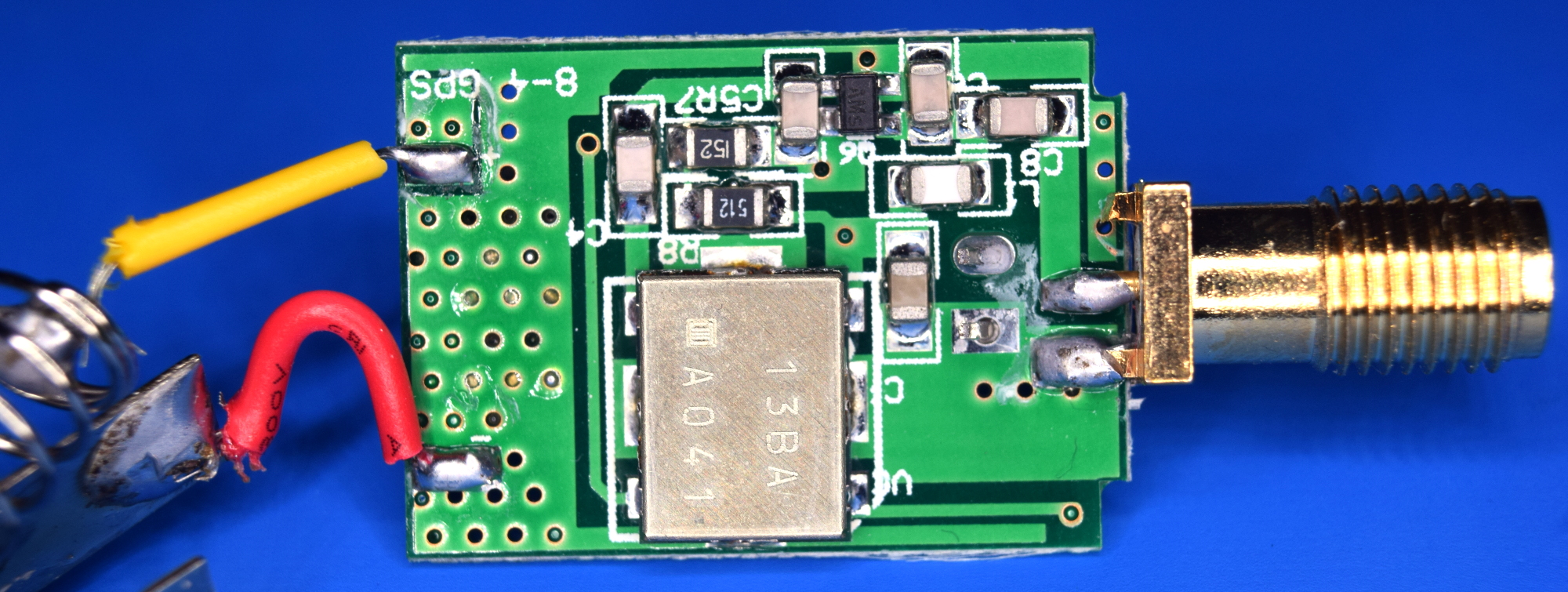
Clearly this component, labeled 13BA A041, is the star of the show. But what is it? While I wasn’t able to find a datasheet for this specific model, what we’re looking at is a microwave voltage-controlled oscillator (VCO). The visible top plate is actually a metallic shield, and with a bit of persuasion, we can look inside to see the incredible array of components that have been packed into the 9 mm x 7 mm area.

The basic theory of operation here is that the VCO’s control pin (labeled VC on the silkscreen) is connected to the output of the 555 timer on the other side of the board. The signal coming from the 555 modulates the output of the VCO, causing the noise we see centered on the 1,575 MHz GPS frequency.

With the scope connected to the VC pin, we can see the 133 KHz sawtooth signal being produced by the 555 timer. If you were to adjust this signal you could potentially shift around the frequency range that the jammer operates on, though without a datasheet for the VCO, it’s difficult to say how far you could push it in either direction. But since these were presumably the cheapest components available, probably not very far.

It’s also worth taking a close look at the small four pin device at the top of the board labeled Q6. Located directly in the path of the high frequency signal as it passes from the VCO to the center pin of the antenna connector, this would be a logical place to put an amplifier. Though it may also be some kind of a diode to protect the electronics from anything that’s picked up from the antenna.

An Unfortunate Surprise

Part of me assumed that the Mini GPS Jammer just wouldn’t work, or at least, it would work so poorly as to not be an issue. But no, in a break from tradition, a cheap imported device from eBay managed to actually exceed all of my expectations.

Not that I’m happy about it. Sure the information to build a jammer like this has been out in the wild for years, but you still needed to have the wherewithal to actually source the parts and assemble it. With such a low bar for entry, this device is clearly quite dangerous in the wrong hands. While a WiFi or cellular jammer would perhaps present a more immediate threat, this is still not technology that anyone wants to see proliferate.


via Radio Hacks – Hackaday https://ift.tt/3m1ETwr