Caring for the elderly and vulnerable people while preserving their privacy and independence is a challenging proposition. Reaching a panic button or calling for help may not be possible in an emergency, but constant supervision or camera surveillance is often neither practical nor considerate. Researchers from MIT CSAIL have been working on this problem for a few years and have come up with a possible solution called RF Diary. Using RF signals, a floor plan, and machine learning it can recognize activities and emergencies, through obstacles and in the dark. If this sounds familiar, it’s because it builds on previous research by CSAIL.
The RF system used is effectively frequency-modulated continuous-wave (FMCW) radar, which sweeps across the 5.4-7.2 GHz RF spectrum. The limited resolution of the RF system does not allow for the recognition of most objects, so a floor plan gives information on the size and location of specific features like rooms, beds, tables, sinks, etc. This information helps the machine learning model recognize activities within the context of the surroundings. Effectively training an activity captioning model requires thousands of training examples, which is currently not available for RF radar. However, there are massive video data sets available, so researchers employed a “multi-modal feature alignment training strategy” which allowed them to use video data sets to refine their RF activity captioning model.
There are still some privacy concerns with this solution, but the researchers did propose some improvements. One interesting idea is for the monitored person to give an “activation” signal by performing a specified set of activities in sequence.
Radar is a complex but fascinating topic, and we’ve seen a number of excellent projects in the field, including a bicycle mounted radar that can be used to generate aerial images and a Doppler radar module designed from first principles.
Thanks [Qes] and [Adam Conner-Simons] for the tip!
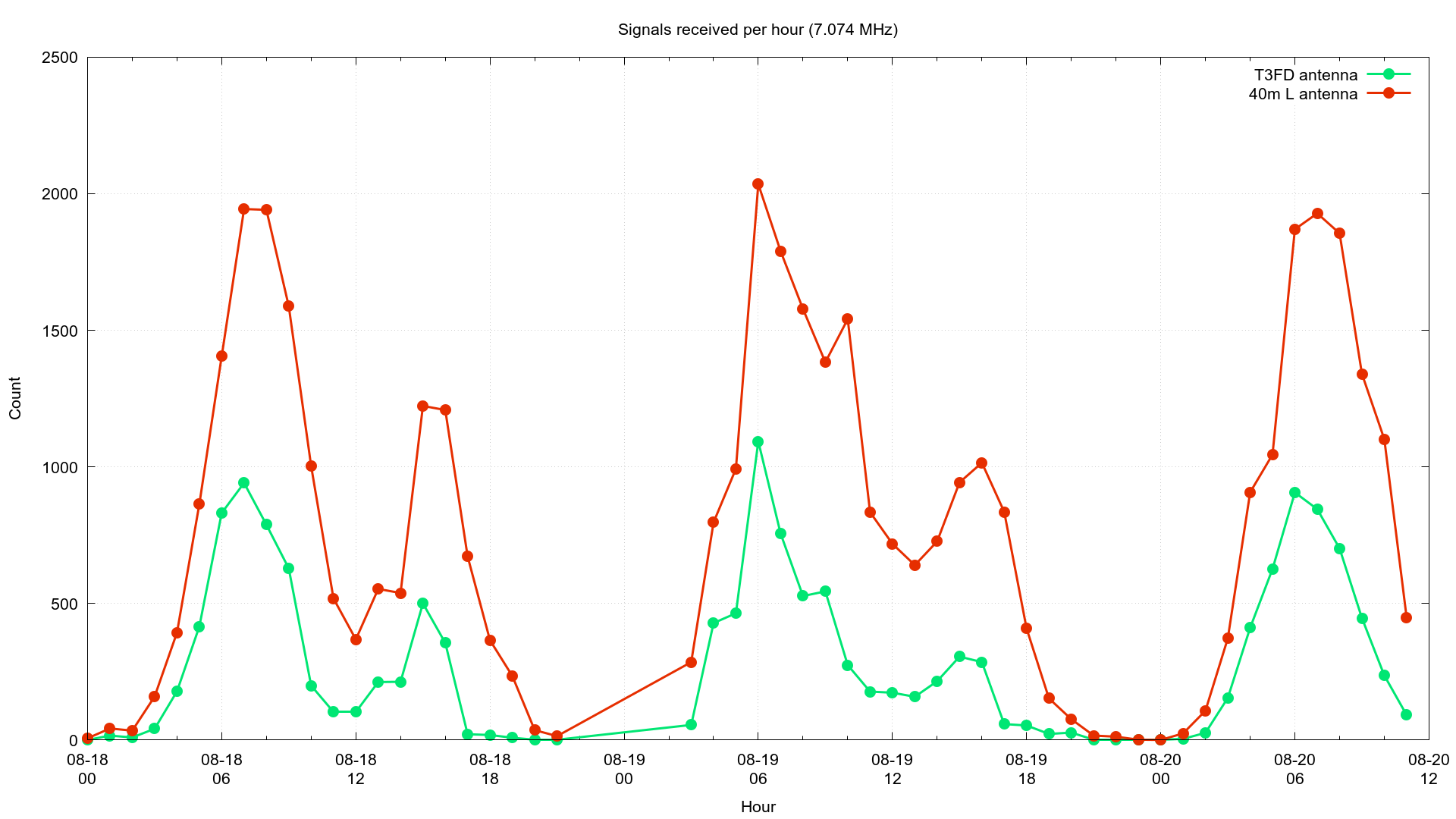
Measuring the performance of antennas in absolute terms that can involve a lot of expensive equipment and specialized facilities. For practical applications, especially when building antennas, comparing performance in relative terms is more practical. Using cheap RTL-SDR dongles and Python, [Eric Urban] was able to compare the performance of two shortwave/HF antennas, and documented the entire process.
The two antennas in question was a single band inverted-L and smaller broadband T3FD antenna. [Eric] first gathered performance data for each over few days, connected to separate PCs with RTL-SDRs via low-pass filters. These were set up to receive FT8 transmissions, a popular digital ham radio mode, which allowed [Eric] to automate data collection completely. GQRX, a software receiver, converted the signals to audio, which was then piped into WSJT-X for demodulation.
Data for each received FT8 transmission was recorded to a log file. [Eric] also modified GQRX and WSJT-X to give him all the remote control features he needed to automatically change frequencies. Between the two antenna setups, more than 100,000 FT8 transmissions were logged. Using the recorded data and Python he compared the number of received transmissions, the distance, and the heading to the transmitters, using the location information included in many FT8 transmissions. Where the same transmission was received by both antennas, the signal-to-noise ratios was compared.
From all this data, [Eric] was able to learn that the inverted-L antenna performed better than the T3FD antenna on three of the four frequency bands that were tested. He also discovered that the inverted-L appeared to be “deaf” in one particular direction. Although the tests weren’t perfect, it is impressive how much practical data [Eric] was able to gather with low-cost hardware.
Some other DIY antennas we covered recently include a hybrid helical for using a geosynchronous ham radio repeater, an off-center dipole, and a directional antenna made from coat hangers. So go forth and attempt to tame the black magic of RF!
The AR-15 remains the rifle of choice for the modern era, and can be found in any shooting discipline, in any shooting activity.
From competition to home defense and law enforcement to military service the AR-15 family of rifles remain completely dominant, the total choice for the discerning shooter. But there is still one area where the AR is meeting a little resistance, and that is hunting.
Now you will find no shortage of AR-15s and their many variants roaming the woods and fields and mountains of America carried by hunters in search of game, but despite the emergence of Gun Culture 2.0, and an increasingly performance-driven shooting public that has been forced to acknowledge the supremacy of the AR and all its many guises, the AR lags behind more traditional choices when it comes time to put meat in the freezer.
Part of it might be aesthetics, and the other part might be that yearning to remain with the old ways, but I believe part of this recalcitrance is owed to the typical chambering of the AR-15, which is traditionally 5.56x45mm, or its commercial counterpart the .223 Remington.
Even today with all we have learned there are shooters out here in the country that believe those cartridges are only suitable for pest removal when in fact you can bag plenty of game with either. In today’s article, I will make a case for bagging more than just prairie dogs with your AR-15.
The AR Afield
Before we get into the great caliber debate, I would like to address the people reading this article that even now are preparing to tie me to the mast, and berate me for even suggesting that the sleek, plastic shape of the AR belongs anywhere in the field where should go instead blued steel and carefully oiled walnut stocks.
There is no accounting for taste I don’t guess, but we need to deal with reality here: essential mechanical and shooting characteristics of the AR-15 make it an ideal hunting rifle when used in conditions where it is suitable.
Like what? Consider this, black rifle haters:
Adaptability: No rifle today is remotely as adaptable as the AR-15. From internals to furniture, barrels to buttstocks, the AR-15 can be tailored for any objective and any shooter, and many modern components are configurable on the fly to meet changing conditions or different shooters needs.
Ergonomics: The inline stock of an AR and superb human engineering remains the Standard for shootability by which all other rifles are measured. Shooting an AR is a uniquely easy and enjoyable experience in most calibers and most conditions. When the time comes to quickly mount the rifle for a snapshot, or if you have to hold the rifle on your chosen quarry for an extended period, you’ll be glad it is an AR.
Accuracy: AR-15s in most guises and foremost manufacturers are rightly famous for accuracy, with even pedestrian offerings being routinely capable of shooting 2MOA with even basic commercial ammo. High quality models from leading manufacturers are capable of atom-splitting accuracy with equally good ammo. The AR-15 is capable of producing accuracy far greater than the average shooter can meet on demand.
Reliability: AR-15s made from quality parts and assembled correctly are exceptionally reliable in all conditions. They are no longer the rifles, they were when first rolled out into the hands of unfortunate GI’s during the Vietnam War. I have before and will continue to take AR variant rifles on excursions and into conditions that would make a nicely bedded and wood-stocked bolt action rifle beg for mercy.
Durability: ARs are tough, and virtually impervious to damage from being dropped, bashed or slammed. What’s more, the principal components in an AR-15 are aluminum and plastic, both of which are resistant to corrosion. The aluminum components along with the steel ones are always anodized, nitrided or given some other form of hard-use protective coating. Their bores are often chrome-lined. Bare stainless or blued steel does not fare well in harsh conditions, and will definitely require more maintenance on the backside.
Optics Mounting: Mounting an optic to an AR is the picture of simplicity, even with the preponderance and ubiquity of Picatinny/Mil-Std. 1913 rails having long since spread beyond tactical weapons. Longer handguards and monolithic upper receivers ensure plenty of room and rigidity for keeping zero on quick detach optics as well as the addition of thermal or NV attachments.
Shooting is shooting, and so long as you and your chosen cartridge are up to the task, it makes sense to go with the rifle that offers the most advantages most of the time. That rifle, in almost every case, is the AR-15. Speaking of cartridges, time to get on to the main event.
The 5.56mm/.223: What Are They Good For?
Not just war as some detractors would have you believe. For the longest time, the reputation of the 5.56mm and its commercial sire the .223 was bogged down and what used to be outdated wisdom and perpetually stalked by myths, gun counter talk and tall tales told around the fire at hunting camps.
Much of this talk usually revolves around how the .223 is simply too light for taking any game larger than a prairie dog or poodle.
Other bunk still abounds, notions that the .223 cannot defeat bone in larger game or pests like deer and hog, or that the projectiles are all somehow inherently unstable to an insane degree, and will break up too quickly upon entering flesh to do any meaningful damage and bring an animal down.
Like most bad answers, there is a grain of truth to each of these but luckily for us they are either blown entirely out of proportion or are founded in truths that are simply 50 or 60 years out of date and no longer relevant or even valid. Technology marches on, and those materials used in bullet construction have improved dramatically along with bullet design itself.
Cartridges evolve. The .223 and 5.56mm, along with many other .22 caliber projectiles, have enjoyed a bounty of performance enhancements that allow them to easily and reliably perform in ways that would have been impossible back in your grandfather’s day.
Many decades ago, a typical full metal jacket or soft point .223 bullet was still pushed to screaming velocities but would indeed behave much as the old-timers still confidently assert today;
So long as impact velocities were high, many of these rounds would destabilize and break up, or colloquially be said to fragment, inside a target creating massive soft tissue damage over a comparatively shallow area.
This works pretty well on people as well as smaller animals but penetration is limited and that made it a poorer choice for larger game outside of headshots. In fact, back then and to this very day a few states still forbid .223 from being used on deer and larger game in lawful hunting.
But now neither of these cartridges have to be relegated to “behind-the-ear” shots for larger animals and are still remaining entirely valid for varmints and smaller game.
The rifles that chamber them are beyond capable in almost any shooting environment, so the weak links in the projectile delivery system are oftentimes the shooter and the specific projectile itself. The former can be improved while the latter must be chosen carefully for the endeavor at hand.
In the following sections we’ll assess how the .223/5.56mm can perform when used against common game and pest animals.
Deer
I am not knocking the man, but you can forget what dear old granddad told you about the .223 as it relates to the hunting of deer.
Shot placement is always king, but we are relying on the bullet to do its job once we have done ours and for that reason you should not choose any light full metal jacket or traditional soft point bullet for this task. As discussed above they are poor choices for the taking of large game in this caliber.
Luckily, modern ammunition manufacturers have produced an extraordinary array of extremely capable bullets optimized for the hunting of larger game that will reliably expand generously, penetrate deeply and retain their weight.
These bullets perform in total contrast to the zippy, unstable .223 rounds of yesteryear that would break up as soon as they disturbed flesh in the target.
These rounds do not require a headshot to produce a clean kill on a deer, and they don’t even have to have a picture-perfect broadside shot.
So long as you know your holds and can shoot straight, delivering the bullet to the heart or lungs of your quarry these rounds will work about as well as anything else for the purpose.
Many of these modern hunting-specific projectiles can more than double their outside diameter when they expand properly, meaning you are boring approximately a .50 caliber hole through the animal. I don’t know anyone who would sneeze at that!
One thing to keep in mind is that the .223 and its cousin the 5.56 are always going to be what they were made to be, meaning small-diameter and extremely high-velocity, and no matter what kind of pill you are lobbing, it will always rely on velocity for proper performance.
That means range is an issue no matter what, and the .223 is best in comparatively short ranges. Think 200 yards and closer.
Firing inside this range band means that the projectile will certainly have enough velocity upon impact to perform correctly. But conversely the more velocity drops, the less likely the projectile will perform properly (i.e. expand, penetrate deeply enough, retain weight), and so effectiveness will be reduced.
Now, some of you are out there probably thinking that doesn’t sound like a very far shot at all for almost any rifle, and you are correct as far as raw range goes. But do not divorce yourself from the practical considerations at hand.
The vast majority of places you are going to hunt deer, especially in the American South, you will rarely have even a 200-yard shot save down a lane of power lines or shooting across a field. For woods and stand hunters even a 150 yard shot is probably going to be a rarity.
Sure, I’ve talked to all kinds of hunters who swore they had nice 300, 400 and 500 yard shots on deer but I believe what we are hearing about in these instances is the same sort of magic that makes a nice little bass grow into a hulking leviathan, if you take my meaning.
I’m not saying they’re lying, I’m just saying perhaps their memory is a little fuzzy!
Don’t believe the detractors in this case: hunting deer with a .223 using modern optimized ammunition is entirely possible, and a great choice in many places. It sure isn’t like bow hunting as some assert!
Varmints and Other Small Game
The .223 and 5.56 have for a long time been near optimal small game and varmint cartridges owing to their supremely destructive effects upon these animals even when using traditional bullets along with the typical pinpoint accuracy achievable with many AR family rifles.
Things have only gotten better with modern rifles being better adapted for use with a high magnification scope, bipod and potentially even monopod and fully adjustable target or sniper type stock.
Eradication efforts are one thing, but what are you supposed to do if you’re trying to bag these critters to supplement your provisions or fill the family cook pot? Once again, careful shot placement or ammunition selection will save the day.
If you are a good shooter and have an improved shooting position, it is far from out of the question that a headshot is an option, and is entirely achievable at modest ranges even on the smaller animals.
No matter how you slice it, zapping any of these smaller animals in the torso with a full-power rifle is going to have some destructive effects on the meat and organs.
We can go the other direction on projectile choice and look for ones that offer only modest expansion or even no expansion but emphasize weight retention since it is the dramatic destruction and fragmenting of the round in the body of smaller animals that usually results in such ugly damage.
But, at any rate, no matter what your mission is when after smaller animals, an AR can definitely take care of it.
Big Game
An even more contentious issue is the use of .223 on larger North American animals, specifically elk, moose and various bear species.
While the modern hunting projectiles I have mentioned previously are certainly capable of showing excellent effect on these animals, neither cartridge would be my first choice for hunting any of them except perhaps black bear.
The reason is that there are more chances to be left with a lower percentage shot when facing any of these animals and the .223 is going to need every last ounce of performance it has to reliably bring down these big creatures even with good shooting.
Elk and moose in particular are far larger, and far denser than whitetail deer. Obviously you can bring down almost any animal with a well-placed headshot, but this is not always an option or achievable.
With regards to placing a round into the “pump house” that will almost assuredly result in a clean kill now, in this context, there is a lot more flesh and bone to get through.
This is where a bullet with greater mass and consequently greater momentum oftentimes makes the difference with these larger species.
If I were going after one of these larger animals, the .223 would not be an acceptable choice, and would not be my first choice if I was in a pinch during a survival situation. But there is another way to square the issue, particularly with bears.
Just because the cartridge is not optimal for humanely harvesting any of these animals does not mean it will not inflict lethal and effective wounds on them in a self-defense situation.
Several bears in the past two decades have been brought down by multiple rounds of .223 fired quickly and accurately in defense, including one highly publicized incident in Fort Yukon Alaska in March of 2008.
As it turns out, the light recoil, easy handling and precise accuracy of the AR-15 means you can be filling an aggressive animal with lead about as fast as you can pull the trigger.
There are those that would only rely on a firearm with a much larger bore and correspondingly more recoil for the purpose but consider what the typical self defense shooting looks like when dealing with the dangerous animal.
Much of the time the animal surprises the defender, either with the defender stumbling upon the animals location and surprising it, resulting in a charge and subsequent mauling, or they unwittingly cross paths with a resting or hiding animal concealed by the terrain in heavy brush or similar circumstances. In that case, the animal erupts with a bad temper and murder on its mind.
You will have a vanishingly short window to effectively engage these animals, and save your own life or someone else’s.
Even though on paper and when viewed through the lens of ethical hunting the .223 is a outright no-go or at best non-optimal for these larger species it is still certainly lethal, and the ability to place accurate shots as quickly as you can acquire your sight and pull the trigger is attractive.
Also especially attractive is the magazine capacity of the average AR in these situations.
Other Animals
AR-15s and their typical .223 or 5.56 chambering work admirably well on all kinds of other animals, from sheep and goats to feral hogs America’s favorite rifle and caliber combo gets it done.
Goats and sheep are certainly within this pairing’s wheelhouse, and I will have you know that the AR firing 5.56 is currently the most popular feral hog eradication choice.
You’re probably starting to sense a pattern here in that the effectiveness of the AR and its classic chambering is largely dependent upon range (what you can read as effective velocity upon impact) and projectile selection.
If one were to be hunting bighorn sheep or other mountain-dwelling analogs in areas where you might be shooting slope to slope or peak to peak at ranges well in excess of several hundred yards you probably want to leave the .223 behind for the task.
Likewise, when hunting feral hogs which are notoriously stocky, tough animals don’t choose a projectile that is known for fragmenting drastically and quickly when it enters flesh. Superficial wounds will not reliably bring these animals down, especially when they are enraged.
Also, it bears mentioning that the stock AR-15 can easily be converted to one of several calibers that will fit upon a standard lower receiver. This means that, if you need a special purpose cartridge for particular game, or just for an unusual purpose, you can do it with a new upper or, in some instances, just a new barrel and magazine.
Don’t discount this adaptability if you are trying to keep your gun safe as lean as possible while maximizing your options and opportunities for hunting.
Conclusion
The AR-15 is America’s rifle, and though its genesis is in military service, it has, like many military service rifles before it, gone on to attain spectacular popularity with America’s sportsmen and hunters.
Even now in the second decade of the 21st century it still has not achieved as much acceptance or widespread popularity for hunting as it probably should.
It is an excellent choice as far as the rifle is concerned, and even its traditional chambering of .223 or 5.56mm can easily be maximized for taking large game simply by choosing a projectile that is up to the task.
For preppers who lack the built-in survival group of a family made up of well-prepared people, like-minded friends or just a loose coalition of associates who they can turn to in times of trouble, the solution to the “lone wolf” prepping problem might be a mutual assistance group.
A mutual assistance group, or MAG, is simply a group of people, often with various backgrounds, skills and resources who decide to work together and rely on one another to better deal with times of crisis, disaster and general trouble.
In a way, it is a sort of prepping “club” although the implications of membership involve far more than just showing up to the monthly weekend mixer.
You can find mutual assistance groups all over the country in all kinds of guises. Some are large, and some are small. Some openly advertise, others are completely secret invite-only affairs.
Some groups function as a sort of inner circle or compartment of another organization comprised of like-minded members pooling resources and time to a common goal.
But on the other hand, some places don’t have any sort of MAG at all, or what MAG they have is completely unattractive or unsuitable for any number of reasons.
If you are a solo prepper who greatly desires a group of like-minded people to rely on and you find yourself living in a place without a MAG at all, or are stuck between choosing from ones that are a poor fit for you, you have only one choice to avoid tackling the apocalypse solo: You will have to start your own MAG. In this article I will tell you how.
What is a MAG Exactly?
Some peppers get too wrapped up in the definition of a MAG. I suppose it is understandable since “mutual assistance group” sounds like the blandest, and most amorphous kind of corporate-speak that can mean almost anything at all. But on the other hand, a MAG can mean almost anything at all to its members.
The most important thing you need to know about a MAG is that it is, ultimately, exactly what it says on the box: A group of people who mutually rely on and help each other in times of trouble. But we can unpack that even further.
What kind of help are we talking about, how often, and for how long? All good questions and all questions that will need answers when you decide to start shaping your own MAG.
Some MAGs are closer to functional tribes or coalitions that will physically band together and take their chances trying to survive a SHTF event in one of several pre-prepared locations owned by one or more members.
Others function as an expanded network of “neighbors” who will lend expertise, tools and labor to other members who are dealing with cleanup or repairs after a disaster or some other calamitous event.
There is no necessarily right or wrong answer. What matters is it the members contribute to the MAG as expected and the MAG contributes to its members. It is up to you to define the standards!
Putting Together Your MAG
Like any other endeavor where you are trying to bring people together under a banner, organize them and get them to work together for the benefit of all you have a bit of a task ahead of you.
If you have never attempted anything like this before it might seem too big, too complicated and too difficult, but you have my assurances that this is not the case.
Just like the eating of an elephant begins with one bite, the assembly of your mutual assistance group begins with defining your vision for the group and then laying out an actionable plan.
Some of these steps are essentially administrative, easily done by anybody with a few brain cells to rub together. Others are a little more esoteric, and might be determined or even changed by factors that are not entirely under your control.
I will provide you with simple and clear instructions for the former and offer you what guidance I can for the latter.
But no matter where you are, what your objective is, and what you are facing I have all confidence that you can pull this off. Below are the steps required to form your own MAG, from inception all the way through recruiting, investment and maintenance.
You don’t necessarily have to do these in order, but I strongly recommend that you do:
Determine Premise – What is expected, of whom and under what conditions?
Leadership – Who is in charge, what do they decide on and how?
Core Principles/Charter – The manual, mission statement and tenets of the MAG.
What are Membership Requirements? – Who will you let in, and what are the qualifiers? What are the disqualifiers?
Investment and Activity – How much skin in the game is required from members, both material and action? What is expected of members to protect the group interests?
Determining Size – How big is your ideal group? A small, tight-knit team or a large assembly? Both have advantages and disadvantages.
Deal with Problems – Where you have people you have problems; you need to be ready to put out fires before they lead to clashes.
In the following sections we will dive into each of these steps in great detail.
As mentioned above, I highly recommend you complete each of these steps in order, though your specific situation might dictate you have to change the order around somewhat.
That is okay; don’t get too wrapped around the axle if you have to do a little cutting and pasting.
What matters is that you approach the process in a logical, thorough way. Failing to really define and nail down what you want your MAG to be about and how you wanted to function is a great way to put together a circus; a loud, garish event full of clowns that will do an awful lot without really getting anything done.
Don’t let this happen to you! Admonishment over, let’s get on to the good stuff.
Premise
The premise, or purpose, of your MAG is vitally important to ensuring that the group works the way you want it to for the people you want it to work for, including yourself. That sounds awfully simple, but believe it or not this is where a lot of would-be MAG leaders or founders go wrong.
It is an easy thing to think that you’ll just let in people who think like you and care about the same things that you do, but that is only the most tenuous premise.
Determining the premise of your MAG is where you really have to drill down, visualize and determine what your group is going to do, who is going to be a part of it, and under what circumstances you will all get to doing.
What does that mean? Perhaps a few examples might better illustrate this concept. Remember what I said earlier that there is no right or wrong answer; you just need to get crystal clear with yourself before you ever set out recruiting.
For a certain prepper in a certain time and place, a mutual assistance group that functions as a loose collective of people who are familiar with each other and committed to helping one another as best they can with tools, their own lived experience or professional skills, and perhaps a little labor in the form of roping in their friends and family members for the benefit of the other group member might be all that is wanted or needed.
This is a MAG in which members who are able will show up to help one member clear down trees from the driveway of their mountainside home after a nasty storm.
Another scenario might be members jumping in to help erect a sandbag dam to protect the home of a member in a low-lying area when a flood is impending.
For a different prepper getting ready for a different set of circumstances they might desire a MAG that is a proper unit, a team, one where everybody puts in maximum effort, and nobody slacks off or quits.
This is a carefully chosen, highly motivated and hand-picked group of people or families that plan on banding together closely when things go “bang” so each person can benefit from a trusted person on their left and right and at their back as the skies darken.
This group might plan to bug in or bug out depending on the SHTF event they are facing, and they might have dozens of other permutations on that plan in between.
The important thing to each member of this MAG is that they know they can rely utterly on their brothers and sisters through thick and thin.
Each of these possible setups is completely valid, and each has advantages and disadvantages. In the case of the former, a larger body of people means you will have many more hands to make light work of whatever situation you are facing.
A group like this forms the core of a community in a neighborly way. The downside is that when things get truly cataclysmic, they might not be invested heavily enough in each other to place the interests of the MAG and its members first.
The second example functions in a way that is much closer to an actual family, or true brotherhood, with members turning to each other first when things get really nasty. This is a tribe, a tight-knit unit that is answerable to one another as priority one.
A downside is finding such elite, motivated individuals, and forging the bonds necessary for this level of commitment requires a great investment of time and is never easy. Furthermore, the loss or desertion of even a single member could be a terrible blow to such a small group.
These are all factors you will have to consider when launching your MAG.
Leadership
The leadership element of your MAG is going to be integral to its success, and getting this factor wrong even a little bit can make everything much harder, or even capsize the group before it properly gets off the ground.
Once again, there is no right answer when it comes to leadership; everything is simply a trade-off. What is most important is that you carefully consider which leadership style will work best to achieve your goals, and the circumstances you are preparing for.
The leadership of your MAG could be comprised of a lone individual, a captain, or a benevolent dictator depending on your style, a committee made up of chair people representative of different factions in the group.
It could even be a proper democracy, or a knights of the round table sort of arrangement where everyone gets a vote, and all members vow to abide by the decision of the vote.
Once again, there are pros and cons to all of these styles of leadership, and some styles work better in larger groups, while others work better in smaller ones.
A particularly skilled, capable and charismatic individual should be more than capable of leading a smaller band of preppers based on merit alone, but the same person will struggle to lead a large group without at least a couple of lieutenants to assist him.
A committee or true democracy style of leadership does make things more bureaucratic and ostensibly fairer, but they become unwieldy and slow in time-sensitive situations when a good solution right now is better than a perfect solution eventually.
Everybody has their own idea of what good leadership looks like, but a detailed discussion of all the variables that go into being a good leader is beyond the scope of this article.
It should go without saying that you should endeavor to learn as much as you can about being a good leader so you can implement the best leadership style for your MAG.
Core Principels or Charter
Any group that is selective in its membership must have a charter and its core principles made publicly available and all members must abide by them or face expulsion from the group. Failing to implement a charter or failing to enforce it simply means you have a free-for-all.
Your charter is what will determine what behavior and effort is expected of members, under what conditions, how often it is expected, and what behaviors or actions will result in correction, disciplinary action or expulsion.
This is another fine-line issue: You want your charter to cover big-ticket concepts that will prevent abuse, slacking off and milking of group resources or efforts without a member paying in the same, but on the other hand, it is easy to get swept up with adding line item after line item, and rule after rule.
Before long, the charter covers every possible contingency and outcome and now you have a door stopper of a handbook that can easily turn off members from even signing up. Simpler is better, but you have to give it enough teeth to help you weed out the shysters.
One good approach is to put the main items for consideration like probationary period, standards of behavior, necessary investment, expectations and contingencies into a simple charter or pledge that all members will put their name to.
At the same time, they would reserve the right for the leadership element of the MAG to arbitrate on issues that are not covered or settle disputes that cannot be resolved amicably among members.
If members are expected to contribute a certain amount of time each month either for contribution toward mutual supplies, property or other MAG-related items and equipment, that should be in the charter big and bold.
If it is expected that members of the MAG will respond to and help their fellow members, if at all possible, that should be in the charter, and the same goes for any rule stating that they are required to help only if they are reasonably able to do so.
Spelling the important stuff out in detail and without ambiguity is essential to preventing hurt feelings and resentment down the line. Knowing what you can fudge a little bit, and knowing what must be a hardliner approach is similarly important.
Whatever you do, unless your MAG consists only of family members and your closest friends and companions make members read it, understand it, initial the line items and then put their name to it before you file it on record.
At the very least this will cut down on people trying to argue from a position of ignorance or duplicity.
Membership Requirements
This is the other crucial element of forming your MAG, and indeed the membership is the MAG, its beating heart.
This is also another surprisingly tricky characteristic to nail down: Who are you going to let in? What is required of them in terms of skills, resources and other factors? What will disqualify someone from membership? Are there any exceptions?
Admitting members can be challenging if you want to do it right. You don’t want to let just anybody in, and you also don’t want to exclude people who have a flaw or shortcoming because they could still be useful, even vital members of the group.
This is, once again, a balancing act. Screening members can be a topic unto itself, and instead of rambling on about it ad nauseam for another 15 or 20 paragraphs I have included a short list of the most important factors just below along with my commentary.
“Hire” Slow, “Fire” Fast– This is an efficiency trick borrowed from the business world. Never be too quick on the draw when it comes to allowing a new member in unless you can vet them by having known them personally for a long period of time, ala a family member or lifelong friend. Conversely, if you allow someone into the MAG and they begin to immediately turn into a total shitshow you should ditch them post haste so their bad attitude does not infect the rest of the group and create drama. In general, the longer you make someone wait as a “probbie” before they join the group the more likely red flags are to reveal themselves.
Background Check or Bust– This is one element of screening members that I am extremely vocal and passionate about. If you fail to do a background check on any potential member you are setting yourself up for a nasty surprise. You need to know who you are dealing with, and although some cynics might rightly say you never, ever really know someone and what lies at the site of their heart, a background check will immediately skyline people who have had a troubled past. Just because someone has a criminal record does not mean they are a hard-pass or not worth consideration, but certain personality types simply do not play well with others and are total liabilities. You need to be aware of that. A background check will arm you with the information you need to make a good decision, even if that information is a suspiciously spotless background.
Presence of External Loyalties and Obligations– This is another controversial element of screening potential applicants, but one that you must include and control for. Under ideal conditions you want members in your MAG who are loyal to the other members first and foremost. Obviously, this can be hard to come by if a member has a family unless they are also part of the MAG, or if they have a job where they swore an oath to do their duty, like a firefighter, police officer or member of the military. Especially in the case of the latter, those selfsame skills are what make them attractive for membership in the first place! But when the chips are down who will they side with first? The job or the MAG? I’m not saying you must do it one way or the other, only that you need to know what might potentially tear a member away from helping the group when the group needs them the most.
Beware Characters– You want people that have character, not people that act like characters. It never fails that the people who put on a persona or try too hard to convince someone else that they are what they appear to be turn out to be posers, fakers, frauds and con artists. Anytime you have a potential member who seems a little bit too much like an actor on a Saturday morning show or B-movie you should double your caution. Chances are if you wait them out and dig a little deeper you will find some glaring flaws that will disqualify them. On the other hand, some people are just eccentric, outlandish or otherwise bombastic but this in no way reflects on their capabilities, performance or commitment. Use your best judgment, but try to sort the jokers out early.
Assess Applicants in Context– The last bit of advice I can give you in this article regarding the screening and admittance of applicants to your MAG is to assess them in totality. Not every person worthy of joining has to be a young, fit, fire-breathing snake-eater who owns 200 acres on the turnpike. An older doctor could be a great addition for his skills and knowledge alone. Maybe a middle-aged woman who is an excellent horticulturalist and has an extensive “lived knowledge” of the county, its inhabitants and all surrounding counties could be valuable. Beyond skills and belongings, consider how the personality of the new applicant might fit in and interact with existing members. Are they likely to chafe, or will they fit right in? All such things matter in the big picture.
Investment and Activity
A potential draw or a potential sticking point for applicants into your MAG, and one that you should consider judiciously, is what level of investment, and what frequency of activity is required of them in contribution to the group.
Obviously, if members don’t have to do anything, and only have to contribute when it strikes their fancy you might not have a MAG worth the name!
On the other hand, if a heavy buy-in is required along with major time commitments you will probably scare off all but the most fanatically dedicated or those were already quite loyal to you.
Generally it is best to strike a balance somewhere in the middle. You typically don’t want people to be allowed into the MAG without having to contribute anything, since having “skin in the game” invests people emotionally and intellectually.
You also don’t want this investment to be anything so great upfront that they feel like they are paying out more than they are benefiting initially; the notion that you are scamming people might not be far from their mind.
Finding this balance requires a careful assessment on your part, and a thorough understanding of what applicants you are trying to attract as well as what kind of MAG you want your group to be.
Top individual duties/roles required for your MAG:
leader
doctor
firearms expert
hunter
cook
farmer
teacher / homeschooler
plumber
electrician
(Keep in mind several of these skills may be performed by a single person)
Activity level is another important consideration, since groups that don’t work together, don’t see each other and generally don’t care are groups only in the loosest sense of affiliation!
Conversely, any group of people that works together, plays together and, in some cases, suffers together have members who forge bonds that are genuine, and cannot be replicated in any other way.
The easiest and oftentimes most productive way to get group members together is through organized workshops, classroom sessions, recreational activities and so forth. Integrated drills and field exercises are also worthwhile endeavors, but logistically are much more challenging.
One great way to foster meaningful connections between group members is by setting up a group forum or chat board using social media or some other service where group members can freely converse, ask for assistance and barter.
If you are going to organize skill-building activities aim for at least once a month with the requirement that members meet every other month at the minimum.
More may certainly be doable, and even better for your group depending on how far apart your group members are, and what everyone’s scheduled commitments look like.
Failing to foster and build good connections between group members means that you are really just have a coalition of strangers, strangers who will have an easy time bucking their commitments to the group at large when the chips are down.
Don’t let this happen to your MAG by keeping everyone invested, working together and helping each other before the SHTF!
Determine Size of MAG
The size of your MAG must be established before you ever start opening up the membership rolls. Obviously you need enough people to contribute to the objectives of the group, but just as important you don’t want to let the group grow too large.
This can make it unmanageable, cumbersome and slow to react in a crisis. Just as too many cooks spoil the broth, too many members dilute the aims of the MAG! No matter if you decide on a group that is large or small, make sure the objective is supported by the number of members.
Smaller groups obviously won’t have as much man power as larger ones, and generally will not be able to bring as many resources to bear in a meaningful way. But what a small group will have over a larger one is greater “intimacy” and familiarity and as such all members are far more likely to be well acquainted, familiar with and comfortable with each other.
Smaller groups can also react far more quickly to emergencies, as the logistical and baggage train required to contact, coordinate and act in concert with a small number of people is always easier to manage compared to one for a bigger group.
Small groups make sense when you already have a sizeable core of people to form the nucleus of your MAG, be they family, friends or coworkers you share similar interests with, and at least some skills to bring to the table.
From there, it is typically easy to rope in another handful or two of members because “everybody knows somebody” and you can leverage that existing social network to find them easily.
Larger groups probably work better in areas of low to modest populations that are spread out over a wide area or in densely populated areas that might otherwise prohibit the easy gathering of members that are separated by any distance.
In the case of the former, a large MAG works as a sort of extension of the “neighbors” concept, an ideal that will be familiar to all involved.
In the case of the latter, a large MAG that places an emphasis on “cellular” activity (defined as activity where a few members might be expected to work together as an independent unit) will allow members that live near each other to link up, and work together quickly during a crisis.
The ability to provide mutual support to one another without reliance gathering the entirety of the group to a central HQ or rendezvous point is invaluable when the terrain might prevent it. These smaller cells can later connect with other cells, or even to the main body as time and opportunity permit.
Again, remember: Every decision you make about your MAG should serve your purposes and the MAG’s purposes.
There is no arbitrarily correct decision, and the best option for you and your members could run completely contrary to something I have said in this article. These are just examples, though examples you can generally trust as a baseline.
Deal With Problems
Dealing with problems is part of running a MAG, just like any other endeavor that involves a mass of humanity.
Some problems you can deal with before they start, nipping them in the bud. Others you will have to deal with as they surface. Some take a long time to gestate, and others arrive with all the fanfare and abruptness of a cannonball.
One problem that is fairly common is that of clashing personalities. Face it; some people just don’t get along with others! Perhaps this can be sorted by mediation, perhaps not. It does beg the question if the chafing is bad enough to even warrant an intervention.
So long as the annoying member is contributing, sincere and putting in the effort, it might be worthwhile to allow them their personality flaws. On the other hand, anytime someone makes people actively hate them, it is only a matter of time until tempers boil over, potentially with catastrophic results during a live event.
Another consideration that many MAG founders fail to account for is that of differing ideologies. I’m a staunch believer that any political views should be downstream of the group culture so long as you are running at your MAG correctly, and loyalties should be to group members before any political party.
That being said, political partisanship is only growing more and more stark and violent today and it shows no signs of slowing down. Pretty soon you’ll have the two main American political parties treating each other’s adherents like Hatfields and McCoys with people selecting their associations accordingly.
It would not do to be dealing with an event only to have one source or another attribute it to the actions of a given political party that then results in an instant schism within your membership. This might be a problem for you and yours or it might not.
Lastly, consider philosophical differences as well. If we are all being honest, everyone knows someone who has a fairly radical view about survival. Maybe they just believe in the Law of the Jungle, that the strong will take from the weak when the chips are down and the rule of law is but a distant memory.
Perhaps you know someone who is quite the opposite, someone with a strong religious or ethical bent that dictates they always do what they can to help those less fortunate no matter what kind of risk or hardship it places upon them.
Maybe you know an ethical contortionist who can justify an opportunity so long as it serves their ends for minimal risk or against certain groups of people. Each of these ideologies can make waves for the MAG in the wrong situation.
While I am not saying that you should outright ban anyone with certain views from joining your MAG, you really need to take the time and have a heart-to-heart with yourself and with them about their proclivities, extreme beliefs and compulsion toward certain situations.
Any might present severe challenges for the rest of the group. It is best to air these issues out ahead of time if at all possible.
Some people carry with them the promise of trouble like an albatross, and it is best to cut them loose before they get you and everyone else into a dilemma. Others, their quirk might not be something worth ejecting them over, but you will need to be prepared to wrangle them or overrule it when the chips are down.
Conclusion
Starting a MAG is challenging but rewarding, and one of the best potential preps you can have if you lack the built-in survival mindset of family or close friends.
A MAG can function as a collective far stronger than the sum of its parts, and so long as you choose with care who you let in and what you expect from them, you can be confident that you will have a group of companions who will go the distance with you when things get serious.
Most hobby-grade software defined radio setups don’t transmit. Of the few that do, most of them put out anemic levels around one milliwatt or so. If you want to do something outside of the lab, you’ll need an amplifier and that’s what [Tech Minds] shows how to do in a recent video. (Embedded below.)
The video covers LimeSDR, HackRF, and the Pluto SDR, although the amplifiers should work with any transmitter. The SPF5189Z module is quite cheap and covers 50 MHz to 4 GHz, amplifying everything you throw at it. The downside is that it will amplify everything you throw at it, even parts of the signal you don’t want, such as spurs and harmonics.
There are other modules, depending on your needs. The CN0417 covers a very narrow range from 2.4 GHz to 2.5 GHz. (If you can call 100 MHz bandwidth “narrow”.) The RF2126 will cover from 400 Mhz to 2.7 GHz.
None of these are powerhouses. The maximum 20 dB gain will only give you a watt or so out with the minimal drive from most SDR transmitters. But for very many applications, that’s plenty, especially with some filtering.
Unfortunately the gain isn’t stable, and we wonder about the linearity which would affect some modulation modes. There are datasheets for these devices around, such as this one for the SPF5189Z.
If you are really into SDR, the SDR Academy went virtual this year. You might also enjoy this book.
As popular as the venerable Yaesu FT-817 transceiver might be with amateur radio operators, it’s not without its flaws, particularly in the user interface department. [Andy (G7UHN)] is painfully familiar with these flaws, so he designed this auxiliary display and control panel for the FT-817 to make operating it a little easier.
There are a ton of ways to enjoy ham radio, but one of the more popular ways is to bust out of the shack and operate in the great outdoors. From the seashore to mountain peaks, hams love giving their rigs some fresh air and sunshine. The battery-powered, multimode, all-band FT-817 is great for these jaunts, but to fit as much radio into a small package as they did, Yaesu engineers had to compromise on the controls. Rather than bristling with buttons, many of the most-used features of the radio are buried within menus that require multiple clicks and twists to access.
[Andy]’s solution is a PCB bearing an Arduino Nano, an LCD screen, and a whole bunch of actual buttons. The board sits on top of the case and talks to the radio over a 8-pin mini-DIN cable using both documented and undocumented CAT, or Computer Aided Transceiver commands. The LCD displays the current status of various features and the buttons provide easy access to changing them, essentially by sending keystrokes to the radio.
Hats off to [Andy] for tackling this project. The only other FT-817 hack we’ve seen before was useful but far simpler, and didn’t require KiCad, which [Andy] had to teach himself for this one.