Purifying drinking water is one of the most important things any prepper can do in an emergency. Whether you’re bugging in or out, you can depend on your local water supply containing all kinds of nasty germs that can make you gravely ill, or worse.
To combat this, preppers rely on all kinds of water purification methods, among them filtration and chemical additives. These time-tested methods are most often effective against common contaminants that can make you sick.
But even if you are prepared with these countermeasures, there is one class of contaminants in your water that you are likely unprepared for dealing with: Heavy metals.
Heavy metal contamination of water is common and dangerous, being both difficult to detect and persistent, remaining in the water source even after it has been treated with sterilization chemicals, or passed through filters, even multiple times.
You can wind up with heavy metal contamination in your drinking water if you are in the middle of the wilderness or in the middle of the city. To deal with this persistent threat you need to learn a few special methods that are proven effective against heavy metal contamination.
Positive Biological Effects of Heavy Metals
When you hear the term heavy metal used in the context of water sources, you probably think of man-made contamination, runoff from factories and refineries, things like that.
In reality, heavy metals are actually naturally occurring elements found right on the periodic table.
Despite being far denser than water across the board, they can be dissolved into the tiniest particles. In fact, they can be dissolved into particles so small they can slip right through most filtration systems.
Quite a few heavy metals are actually necessary for maintaining and regulating bodily functions, and preserving your health. We all know that sodium is required, at least in limited amounts, along with standbys like calcium, potassium, zinc and copper. You can look on the back of any multivitamin or ask any doctor and they will confirm it.
Beneficial heavy metals (in the right, minute concentrations) will handle everything from firing your muscle contractions to the clotting of blood, bone growth, enamel maintenance, cellular hydration and electrolyte balance. Turns out heavy metals are pretty important for healthy body function!
But as you were probably expecting there’s a dark side to heavy metals, including the beneficial ones if they accumulate in too high a concentration in your body.
Even worse, there are some heavy metals that serve no positive benefit at all, and are dangerous even in very small quantities…
Negative Biological Effects of Heavy Metals
Heavy metal buildup in the body can cause all kinds of horrible health effects and diseases, both short- and long-term. All of the beneficial heavy metals listed above, if they are allowed to build up excessively in your body, can be just as bad as the toxic ones.
Some of the metals listed below are well-known contaminants that many municipalities worry about keeping out of their water supplies. Others, while seemingly more exotic, are just as harmful.
Lithium
Mercury
Lead
Beryllium
Cadmium
Antimony
Silver
Arsenic
None of the heavy metals above should be in your body in any quantity, and taking in a goodly amount in a short time will make you terribly ill, causing nausea, stomach cramping, vomiting, vertigo and migraine.
But it is not necessary to ingest large quantities of any heavy metal all at once for them to adversely affect you.
Heavy metals are notorious for lingering in the body for years and years, and as they build up more and more, you become sicker and sicker, until one day you are riddled with disease.
These negative effects vary depending on the metal, your existing health, age and other factors, but they’re all awful and potentially lethal. Ingesting too much of any one heavy metal may result in the following:
Memory Loss/Recall Problems
Renal Failure
Cardiovascular Disease
Mental Abnormalities
Tremor
Bone Marrow Failure
Coma
Death
Any one of those issues should be enough to get you to sit up and take notice of just how serious the problem of heavy metal contamination in drinking water is.
You should also take note that heavy metal contamination is a perennial problem, not just one present after disasters or during emergencies.
How Does Heavy Metal get into Drinking Water?
Heavy metal contamination is far more prevalent then you might be thinking. It is a shocking thing to consider, but heavy metals are present in water systems that have never been touched by human hands or otherwise affected by human habitation.
In fact, heavy metal counts have been going up over time even from naturally occurring deposits.
This is not to say that humanity does not significantly contribute to heavy metal contamination of water sources, because we do (and do so in all kinds of ways), but you won’t be safe from it just because you are sipping from the “purest”, remotest mountain stream.
The problem of heavy metal contamination seems like one that cannot be surmounted. It finds its way into aquifers and springs from naturally occurring mineral deposits in the ground.
It falls from the sky as rain contaminated by car exhaust. It is leached out of the very pipes present in towns and cities all across America and the world.
How on Earth are you supposed to get away from heavy metals in your water?! The answer is, you really can’t, and you just have to deal with them when and where they occur if they are occurring in levels that will bring about harmful health effects.
Top Contamination Sources
Below is a list of the biggest and most consistent sources of heavy metal contamination for drinking water supplies.
Dumping, Spills, Industrial Accidents
Chances are you have seen footage of the devastation that industrial waste, illegal dumping of chemicals and accidental spills can inflict on water supplies.
Whether these industrial and commercial byproducts are loosed into the ground, into streams, ponds or straight into lakes, the results are the same: skyrocketing amounts of heavy metals.
Even a single small incident of this nature can render entire water sources completely unsafe to drink without laborious and intricate clean up.
Combustion Byproducts
The burning of any kind of fossil fuel releases emissions that are full of heavy metal particles. These gases and vapors will rise high in the atmosphere, where they’ll be trapped by rain formation and subsequently fall back to the ground.
This rain, contaminated with heavy metals, easily contaminate any above ground and many below ground water sources.
Rain that is extraordinarily contaminated with heavy metals and other emission byproducts can form acid rain, which is even worse for water. Acid rain is typically encountered near major metropolitan hubs with lots of road traffic or industrial centers.
In-Ground Contamination
Heavy metals have been in the ground very literally since the beginning of time. These are not man-made contaminants!
Heavy metals occur all over the world in varying concentrations and when these mineral deposits are exposed or brought into contact with water sources by earthquake, drilling or erosion contamination is the result.
Pesticides
You won’t find a modern farm that does not use pesticides and other agricultural products to help keep their crops intact and healthy.
The vast majority of these chemicals are packed with heavy metals and readily absorbed by soil and groundwater.
Heavy rainfall can wash away recent applications of pesticides, carrying the resulting solution into above and below ground water supplies.
Metal Plumbing
Some sources of heavy metal contamination are closer to home than others, literally. Old metal pipes, be they lead or copper, will steadily leach metal into the water supply bound for your taps.
This can also occur in public water utilities where the pipes and ducts are older metal. Other potential sources of heavy metal contamination are from plumbing sealants, brazing and other compounds.
If this gives you reason to worry, you should be. Typically heavy metals that are contaminating water supplies will give no indication that they are in there unless the concentration is substantial. In small amounts they are odorless, tasteless and colorless or very nearly so.
Even if you preemptively filter and treat your water for other contaminants, chances are you’ll be getting very little or even no heavy metals out of it. Most commercial emergency water filters do nothing against the majority of heavy metals.
What’s worse, even with testing you still can’t be certain what kind of contamination you are facing. Most over-the-counter in-home water tests will only check for the presence of copper, lead and iron.
As you saw on the list above, there are quite a few more heavy metals you should be worried about that just those three!
Heavy Metal Removal Methods
There are only a handful of methods for the removal of heavy metals from water that are highly effective. Many in-home and portable water filtration and purification methods will do nothing to remove heavy metals, or at least remove them in any appreciable quantity.
You’ll need to rely on more specialized methods detailed below.
1 – Cilantro
You got it right: bog-common cilantro. Before you dismiss it as the ravings of the All-natural Healing Essential Oil Frou-Frou Brigade, you should listen to the facts.
Studies have been conducted using cilantro on laboratory mice that were being force dosed with lead for a month’s time. A week into the experiment, the mice were also given cilantro concurrently with the lead dosing. The results at the end of a one-month trial were amazing:
Drastically lower lead build-up in the mice’s bodies than was expected, and even more amazing minimal kidney damage compared to what was expected with lead dosing of that magnitude.
As it turns out, cilantro contains a chelating agent that removes heavy metal from water naturally, and does so with a shocking amount of efficiency.
This was proven in Mexico City when scientists used cilantro to remove heavy metal from some of the most contaminated public water in the Americas.
Dried cilantro can also be placed into tea bags that are placed in a pitcher of water for a few minutes to suck out the heavy metals.
And mind you, this was cilantro used as is, not with some amazing agents refined from cilantro, not cilantro treated with all kinds of other chemicals and additives, I mean plain cilantro!
You can make use of cilantro’s wondrous abilities yourself by dunking a tea bag full of it into your suspect water or using one of those pitchers that has a separate chamber for the holding of fruit, herbs and things like that.
All you need to do is leave the cilantro in the water for about 24 hours and then remove it. It helps if you agitate the water periodically to help circulate it.
Also, if your water is dirty or cloudy in addition to being suspected of harboring heavy metals, make sure you pre-filter the water before employing the cilantro treatment.
Considering that cilantro grows very readily and bountifully in hot areas that get full sun, you can keep cilantro growing not just as a tasty additive for certain dishes but as an emergency way to remove heavy metal contamination from water.
If that doesn’t make it a prepping superstar I don’t know what will!
2 – Reverse Osmosis Filtration
We already know that most conventional filters just don’t have the chops to get heavy metal out of water, or at least get the majority of it out. If they do manage to do so, they’re only removing the easier ones to nab like copper, tin and lead.
That is certainly good, but it is no victory. If you want to ensure you are getting heavy metal out of your water supply using a filter, you’re going to need to pull out the big guns in the filter world: reverse osmosis filters.
Unlike the LifeStraw that you probably have in your bug-out bag, reverse osmosis filters are large, bulky and typically installed in a structure somewhere.
Portable models do exist, but will never rival the more traditional water filters we are accustomed to in size. Natural process by which reverse osmosis filters function is extremely technical and pretty boring.
Suffice it to say that the water will be filtered several times through increasingly fine filter systems before reaching the heart of the system: a filter so impossibly fine, so barely permeable that the pores of it measure only thousandths of micrometers in width.
Only a filter this fine has the capability to snag the smallest heavy metal particles which can still cause you harm.
Unfortunately these systems do have some drawbacks. They are expensive, maintenance intensive and tricky to keep operating at high efficiency.
Like I said, these things are complicated and you’re going to pay for it accordingly, both in funds and in time.
That being said, if you’re willing to make those investments, nothing is more effective at removing heavy metals from water on a mass scale.
3 – Distillation (Recommended)
Distillation is a method of water purification well known to most preppers.
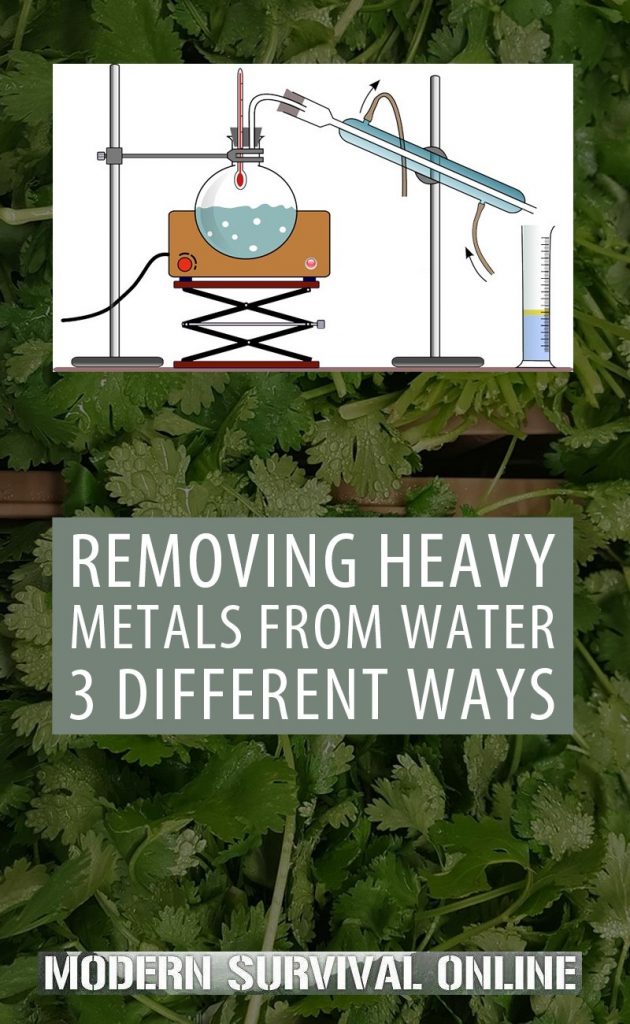
Instead of the arcane trickery of cilantro or the brute force filtration method of reverse osmosis, distillation makes physics our ally in removing the heavy metal from water, or rather, removing water from the heavy metals!
Distillation works by turning the water to steam, and evacuating it from a vessel leaving all the contaminants previously in it behind.
Distillation is common in industrial and laboratory settings where pure water is needed for controlled experiments and conditions.
You can definitely replicate these results at home with a very minimalist lab setup, but you don’t need any fancy equipment to pull off distillation in the field, either. All you have to do is boil water, catch the steam and allow it to condense.
The trick is keeping the water just at boiling temperature, as going too far beyond this may also vaporize any contaminants in the water, allowing them to travel with it as steam. This is not an issue for heavy metals, but could be for other chemical contamination. Keep that in mind.
At home or in the field, you might also make use of distiller appliances which can fit on a countertop. All you have to do with these contraptions is fill them with suspect water, turn them on and let them do their work.
They work well, even if they are a little bit slow. As with the cilantro method above, if you were dealing with murky or highly suspicious water you should pre-filter it first before running it through the distillation process.
Conclusion
Heavy metal buildup in your body is a serious threat, and the easiest way heavy metal gets into your body is ingestion through food and most especially water.
The typical water filtration and purification methods you have learned so far in your prepping journey will not be enough to deal with heavy metal.
You’ll need to rely on one of the several specialized methods described above if you want to be truly certain you’re getting all contaminants out of your water. You should understand and try all of them so that you can employ them in an emergency.
Dealing with a prolonged period of isolation can be tough, and it can be even tougher if you have a family to take care of. This is sort of the prepper stock-in-trade, as most of us will have layer upon layer of plan for dealing with every kind of emergency, setback and contingency.
But there is more to dealing with prolonged isolation than nipping problems in the bud. Sometimes the biggest challenge you might face is entertaining your family!
Keeping the doldrums at bay is important, both for morale and for family unity. Stress relief, recreation and relaxation will help keep both bodies and minds in tip-top shape. Everybody needs a certain amount of fun and engaging distraction no matter what is happening.
This certainly applies during a prolonged disaster scenario, but it could also arise from less threatening and scary circumstances, maybe just being snowed in in the winter time or living it up while social distancing to the nth degree.
No matter why you and your family or significant other are being forced to hole-up in self-imposed isolation, we have you covered with a list of 20 old-fashioned family activities that you can make use of almost anywhere, in almost any season and any situation.
Activities for Fun or Growth, but Why Not Both?
There seems to be something of a misconception regarding activity planning during periods when you are bugging-in, self-isolating, snowed in, out of touch or whatever, and that misconception is that downtime must somehow be centered around survival, skill improvement or some other prepping-centric activity.
It certainly can be, but this overlooks the crucial fact that recreation can be just fun for fun’s sake.
Mentally and physically letting off steam is an important objective in and of itself, both in high-stress situations (where possible) and in long-term but merely boring scenarios.
Especially when dealing with children, both the very young and the older alike seem to have a sense for when you are setting them up to do something educational under false pretenses. Verisimilitude is the name of the game.
If you can get someone genuinely interested in something on its own merits you’ll be killing two birds with one stone; you won’t be beating your family member over the head with something that they don’t really want to do and they will be learning something valuable at the same time, even if it is not a hard skillset.
Think back to your own childhood or early adulthood.
Remember helping out someone in the family with a task or chore that might have seemed like a bore or annoying at the time, but in the time between when you started and the time it ended it somehow transmogrified into quality time, and an event or outing that you cherish to this very day?
The activities you do with your family during this time can become those future cherished memories, or even ongoing and meaningful family traditions.
All periods of challenge are fertile soil for growth, and the situation you find yourself dealing with will be no different.
All of the activities presented on this list have the opportunity to bring your family closer together, teach your children important lessons or help you bond with your significant other.
Some of them will merely be hobbies, but others can have important benefits ranging from skill development to physical fitness.
All are valuable and worthwhile. You’ll also note that the activities on this list do not rely on modern technology, be it a television, a video game console, a computer or a smartphone.
In a situation where you do not have any electricity or internet service, these can still be your ace in the hole.
In a situation where you do still have both of those modern utilities you can use these as part of a “technology sabbatical” to help yourself and your family reconnect with simpler but richer pastimes.
Most of them can be done year-round in almost any climate. Give the list below a read-through and see if you can’t come up with a few favorites.
20 Old-Fashioned Family Activities
Board Games / Traditional Games
You know them, you love them, it’s time to stock up on a few of your family’s favorites and play them! Board games are a blast, and have certainly come back in a big way compared to recent years past.
No matter what your family demographics are, there is a board game out there or a similar tabletop game that everyone can enjoy.
No matter what kind of game you’re playing, board games represent a comprehensive sensory experience: Physical pieces on a board, the clatter of dice or chips, laughter, and some good-natured banter, or trash-talking.
No matter what kind of game you are playing, they’re always lessons to be learned, even if it is it sometimes that you just have to deal with a bad turn of the cards, or a bad roll of the dice.
More advanced games can teach advanced computational skills, vocabulary, arithmetic and several layers of strategy.
With everything to choose from like ancient games of chess and mahjong to modern, time-gobbling classics like Monopoly, Scrabble or Clue, you are sure to find a few that you can put in your rotation that your family will enjoy playing, and these can become traditions in their own right.
Beyond boardgames, games like Pictionary and Balderdash can teach improvisation and lateral thinking, aside from being a laugh a minute.
So long as you make sure that everybody gets a turn to pick the game they like most on game night this is sure to become a fixture at your household with your family.
Telling Stories
Telling stories, big ones and small ones, true ones and tall tales, should be an integral part of any family’s culture, and could even be an integral part of your day.
The sharing of mundane and incredibly grandiose stories is a great way to bond and build rapport with your family members and the verbal histories, legends and personal accounts of noteworthy events should make up a significant part of your family mythology.
You can make storytelling an event unto itself or integrated into another part of your daily rituals with your family. I personally like to tell stories when sitting down at the dinner table, short ones, at least.
You can make it a point that every family member tells a story about an observation or thought they had that day, or a positive memory.
Ultimately you can come up with a kind of theme for story time. Family members can talk about dreams they have, or used to have. They could even talk about regrets they still carry, and about things left undone.
You could make it an improvisational exercise, with each member of the family responsible for telling a part of a story before handing it off to the next person to build on while improvising. The sky’s the limit, use your imagination.
Even before we had the written word, we had oral tradition and it is high time to make it a part of the average American family culture again. A prolonged bout of isolation is the perfect time to do so.
Go for a Walk or Hike
Depending on how strictly you have to isolate or stay indoors, this may not be a viable activity, but assuming you can leave the house for any reason this is a great way to get some fresh air, get a new perspective on things, observe nature and get in some much-needed exercise.
Going for a walk or an easy hike requires almost no set up and no equipment beyond your own two feet although you would be wise to carry a small emergency daypack if setting out on a proper hike.
There’s something magical about traveling on foot with someone else, something that opens up the soul and the senses.
The things that you see around your town or around your region in nature will stir the spirit and chances are it will create plenty of new memories for years to come.
There’s also a very practical element that comes with walking or hiking, that being the improving of land navigation, orientation and observation skills.
Both are also extremely good for your health, helping you to lose weight, and having a major positive impact on your cardiovascular system.
You can definitely work your muscles if you choose to carry a heavier pack when you head out for your walk or hike.
If you’re the kind of prepper who has bug-out routes in mind when things get really bad, hiking them, or at least part of them, is a good way to get acquainted and get your family acquainted with the routes in case that gravest extreme does occur, and it’s time to grab your BOBs and hit the trail.
Cookout/Picnic
There is hardly anything better than enjoying a good meal outdoors with your family. It doesn’t matter if you fire up the grill to throw some burgers and veggies on a roaring hot fire, or go the cold supper route with a picnic basket full of sandwiches, fruit cocktail and pickled delights.
Enjoying a meal out in nature, even if nature is just the back porch or the backyard, is a joy and the novelty of it will go a long way towards beating off boredom and the doldrums.
You don’t need much to have a good cookout for picnic, and if you were going the former route and lack a grill, it is an easy thing to build a primitive grill or fire pit in short order for cooking over either charcoal or wood.
If you decide you want to use pre-cooked or ready-to-eat food instead, all you need is a way to carry the food, a ground covering to keep yourselves and your food tidy and dirt free, and some utensils.
Whatever you decide, don’t make it a major production: a simple meal well-executed and enjoyable will work wonders for morale.
But you can get the family more involved if you are typically the chef or grill master by assigning them tasks to help you with preparation or place settings, or in the case of a picnic searching out the ideal spot with the best view that will be the most comfortable.
Gathering Around the Fire
Indoors or out, adults and children alike will attest to the wonder and the magic contained in a crackling roaring fire.
In a fireplace, an outdoor fire pit or built as a simple campfire, mankind’s relationship with flame is both ancient and primordial, and simply enjoying each other’s company around the fire is often entertainment and comfort enough.
Even on a sweltering summer night in the south there is just something about a fire that will entrance the viewers.
Of course you can always spice up a fireside gathering with such time-honored activities as roasting marshmallows or making s’mores, telling stories (especially ghost stories), singing or playing an instrument. There is almost nothing that a fire won’t make better.
Naturally, as a prepper you should never pass on the opportunity to teach basic survival skills to your family.
Especially for the kids, building and tending a fire is a fundamental skill that will serve them well for their entire lives.
So as long as they are old enough to mind what you say, and understand what you are teaching them don’t build the fire and then call the family to gather round, get them involved so they too can become keepers of the flame!
Pass on a Hobby or Skill
Being home for an extended time with your family is the perfect opportunity to start laying the groundwork, and passing on a cherished hobby or skill to the next generation.
Obviously, as preppers we probably have a hundred and one skills that we are convinced our family members need to bone up on for their own good, everything from outdoor survival to water purification and improvised medicine.
This is certainly a good idea, but don’t neglect the value of passing on just a simple hobby, or a hobby that is both useful real-world skill and enriching pastime.
For instance, hunting is an excellent skill for survival purposes, and also a rewarding recreational activity in its own right.
You might not be able to get your kids or significant other out into the woods depending on the situation, but you can start passing on other skills related to hunting, like tracking, camouflage, and even the fundamentals of marksmanship with a gun or a bow.
Even tinkering on a car which many people do for fun is certainly a skill worth cultivating, since it makes you more capable, more independent, and will save you money on maintenance and repairs.
If you want to go strictly for a hobby route you might introduce your family members do whatever you are into so long as they can stand it and show even a little bit of Interest.
My grandfather got me into model-making when I was very small. It never took root with me when I was younger, but boy have I cherished those memories, and in just the past few years it seems like the call took me all at once and I gained an all-new appreciation for what he showed me way back then since undertaking builds of my own.
Catch
Sometimes it is the simplest things that can be the most rewarding. One of the simplest games that two or more people can play is catch. Any ball you want, no rules just catch and throw.
There has hardly ever been a more time honored activity shared between father and son, but you can certainly get the entire family in on this one.
There’s something satisfying about catching a ball and then throwing it back with accuracy to the intended recipient. Nothing more, nothing less.
But aside from just being one of the simplest games there is, playing ball improves reflexes, sharpens hand-eye coordination and it’s good exercise when done for a modest amount of time.
Not for nothing, the ability to throw something with accuracy will enable you to either hit a target or pass an item to someone else with speed in a pinch. Even the simple stuff has value when you have your eye on the bigger picture.
Don’t be afraid to incorporate some challenge into the event, either.
Incorporating movement, even quick reactionary movement, adds a little bit of excitement and drama to what is otherwise a completely mundane game, and will definitely get the heart pumping and the blood moving.
Birding / Wildlife Watching
Way, way before there was ever Pokémon Go, there was bird watching, and some people would spend most of a lifetime trying to track down that last one or two elusive species in their region for their scrapbook.
Besides watching for birds of all kinds, you can also look for other wildlife in your area even if it is just in your backyard. Everything from mammals to reptiles and even insect life exist everywhere in a fascinating amount of variety.
This is a great, close-to-home way to simulate the hunt, and you can get the whole family involved keeping their eyes peeled for particularly elusive or difficult to catch specimens.
Beyond alertness and observational skills, the more information you can learn about your quarry the easier time you will have adding a “trophy” to your tally.
You can improve the enjoyment factor by breaking out the encyclopedia or firing up the internet and learning everything you can about your subject critter’s behavior, from its activity, calls or other noises it makes, to what it eats and what eats it.
This is a painless way to get your family on track to reconnecting with nature, and with the greater world around them. You don’t even have to go outside to watch for birds or other wildlife if you don’t want to.
A comfy chair, some tea or coffee, and an alert mind are all that is needed, and this is an activity that millions and millions of people around the world enjoy every single day no matter the circumstances.
Make a Time Capsule
Talk about a blast from the past! Putting together a family time capsule, especially if you bury it to be dug up at a later date, is a strangely intriguing activity that the whole family can get on board with.
You can fill it with all kinds of things; things relevant to the current situation, the current year, what is in style or hopelessly out of fashion, current events, messages, notes, fears, hopes, dreams and everything in between.
Make sure to include a good photo of the family so you can compare it to yourselves later on down the line! One particularly insightful thing that you might get each family member to include is a message to their future selves.
If you’re going to bury your time capsule, make sure the container is super heavy-duty, completely waterproof, and just to be sure to take care and waterproof the contents with vacuum or zipper bags on the inside.
You might even want to place the primary time capsule inside another container just to be on the safe side.
Next, pick a spot on your property to bury it and either make it or make sure it is next to an immovable landmark. If you aren’t going to bury it, seal the box, then pack it away and forget about it.
Make sure you and your family all decide and agree on a date in the future when you will dig it up. This could be as short as five years or as long as thirty years, or even longer! Just make sure you don’t forget it and move off without it if you aren’t staying in your forever home!
Hide-and-Seek
The undisputed champion of childhood games and one that adults can still enjoy to this very day. Hide-and-seek is a terrific game that can teach some pretty serious survival skills.
Stealth, strategy, knowing your foe or your quarry, bluffing and more all come into play if you want to be a successful Seeker or Hider.
There is no reason the entire family can’t get involved and have a good time with this one. Even if you are playing with small children, adults can pull their punches a little bit so the kids can have a good time and I promise everyone will still be rolling in laughter by the end.
Hide and seek works best over a larger area that affords more opportunities for stealthy movement, and for creative hiding spots.
But if you don’t have a whole lot of good hiding spots in your area you can spice things up by putting a capture the flag twist on this classic game…
After the Hiders have run off to hide and the Seeker completes their countdown, then the Hiders cover their eyes while the Seeker places several flags around the play area, one specific for each player.
The hiders then have to capture their flag before they get to home base. Trust me, this makes for some pretty intense games!
No matter what, stick to the rules, stick inside the agreed-upon hiding area and absolutely no peeking!
Waterballoon/Snowball Fight
Some disagreements are best settled in the old ways, and there is no better way for the family to get out some good-natured aggression than a snowball or water balloon fight depending on the weather in your locale.
So long as nobody gets hurt and no one is playing for keeps, this is a great way to get some exercise, work on your fighting spirit and your throwing arm!
Far and away the best way to conduct this activity is to preload all your ammunition, filling up the same amount of water balloons per side or taking the time to construct nicely packed and not too hard snowballs to be cashed and retrieved as the fight rages on.
A couple interesting twists you can put on either one of these festive fights is to make it a “tale of two forts” type bombardment duel from fixed locations or to make it a wild melee with each player only getting so many snowballs or water balloons and being tasked with being the last one alive on their team or on the field.
This is arguably one of those activities that requires the most from the participants, physically, but if you have some real little ones in the household you can make this a family team event versus some standing targets.
Reading / Book Night
This is far and away my favorite family pastime on the list, and everyone in my family is a voracious reader of all kinds of books. Assuming you have some bookworms in your family, this should be a shoo-in.
You can organize this as a quiet evening together, with everyone perched on their favorite piece of furniture, comfortable and cozy with their favorite beverage and snacks, reading whatever has their interest at the moment…
Or make it more like a book club type of activity with the person who has picked the book either reading aloud from it or sharing what they are enjoying most about what they are currently reading; the characters, the plot, the writing, etc.
The benefits of learning to read well and quickly as well as understand and digest a variety of topics from fiction to non-nonfiction, academic works to technical manuals cannot be understated, as is the ability to read aloud well and speak compellingly and entertainingly.
If you have someone in the family who is just not into reading on their own or reading aloud, you can still include them by asking them to listen to whoever is reading aloud and ask good questions; being a good listener is just as important as being a good reader!
So long as there is not too wide of a gap between the audience and whoever is doing the reading, making it the book club type of activity is a great option, but if whatever is on the schedule for the weekly or monthly club night is a bit too over the heads of younger readers, don’t be afraid to let everyone read their own thing.
Cooking
Cooking is definitely one of those activities taken for granted, and it’s certainly a rewarding and liberating skill to learn if you don’t know how, as well as one that pays dividends immediately as you improve.
If you have family members that are hopeless in the kitchen, start including them in meal prep.
Everybody started somewhere, and enlisting an older child to cut the crusts off their younger sibling’s sandwich is certainly not beneath their station.
Pretty soon they will be boiling water and then the next thing you know preparing a Michelin-quality three-course meal.
Aside from being a family tradition and part of a family’s mythology with recipes, traditional dishes and so forth, you can definitely make it more interesting by challenging each other to prepare new dishes in various styles.
You could try regional cuisine from your own country or items from a global menu and various other cultures. So long as you can get the ingredients you need or have them on hand this is an easy way to get in some quality time and build skills with your family.
There are many directions you can take cooking also, since you don’t have to confine yourself to the kitchen, and you can make things a lot more challenging by getting them to help you on the grill or, even better, over an open fire.
This is another skill that definitely has some survival positive connotations.
Create Art
Excepting a very few artistic families, the creation of art is a chronically underutilized method of expression and hobby, especially in America.
You don’t have to be an especially good artist in any particular medium to enjoy and get satisfaction from creating art, and the best thing about it is that you can approach it and almost any way you want!
From the sublime simplicity of working with pencils and sketching to intricate oil painting or sculpting with clay, truly the only limit is the bounds of your imagination.
Art is one of those things that for many people is enjoyable out of all proportion with the finished result. It is the creative process, the impulses and emotions that are generated by and generate the art itself that make the journey worthwhile.
Creation is fundamentally a part of the human spirit, and exercising it on a personal piece of art, either in a sublime rendering or an impressionist interpretation is a great stress reliever.
Once again, art has some surprisingly practical applications. A good artist can handily sketch a landscape, a person or a route on a map.
Those of a more practical mindset can use their artistic skills to create blueprints and draft drawings. So make it a point to get the family together, grab whatever you can use to create with, and let your artistic side run wild.
Grow Herbs
For many aspiring gardeners, starting out with an indoor or outdoor herb patch is a fulfilling and far simpler undertaking then plowing and tending to your very own full size garden.
Gardening is an awful lot of work, but you can get much of the satisfaction and quite a few of the benefits while learning about tending to living plants by growing tasty, even medicinal herbs.
Compared to a larger fruits and vegetables which require more room and significantly more time and care, many herbs are far hardier plants that are more forgiving of mistakes and the environment they are in.
Even better, you can use your herbs much sooner than fruits or veggies since they mature faster and are ready to pick and go into dishes or medicinal poultices in no time flat.
Even if you live in a colder environment, chances are there are several species of herb you can grow indoors using nothing more than the sunlight coming through the window.
A couple of small pots or containers, a handful of seeds and in no time flat you will have delicious, useful herbs sprouting. They also smell great, and will help freshen your home!
Jigsaw Puzzles
Love them or hate them, putting together a jigsaw puzzle is certainly an engaging way to get in more quality time with your family members. All you need is a puzzle, a flat surface, patience and perseverance.
The sublimely rewarding feeling of watching a puzzle go together, especially as it accelerates near the end is a strange kind of rush that dedicated puzzlers struggle to explain to those not in the know.
Many high-quality puzzles present highly attractive photographs or artwork when they are finished, and are suitable for framing as a small monument to the family working together to accomplish something.
Young and old alike can participate in assembling a puzzle and this makes it great for multi-generational families, and so long as you don’t go out of your way to get one of the mind-numbingly difficult ones that are almost impossible to put together in a timely fashion, you’re all bound to have a good time.
The best part is, you can start and stop working on a puzzle whenever you want. If all you have is 5 or 10 minutes to spare, or you need a break from some other tasks, you can sit down and work on the puzzle a little bit by yourself or with someone else.
Riddles
Riddling is a time-honored activity that dates back hundreds and hundreds of years. Very few people know more than one or two good riddles these days and it is high past time that we bring back the practice.
Telling and more importantly solving a good riddle will definitely give your brain a workout and forces you to think in unconventional ways to solve a problem, definitely good practice for the trials and challenges you might face as a prepping family!
It is not entirely necessary to learn a bunch of riddles by heart to take part in this activity.
Entire books or documents worth of riddles are available for very little money or even for free, and you can set up a riddling night for the family with people take turns reading, one by one, riddles that the rest of the family or the person of their choosing has to solve.
But, in order for this to be a fair contest, you must make sure the book of riddles is kept under strict security, and no more mischievous members of the family go rifling through it to learn answers ahead of time and so get an unfair advantage.
You can definitely add some pressure to the proceedings by making a wager between the two competing parties for every riddle.
Something like chore duty, or other menial tasks are perfect. If the riddler can stump the answerer, the failed answerer must complete the agreed upon task for the riddler, and vice versa.
Scavenger Hunt
There is hardly anything more fun than solving a good mystery and that goes double for scavenger hunts, especially for kids.
Scavenger hunts are also a lot of fun for the people that are hiding the goods, since they must come up with a good hiding spot that is still accessible and leave a trail of compelling, challenging clues to help the hunters find the stash.
The prize at the end of the trail can take the form of almost anything, candy and small toys are great for children, with love notes or other trinkets being appropriate for adults.
The point is people have to get their brains in gear and follow the trail or the treasure map and all of their clues to correctly deduce the final resting place of the stash.
This is another one of those activities that seems to be fundamentally enjoyable for the entire family, and can also be used as a dry run for finding various hidden prepper caches that you might place for future contingency use.
Working Out
The family that works out together gets through it together! Building a culture of fitness among your family is not only a great way to keep everybody healthy and happy, but also the single most important thing you can do to disaster-proof them.
Fitter people are harder to kill in all kinds of conditions and from all kinds of potential causes. The end. It is never too early to get your family on board with a group workout program.
You don’t have to make every workout a back-breaking strongman competition or a grueling endurance exercise. You can do some simple calisthenics, light weight lifting and other athletic events to build muscle and endurance while shedding fat.
Not for nothing exercise is also one of the single most important things you can do for improving mood and state of mind, and it is an imperative that people take it upon themselves to stay moving, especially when they are forced to be cooped up.
You don’t even need any gym equipment. Knowing the right exercises is enough since your body will provide both of the weight and the resistance. Get the whole family together at least a couple of times a week for a family workout, and you will reap the benefits and no time.
Give Thanks
This might sound a bit sentimental to those of you who only take the time to participate in this activity on Thanksgiving, but gathering the family round to give thanks, one at a time or together…
… for everything that you have, everything that you have had, and everything that you will have is an extremely comforting thing to do in any situation, but especially when times are a little tough.
Time spent getting your mind right and focusing on the things that matter the most is never wasted. You can make this activity as simple, or as elaborate as you want.
I know some people like to go on and on until they have exhausted every blessing and every gratitude big or small.
Some people like to say what they’re most thankful for that day. Whether or not you are religious makes no difference, we should all strive to be more grateful for what we have.
Instilling a culture of gratitude and making it an active, present part of your family life is one of the most important things you can do.
Conclusion
A period of isolation with the family, even a prolonged one, is not a reason to give up on recreational activities that you can use to relieve stress, strengthen bonds and create positive memories in the midst of what seems so hard to cope with, terrible or unexplainable.
You can use any one or all of the old-fashioned family activities above to enjoy the time you are given with your loved ones while developing important character traits and skills!
With the easy and cheap availability of parts by Internet mail order, it’s easy to forget that acquiring electronic components was once a more tedious process, and it was common to use salvaged parts because they were what you had. Scouring a panel from a dumpster-find TV for the right resistor may now be a thing of the past, but it’s not entirely dead. [Ryan Flowers] was lucky enough to score a box of old CB radios at a garage sale, and takes us through a teardown in search of parts he can use to make a QRP amateur radio rig. Delving into aged electronics is right up our street!
An IF amplifier was high-tech back in ’75.
A possibility for a 27 MHz CB rig is to convert it to the neighbouring 10 m amateur band, but since these were all AM rigs, a mode that sees very little amateur use, it was better to part them out. It’s an interesting study in the evolution of radio design, as an entirely analogue design of mostly discrete components is revealed.
Careful inspection of the photographs reveals a Fairchild uA703 5-transistor IF amplifier chip in a metal can, but that’s about as high-tech as it gets. Unexpectedly there is a huge bank of crystals rather than the frequency synthesiser that would have been standard only a few years later.
He comes away with the chassis, switches and pots, and the RF inductors and crystals from the PCB. Those miniature Toko inductors used to be a common sight, but are now something of a rarity. If you fancy a wallow in semiconductors from this era we’ve previously taken a look at the vintage Fairchild catalogue, in which the uA703 is on page 398.
We’ve seen no shortage of projects that use the ESP8266 or ESP32 to add “smart” features to existing home appliances, often by pairing the microcontroller with a radio or IR transmitter. If your device has an existing remote, integrating it into a custom home automation system is often just a matter of getting a few cheap modular components and writing some simple code to glue it all together.
But what if the appliance you want to control doesn’t use a common frequency? That’s a question that [eigma] recently had to answer after finding the remote control for the bedroom ceiling fan was operating at a somewhat unusual 304 MHz. Something like the MAX1472 could probably have been tuned to this frequency, but the chip doesn’t seem to be available in a turn-key module as the popular 315 MHz transmitters are.
There were a few possible options, including using a software defined radio (SDR), but [eigma] didn’t want to spend a fortune on this project or wait months for parts to get shipped from overseas. The most straightforward solution was to design a custom transmitter tuned to the proper frequency using discrete components; something of a dark art to those of us who’ve been spoiled by the high availability of modular components.
What follows is an fascinating look at the design, testing, and troubleshooting of a truly scratch-built transmitter. You won’t find any ICs here, the carrier signal is generated with just a transistor, some carefully measured pieces of wire, and a handful of passive components. By modulating the signal with an ESP32, [eigma] successfully makes the oddball ceiling fan an honorary member of the Internet of Things.
For sheer terror, there are few emergencies that will be closer to home and statistically more likely to occur for the average prepper than a home invasion.
Home invasions may not have the region-wasting punch of a major natural disaster or some other exotic event, but I can guarantee you they will be more than disastrous enough for you and your family. There’s precious little time to react during a home invasion situation and absolutely no room for error.
Successfully preparing for and defending against a home invasion involves a lot more than having a gun and a flashlight on the nightstand ready to investigate some bump in the night.
A comprehensive, holistic home invasion plan will wrap your home in layers of security like an onion: you want to dissuade, slow down and hopefully stop the bad guys from getting in in the first place.
If you can’t stop them at least funnel them into an area where you can engage them on your terms.
There’s a lot to learn about home invasions in order to craft a good plan. You’ll need to know about interior and exterior defensive strategies, criminal behavior and psychology, and know how to handle yourself in a fight.
And you need to do it all while your family is in the home with you. It won’t be easy, but today we are presenting you with a guide to arm you with the right stuff for surviving the terror and chaos of a home invasion.
Home Invasion Facts, Figures and Statistics
A home invasion is one of those crimes that most people, whether they would admit it publicly or not, think will never happen in their neighborhood.
At least, people that don’t live in high-crime areas think it will never happen to them.
I hate to say it, but the chances are increasing all the time that they may be wrong. Possibly dead wrong.
A home invasion is defined as a criminal entry of a dwelling while the occupants and/or owners of the dwelling are present. This is different from a cat-burglary which occurs when the structure is unoccupied.
We are fortunate that overall crime and violence is going down, but regrettably home invasion is one category of crime that is becoming more popular over time. Some more facts about home invasions in America:
Compared to conventional burglary, the rates at which home invasions occur are growing.
Home invasions are not solo acts; you will encounter multiple home invaders as a rule, and they typically number between 2 and 5.
Your average home invader will be armed with a knife or a gun. Weapons of opportunity, i.e. tools and other implements that may be used as weapons found on site, are used in nearly half of all home invasions.
Most assailants invading your home will use force to get in, kicking in a door, or forcing a window. Unbelievably, over 30% of home invaders will enter through an unlocked door or window.
Most home invasions occur in hours of darkness.
Homeowners are victimized regularly during a home invasion. More than one in four home invasions sees the occupants of the home wounded by the assailants.
It cannot be overstated how shocking, how fast and how violent a home invasion is. You must be prepared.
And the first step in preparing for a home invasion is understanding the mindset, the tactics and the objective of the criminal scumbags who will be kicking in your front door.
Know the Enemy: Criminal Tactics and Objectives
The prospect of facing a home invasion strikes a nerve with many preppers and with good reason. The notion that you could be so brazenly attacked in your very own home by a posse of criminal scumbags is a bitter prospect.
And unlike most self-defense scenarios that people typically practice, there will be the added pressure to perform with an environment full of the people that are most precious to us.
If you are unfortunate enough to be one of those one million-plus homes that are invaded every year you or your loved ones will then have about a 25% chance of being violently assaulted by the criminals. Ponder that…
We are not going to let that happen to you, though. Unlike the naive, shiftless and cowed masses you are ready, willing and able to do something about.
Your first prerogative is to know when you are most vulnerable. Statistically, most home invasions will occur after sundown with the vast majority taking place between 9 p.m. and 3 a.m.
Compare and contrast that with your typical burglary. Most of those take place in broad daylight. Does that seem strange to you? It shouldn’t; the burglars are counting on the occupants to be gone when they break in, meaning at work, at school or elsewhere.
Home invaders are just the opposite; they are counting on the occupants to be home and they use maximum speed and violence to intercept and then corral them before they can mount an effective resistance or call for help.
That being said, you are never safe, not entirely, from a home invasion and they can and do occur and hours of broad daylight.
The next vital piece of the home invasion puzzle you’ll have to put together is understanding why your house was chosen among all the other houses on your street, in your neighborhood and in your town.
Most criminals do this stuff for a living; many of them are not stupid, and there is a reasoned calculus to their decision-making process.
Typical indicators that home invaders look for when choosing a target house are things like poor lighting, line of sight blocking obstructions between neighboring houses and the target house, signs of inactivity, easy routes of ingress and egress, and so on.
There is far more to the average home invader’s selection process than a simple checklist, however, it will definitely help you to understand how they make their decisions.
Once you start to get inside the criminals’ decision-making process, you can then reverse-engineer defenses and countermeasures for your house and property that will hopefully keep them from considering it at all.
Your typical criminal will plan and execute a home invasion or other crime in six steps, listed below.
Intelligence Gathering
Before they do anything, your average criminal looking to make a score has to take in some information that will direct them to where the loot, or the easy mark, is.
It could be something as innocuous as a social media post revealing that you will be home alone while the rest of the family is out of state at a competition.
It might be the conspicuous pile of valuable electronics boxes you set out for the trash pickup. It might just be a property configured just so that makes them feel really safe breaking in.
Criminals will usually gather intelligence on potential targets, read that as victims, until they have enough to choose from.
Victim Selection
After sorting, sifting and comparing all of their gathered intel, our criminal element will compose a list of potential targets worth their time. Here there are many variables.
The skill, ambition, habits and preferences of the criminal are all factored into this decision-making process and they may filter and sort potential victims for days, months or even longer.
Some may choose a victim within seconds after minimal intelligence gathering. You could get sighted today and robbed tonight in some cases.
Observation
Believe it or not most criminals don’t blunder straight into a crime. They will surveil and closely watch the selected victim to gather even more information.
They will look for habits, vulnerabilities and size you up to try and determine if you will fight, run or just give up. Observation will likely continue right up until the point of the attack and all the way through the next phase, planning.
Planning the Deed
The planning phase may occur concurrently with the observation phase, and both could be concluded in as little as a few seconds.
No matter how much time or how little the criminal takes in the planning phase, they will begin to figure out the best way to get close to your house unobserved, make entry to the house and hopefully find you and overpower you so they can get to work extracting a toll from you and in either treasure or blood, or both.
Movement to Victim
Once the planning is wrapped up, the bad guys will move. It is on the approach to the target that the victim has the best possible chance to catalyze the attack, and either repel the attacker or get them to break off.
Defensive measures that will slow, halt or confuse the attacker work best while they’re in this phase. Anything that costs them time or injects uncertainty into their decision-making process increases the likelihood that they will break off.
Contact and Attack
It is now that the criminals actually break into your home, if they are not stopped. Keep in mind that the bad guy always gets to choose the duration of the attack unless you stop him!
If he has no incentive to halt his attack he will keep going until he has achieved his objective.
Break Contact and Escape
No matter if the criminals succeeded or not they will move to escape and do so, hopefully, without getting shot, shanked or beaten up.
Of special importance to your average criminal is the desire to escape without attracting any attention from potential witnesses or being pursued by police.
Here is a small homework assignment for you before we move on to the next section.
Glancing over the above steps in the criminal’s decision making process, at what point in that process do you think you would have the best chances to stop him from victimizing you and picking your house?
The answer is during the intelligence-gathering or victim selection phase. If there is ever a chance to avoid being victimized, to avoid a fight, you must take it.
No matter how good you are, no matter how skilled, no matter how heavily-armed there’s always a chance that the fight can go against you, and that may see you or your loved ones be grievously wounded or killed during a home invasion.
In the following sections we will move on to the practical elements of getting ready to defend against a home invasion, including making your home a hard target and preparing yourself to deal with the difficult task of repelling invaders.
Protect Your Home From the Outside In
Defending your home from a home invasion is a full-time gig, but luckily there are some techniques and procedures you can employ it will be on duty 24/7 without you lifting a finger once you have implemented them.
I’m specifically talking about hardening your home via some choice upgrades, careful landscape revisions and, potentially, the installation of some new vegetation.
You’re not going to have to build an 8-foot wall topped with broken glass bottles around your home to protect it. You won’t even necessarily have to put in a fence.
All you’re going to do is alter view landscape features, upgrade some door and window hardware there and before you know it criminals will take one short glance at your home before saying ‘nah’ and moving on to what is potentially on easier score.
If the criminals skip your house for someone else’s, that is a win right out of the gate.
There are four areas of consideration on your property that will need your attention:
Curtilage
Home Exterior
Home Entry Points
Home Interior
Before you do anything, take the time to go outside and stand in front of your house. Now look at it, observe it as if you were the bad guy.
If you were the bad guy, where is the safest approach to get close to this house and hopefully get into it without being seen by the occupants or someone else? This is called a clue.
Now repeat this exercise from various angles, up and down the street and even potentially from your property line with your neighbors.
Carefully assess everything you can see. Look at all the windows, look at all the doors. Which one looks most likely to let you in easily? Are there any nearby tall trees they could be climbed to reach a second-story window?
Repeat this exercise from the backyard. Is a concealed approach to a big, juicy, easy-to-break sliding glass door available from the rear of the house?
If you are like most homeowners, no matter what kind of home you have and no matter where you live if you take this exercise seriously you will see plenty of ways to get inside the house.
That’s okay; we are going to take what you have gleaned from your observations and implement that into a troubleshooting plan to eliminate those shortcuts and “easy ins”.
Curtilage
Curtilage is just a fancy word for the grounds of your house that are part of your property. Your curtilage extends from the exterior of your house all the way to the sidewalk, the road or the property line depending on what borders your property on that side.
Consider the curtilage to be the sort of outer perimeter for your house.
Assess your curtilage by looking at the terrain features inside it. Look at the rocks, the shrubs, the trees. Look at any large decorative features like fountains, rock gardens and the like.
Do you have any large children’s playground equipment they could offer concealment for someone? How about a shed or outbuilding?
Of particular importance is your perimeter is fencing. People love privacy fencing because it makes for good neighbors, and good neighbors are nice but being safe from home invasion is better and fences make your home more likely to be targeted for home invasion.
Why? As soon as the criminals cross the line of your fencing on approach to your house they get more concealment on your property. If your neighbors can’t see what you are doing, they cannot see any scumbags sneaking up on the back door.
Also, don’t assume that a fence is a real deterrent to illegal trespass or entry on your property: the vast majority of privacy fences are way too short to be anything but a mild inconvenience.
Yes, you could crown the fence with barbed or razor wire and in a SHTF emergency to shore up the old home protection factor a little bit, but doing this in normal times is not going to make you any friends.
Dense, surrounding privacy hedges works similarly to fences but are practically even worse from a defensive standpoint. Hedges will block line of sight on your property, but are easily crossed compare defenses.
If you are fortunate, or unfortunate enough to have a wall around your property, you can take comfort knowing that they do afford you a little bit of ballistic protection from gunfire and may stop vehicles cold, but they have all the other vulnerabilities and shortcomings of fences and hedges.
Make it a point to trim back all plants and hedges that could afford bad guys a hiding place or a concealed approach to your house.
Make sure you do one more assessment of your curtilage at night. Assess the lighting.
Any predator wants to work in the dark if they have the choice, and that includes home invaders. Ideally, we went to deny them the use of the darkness by installing bright security lighting.
But you must be cautious: light that is placed or aimed carelessly can create even deeper, inky pools of shadow that can completely conceal someone.
A combination of bright spot and flood security lighting combined with softer wide-angle landscape lighting can keep your yard attractively lit, and also make it hell for home invaders to sneak through.
Home Exterior
It is the rare homeowner who does not want some attractive plants to enhance the beauty and value of their property.
Many preppers will surely want the same thing, but preppers will also want their plants to serve double-duty as defensive countermeasures to a home invasion.
No matter where you live, no matter what the environment or the weather, there is some variety of plant that will grow there that will feature thorns, spines or some other ripping, snagging and tearing organic apparatus.
You can cultivate these plants beneath your windows, and potentially on either side of exterior doors leading into your home. This will certainly disincentivize home invaders from attempting to enter via the window, or lurking in ambush near a door.
Even if the spines themselves are not vicious enough to completely deter someone from moving over them, many of these plants will often raise enough racket to help give you a little bit of early warning if someone is trying to traverse them.
No matter which ones you choose, make sure they grow tall and wide enough they cannot be easily bypassed.
You have two choices when it comes to planting these prickly defensive plants: you can grow them from small, potted cultivars, or transplant mature plants. The latter is risky as it stresses the plants significantly, and might kill them.
The former is much easier, safer and less expensive, but you need to get a jump on that as soon as you can since plants take time to grow.
No matter which option you choose, give your defensive flora the care and feeding it deserves so it will stay healthy and keep on defending your castle for as long as they live.
Another option worth considering is the installation of security cameras on the outside of your house. The ability to remotely check the exterior of your home and additional parts of your property is surely handy and can increase your safety.
But this is a double-edged sword: the visible presence of security cameras may tip-off potential home Invaders that you are protecting something valuable inside.
The counter to this, of course, is to install cameras that have very little or no physical footprint. You should carefully consider the cost-benefit ratio of security cameras before committing to a system.
Home Entry Points
No matter how fastidiously you prep the grounds of your property in order to dissuade home invaders there is a chance your number will just come up. Maybe they have decided your house is worth the risk. Maybe there’s someone personally known to you that has a grudge.
Whatever the reason, the attackers have decided that they are coming on and are now going to attempt entry into your home.
The next phase of home fortification involves the entry portals into your home itself. I said portal in this case, not just doors, because we must consider every possible way into the home.
Windows, doors, exterior attic access, everything. Hardening these entryways will go a long way towards keeping the bad guys out or at least held at bay until you can mount an effective defense.
I mentioned it up above and I’m going to say it again here: roughly a third of home invasions begin with the invaders entering through an unlocked door or window!
Don’t be one of these poor, unfortunate homeowners! Keep all doors and windows closed and locked at all times.
If a window must be open for ventilation, make sure it can lock in the partially open position so it will at least slow someone down or force them to break it if they want to get in.
The most common way that home invaders will break in is simply kicking an exterior door right off its hinges or busting a sliding glass door or large bay window. We protect and fortify doors and windows in slightly different ways.
Let’s start with the physical makeup of the doors themselves. Absolutely every exterior door that could yield access into your home must be made from solid core hardwood or metal, no exceptions.
But the sturdiest door does no good if it is mounted with cheap, flimsy screws and other hardware. You might be surprised to know that it is the screw set itself, not the door proper, which absorbs most of the force when a door is rammed or kicked.
If you cannot afford to upgrade the doors themselves with thick, sturdy versions, at the very minimum you should upgrade all the hinges, all the locksets, and the screws themselves.
Adding additional hinges will increase the strength of the door as a system.
Just as important, actually more important, is upgrading screws to high-grade fasteners which go into the door frame at least 6 in. long and preferably more.
Stronger, longer screws likewise mean more strength is needed to breach the door, and will buy you time. If you are lucky, your home invaders may give up after a few failed kicks.
One of the best and lowest profile options for preventing a door Ram or kick is the cleverly named anti-kick device, typified and made famous by a company called Door Devil.
An anti-kick device is a low profile frame that will install between the edges of the door itself and the door jamb.
When activated, the metal framing of the anti-kick device transfers all of the shock and force into the structural frame of the door and surrounding wall, not the vulnerable screws or lockset.
They are very affordable and easily DIY installed on most doors. Definitely look into these for all exterior doors!
Now we move on to windows. Windows are somewhat harder to fortify compared to doors because of their vulnerable nature. They are made of glass, after all!
If you live in an older home with worn-out, drafty windows you should consider having them replaced with modern ones if at all possible.
This will obviously take time, and not an insignificant amount of money, but replacing windows is actually pretty simple and can be done yourself if you are reasonably handy. That can help keep costs down.
Window bars and security gates or shutters other good options, but almost always conspicuous in the way the security cameras are conspicuous. It might tip-off potential home invaders that your house is worth invading.
Also, bars and shutters that are not quick releasable are a major liability in case you need to evacuate the house rapidly through the window, say in case of fire.
A clever, low-profile option for fortifying a window is the application of a protective or ballistic-grade window film.
Mylar is one common application among several others, and is commonly encountered on homes near coastlines or in the Great Plains since they will make windows resistant or even partially invulnerable to airborne debris blown by powerful winds from hurricanes and tornadoes.
Thicker, stronger varieties of these window films can even afford you some protection against bullets, blunt impacts from tools and even cutting forces.
As with doors above, you must always, always keep windows locked and preferably shut.
Home Interior
The most obvious defensive upgrade for the interior of the home is an alarm system.
Do-it-yourself installed or traditional monitored systems can alert you when anyone busts a window or a door, and monitored systems can even summon help if you are too busy to get on the phone and call the cavalry yourself, say because you are repelling four masked bad guys with your trusty shotgun.
Alarm systems with a loud klaxon or siren also have a psychological effect on most criminals. Once the alarm starts howling, they know the clock is truly ticking and that reinforcements will likely be on their way.
No matter which alarm system you choose you must make sure every single door and window that could be a potential entry point into your house is rigged with a sensor that will activate the alarm whenever tampered with.
Ensure that your alarm system is more sensitive, not less, and not particularly forgiving of wrong key codes being entered.
You don’t want a 15 or 20 second warning countdown before the alarm actually goes off. Set that thing to 5 seconds, tops.
You also might consider an ancient primitive alarm system, or as most preppers know them, dogs!
You can get a big dog, or a small dog, it doesn’t really matter so long as the dog goes completely ballistic whenever it detects anything near or around the house.
The keen senses of canines far exceed the puny ones of humans, and so long as your dog is alert and sounding off when it detects something, you can be assured that your faithful pooch will hear the bad guys coming along before you do.
Larger dogs have additional advantages. Big dogs can deliver powerful bites, and many people are instinctively terrified of an aggressive dog.
Note that you must not delude yourself into thinking your faithful canine friend will go to attack mode just because he perceives someone in the home or threatening the family.
Yes, many dogs will but just as many will either do nothing except bark, or run away to save their own skins. If you are serious about using a dog in a truly defensive role, you will need to embark on protection training for you and the dog.
Oh, and one more thing about the alarm systems, if you choose to install one of the now popular over-the-counter wireless camera and alarm system combos you should keep in mind that the criminals of today are not the criminals of yesteryear.
They are increasingly technologically savvy and the installation of one of these systems means you’ll need to now become versed in and apply home network security procedures and other information system defenses to prevent your system from being breached remotely, turned against you or just disarmed.
Repel Boarders!
Dealing with attackers inside your own home has a lot in common with dealing with them out in a public space, but also has some important differences. Let’s get into them.
First, the most obvious restriction: If you live at home with your family or just loved ones, in all probability simply trying to escape your own home and flee from home invaders will not be an option.
Chances are you will not be able to round up everybody inside and ensure they get out with you in time.
During a real home invasion, you must keep in mind that your attackers are trying to find you in your master bedroom, likely, as quickly as possible in order to overwhelm and subdue you.
They won’t be creeping around looking in the silverware drawer in your kitchen affording you the time to tiptoe across the hall, upstairs, back downstairs and then out.
This means you will have to make a stand and fight. If you are lucky, or just very good, you might be able to consolidate everybody in one room or one wing of the house, and then lock it down with lethal cover with no ensuing fight.
But the chances are good you will have to fight. That means you need to start training and learning how to fight now, and not making it up as you go along on that fateful day at 3 a.m. in the morning.
This is where you will have the principal advantage over the bad guys: They will only have one live trial run of going through your home on that day.
You have every day up until that day to prepare yourself and prepare your home for the fight ahead. Don’t squander it.
They have to get everything right and do it very quickly in order to win. If you can get into the fight quickly enough, stopping them, catalyzing the attack, you will very likely drive them off.
Weapons – Firearms
No matter how fit, furious and talented you are when it comes to hand-to-hand fighting, you don’t want to be bringing fists and feet to what is an all probability going to be a gun or knife fight.
You will want to obtain a weapon, preferably a gun, and learn how to use it. There has been an ocean of ink and countless bazillions of electrons spent on going over which gun is best for home-defense and under what circumstances.
I and other authors have done plenty of just that on this very site. I will go over briefly here a few factors to consider when choosing a home defense gun.
Since the turn of this millennium, rifles have become a surprisingly popular choice for home defense, dethroning shotguns in many areas.
The preponderance of over-the-counter legal short barreled rifles in the form of “large format pistols” has seen this type of firearm skyrocket as a self-defense choice.
Rifles afford a home defender immense stopping power, typically large magazine capacities and often excellent handling, but depending on the caliber one must be concerned about overpenetration.
Larger rifles and some carbines may also be difficult to maneuver in the cramped quarters of a home.
Handguns are in many ways the ideal home defense weapon since this is likely the weapon you are already the most comfortable and proficient with if you concealed carry on a regular basis.
Handguns have the advantage of being extremely easy to maneuver, are able to effectively be used with only one hand and are easy to protect from takeaway attempts, a legit concern if you should bump into a home invader at bad breath distance.
The disadvantages of handguns include limited effectiveness and being very difficult to shoot well, especially under stress.
For many preppers the shotgun remains the king absolute of home-defense weapons.
A classic and steadfast choice, typical defensive loads for shotguns have absolutely devastating effectiveness on human bodies, have the added bonus of being very easy to hit with if shot is employed and also allow you the flexibility of changing shell types for different circumstances or home living situations.
Some disadvantages include ferocious recoil, limited capacity and typically heavy weight.
You must consider a great many factors before choosing a home defense firearm. The layout of your home, location of bedrooms in the home, proximity of neighbors and other factors will all play a part alongside your own capability, proficiency and confidence with a given type of firearm.
Weapons – Other
Alternate lethal weapons include things like clubs or bladed weapons. You can use anything from a sturdy piece of lumber, a common hatchet or felling axe, a baseball bat or even a spear for home defense.
No matter what you choose, you need to practice with it if you want to be effective with it. Long handled weapons have the advantage of affording you some standoff distance from the attacker if they are armed with only a knife, but this will obviously do no good at all if they have a gun.
Shorter weapons like knives can certainly be lethal, but you must necessarily be within range of the attacker for you to bring your weapon to bear.
One often overlooked option for home-defense is pepper spray.
High quality, hot pepper spray is immensely effective when it comes time to take the fight out of someone and even if they choose to continue fighting it will seriously degrade both their vision and their breathing, giving you an advantage.
The obvious, major disadvantage of pepper spray is that cross-contamination is a thing; you may very well be affected by your own spray.
Additionally, pepper spray is obviously, purposefully not lethal, and if you don’t have a lethal force answer to a lethal threat against you, you might have a serious problem.
If you’re going to choose pepper spray for home defense make sure you get one of the extra large riot size cans that will yield advantages of more range, more solution going towards the target, and greater capacity for an extended defensive scenario.
Safe Rooms for Home Invasion Protection
If there is one scenario where a safe room would truly shine it would be a home invasion. A properly built and properly equipped safe room would be completely proof from even a team of bad guys trying to force their way in or shoot their way through.
Ideally, you and your family can hustle into the safe room, close and lock the door, and be all but assured that you’ll be safe as soon as the bad guys leave when the cops show up.
A properly equipped safe room will have redundant, independent communication systems to allow you to summon help no matter what has happened to the phone lines or the electricity. Keeping weapons, medical gear and other supplies inside is always a great idea.
One often overlooked element of safe room construction is the inclusion of a hidden and secured emergency exit that can allow you to bail out of your safe room and home in such a way that will evade notice and detection.
This may be the only thing that saves your life if someone decides to burn your house down around you while you are cowering in the safe room. Never leave yourself without a way out!
Safe room construction is an entirely separate topic, but suffice it to say it is often easiest to do while you are doing a major remodel or scratch build of a house.
If you aren’t, you can still install a safe room or convert an existing room into one, but this may involve extensive work and modification.
That being said, you should seriously consider a safe room for home invasion protection. Many preppers choose to make the master bedroom the safe room, since all they will have to do is gather the family members there and then close and lock the door.
Tim’s Home Invasion Protection Pro-Tips
For the truly serious preppers there are a few additional measures you can take to help minimize the chances that your house will be chosen for home invasion.
Some of these may seem fairly extreme, but they will contribute to your overall chances of living your life peacefully without having a team of scumbags kick in your door at zero dark thirty.
Bar Entry to All Strangers
If you are not expecting company that is known to you, be that family or friends, don’t let them into your freaking home.
Traveling salesman, friend of a friend of a friend, “neighbor” that lives down the street, around the corner and across the glen, service and maintenance personnel, anybody and I mean freaking anybody.
Don’t let them into your home. You don’t know these people from Judas, and you don’t know their friends.
It is entirely possible that they may moonlight as a criminal scum bag, and are taking copious notes on their daily rounds…
Keep Doors and Windows Locked at All Times! No Exceptions!
You would be disgusted, astounded and horrified to learn how many home invasions that end with the death, dismemberment or maiming all the occupants begin with the attackers simply turning a knob and letting themselves in.
We are talking almost a full third of home invasions occur under exactly that scenario.
If you do nothing else but habitually, obsessively keep your doors and windows locked at all times, and you triple-check every single one of them before you go to bed at night, you will go a long way toward preventing a home invasion, or at least making it easy on your attackers.
PERSEC, PERSEC, PERSEC!
PERSEC is a military acronym that is short for “personal security”.
Maintaining personal security means keeping personal details- things about your life, job, purchases, travel, habits, schedule, etc.- private and out of the ears, off the lips and off the airwaves of anyone who is not within your circle of trust.
Criminals constantly troll open sources of intelligence, read that as social media, to build their list of potential targets.
Aside from keeping the entirety of your life except your love of dank memes off of social media, stop blabbing to people you barely know about the comings and goings of your life.
Conclusion
The stereotypical idea of defending against a home invasion is often thought to be bolting awake, jumping out of bed in your jammies and grabbing your favorite flavor of gun before racing off to confront the bad guys.
Doing the job well involves an awful lot more than that, including defensive adaptation of your property and your house, careful planning of your defensive strategy and honing your skills for the fight ahead.
Use the information in this guide to get yourself pointed in the right direction and start preparing now. Pray that day never comes, but if it does, you’ll be ready.
If you are looking for a fun project while you are cooped up and you have some spare coathangers, why not try this 4-element Yagi antenna (PDF)? [Pete N8PR] showed it off at his local ham radio club and it looked like something good for a lazy afternoon. If you aren’t a ham, you could adjust it all for a different VHF or UHF frequency.
For the boom, [Pete] mentions you can use wood, but it isn’t weather resistant. He chose half-inch PVC pipe. He also offers you a choice of material for the elements: #8 wire, welding rod, or — our favorite — coat hangers.
This is a big upgrade from a simple dipole or a vertical made from coax. The yagi should have about 8 dBi gain in the direction it is pointing. The center of the boom doesn’t have any elements, so that simplifies mounting. The insulating boom also makes mounting the driven element a breeze.
If you use the coat hangers, we’ve heard an easy way to get them very straight is to put one end on a vise and the other end in a drill chuck (see the video below). The method will weaken the wire, but the elements won’t have much stress. If it worries you, just go slow on the drill and you might consider annealing the wire with a torch afterward.
It would be easy to make this portable like some other designs we’ve seen. If you want the history and theory behind the venerable yagi antenna, you’ll want to revisit this post.