Monday, April 27, 2020

Why Exactly Are MREs So Expensive?

You will commonly encounter preppers stocking, stashing, praising and pillorying MREs, those ubiquitous pouched meals that seemingly never expire. Everyone that has ever served in the military is well acquainted, but these infamous transportable rations, and probably learned to hate them.

But for us preppers, even if not the biggest fan of the taste, you probably do appreciate how stable and convenient they are as a survival food. What you probably don’t appreciate is the cost. Why are MREs so expensive?!

While not exorbitantly pricey compared to other shelf-stable Staples, MREs do cost quite a bit more per meal than other comparable survival foods.

With the cost of a case of 12 going anywhere from $70 to $100, the cost of a complete MRE goes anywhere from $4.50 just $6.50. Much of this cost comes from the packaging, each meal component typically being housed in a heavy duty plastic wrapper inside a cardboard box, and the entirety of a meal’s contents make contained in a heavy vinyl plastic. Processing and extensive packaging are responsible for much of the cost of an MRE.

$4.50? Is That Really So Pricey?

Yes. Yes it is. Preppers typically calculate their ration expenditures as a function of cost per calorie.

This makes sense, since calories are really just fuel for our bodies, and while we cannot anticipate how fast will be burning fuel we do generally know how much fuel our bodies require to remain functional at a low, moderate or high level of activity.

Not really much different than calculating how many batteries you need for your electronics or how much fuel you’ll need for a generator!

So for what they provide in terms of raw calories, MREs are not terribly efficient and are costly compared to other foods, even long-life, shelf-stable foods.

If you’re on a budget, you may not want to make MREs your primary meal option for your survival stash.

Handling Considerations

Costs aside, cost per calorie is not the end-all, be all consideration for survival. The biggest advantages of MREs are convenience and durability.

Durability is not something often considered as a positive characteristic when discussing food, but for our purposes it might make a difference. MREs are designed to not only be shelf-stable in various temperature extremes for a long time, but they’re also packed to last.

Their robust, heavy-duty seals and internal redundant packaging make MREs resistant to all kinds of rough handling and mistreatment that would compromise the packaging and ergo the longevity of all kinds of other foods, cans included.

If you know you’re always going to be on the go, are constantly transporting your preps by vehicle, or want some food to bounce around in your BOB with no ill effects, MREs make a lot of sense.

They can be jostled, bashed, mashed, shaken, dropped, punted and slammed while remaining completely safe to eat and nominally tasty.

Now, some of your fragile items like candies and crackers will probably fall apart under such duress. Powdered or not, they will remain safe to eat!

Logistical Considerations

Beyond their durability, MREs have other advantages over similar survival foods.

In a bind or just in a big hurry, you can open up an MRE and eat it with no more preparation necessary than mixing up your powdered drink in a cup of water.

While their efficacy is highly debatable, MREs also include a flameless ration heater that takes just a little bit of water to steam your main entree to a more palatable temperature. I know, it’s usually lukewarm at best, but sometimes it beats cold.

If you want to think of it another way, you’re paying a certain amount of money for the convenience of having, literally, everything you need for a meal and want easy to transport, rugged package.

From the silverware, heater and napkin to the hot sauce bottle and the food itself, there’s nothing else to transport and nothing else to buy. Convenience, as with all things, commands a certain premium.

Also worth consideration is the fact that a case of MREs is easily grabbed, hauled or taken on the road. While not as efficient as freeze dried food, MREs are still quite compact compared to a shelf full of the usual staples.

Combined with their above-mentioned longevity, this may make MREs more appropriate and useful for mobile operations, like a bug-out, than other foods.

Cost-Benefit Analysis is King

There’s no two ways about it: MREs are expensive on a per-calorie basis. Whether or not they are good value depends on your preferences, plans and other factors unique to your situation.

For those who would rather spend a little more on food with the assurances that will last a long time sitting in storage, is durable enough to survive being crammed into a pack or their container, and would prefer a variety meal options with no additional planning, MREs are good choice.

If you plan predominately to bug in, or don’t mind and are already set up for cooking in austere conditions, storing bulk staples or conventional freeze-dried survival food may be the better option.

And why not both? There’s more than enough room in the average pantry for staples, freeze-dried foods, and MREs.

MREs are ideal for bugging out, especially when their packaging is broken down they can be more efficiently packed into a BOB. Freeze-dried foods are extremely light, very compact and fairly easy to prepare.

All they need is a little boiling water. Staple foods, like beans, flour, honey and rice can keep someone alive for a very, very long time for little money and they themselves are pretty easy to store long-term though pests are an issue.

So while you are not wrong in declaring MREs expensive for what you get, if you’re just looking at calories and not capability your analysis may be skewed. Be sure to consider all pertinent factors for choosing your survival rations.


via Modern Survival Online https://ift.tt/2VLMu7v

Sunday, April 26, 2020

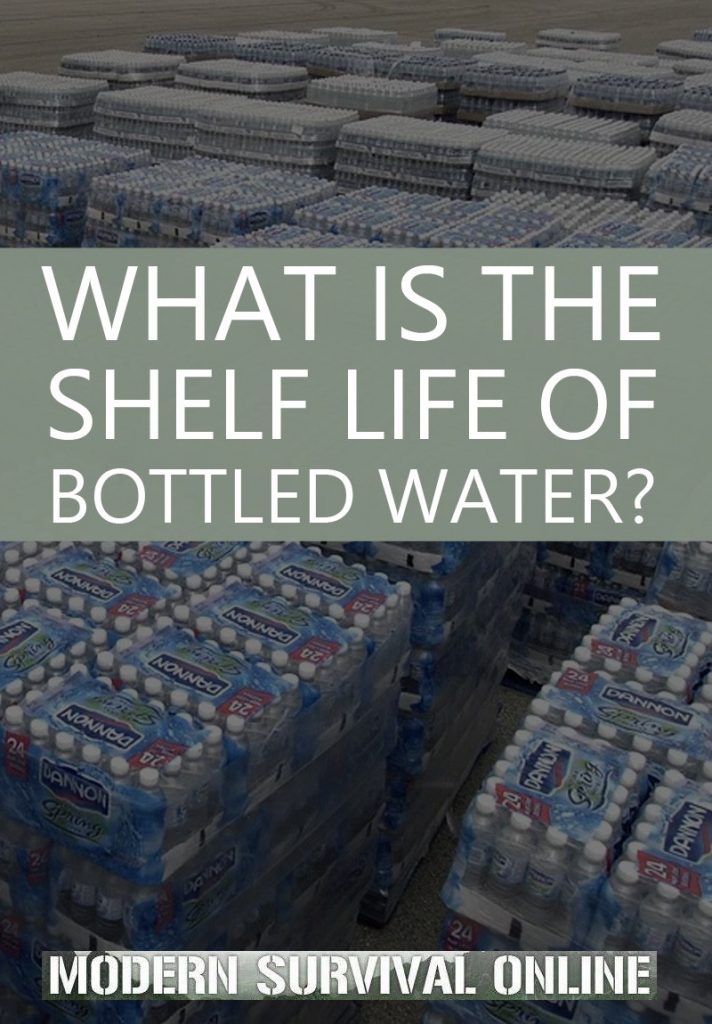
What is the Shelf Life of Bottled Water?

Water is an absolutely essential survival provision, typically to be used for both drinking and cooking, since you cannot go more than just a few days without it before dying of dehydration, and you will be in bad shape significantly before then.

While some may rely on large storage barrels or tanks, most of us buy water by the bottle or the jug and stack it deep on shelves and in pantries. Most of us are meticulous about our food shelf life but never spare a moment to consider if our water expires.

Perhaps you haven’t either. But now that I have mentioned it, you probably question whether it will or not. Does it?!

Bottled water that is factory sealed does not really expire, even if it loses volume to evaporation over time. What is commonly called the expiration date on bottled water is really a “best if consumed by” date. You may though notice bottled water that is sealed will over time develop an unpleasant taste as chemicals leach from its container into the water. Also any sealed bottle or jug of water that has it seal broken or otherwise compromised may be contaminated by microbes or algae.

We will dig a little deeper into this occasionally confusing issue below.

It Sure Looks Like an Expiration Date…

It is understandable that you and other consumers might think that, and in certain locales it may actually be an expiration date as required by law. But that is all! That does not mean that the water really expires as do other perishable foods and drinks.

Because of this, manufacturers who sell their product at a regional or national level will probably look to keep costs to a minimum by standardizing any and all packaging in any way that they can.

This means that if any bottles must be embossed, engraved, inked or otherwise marked with this expiration or best-by date, then all bottles will likely be even if they are not heading for a market in a state that requires such dating.

While the savings per unit of making their bottled water this way is likely only fractions of a cent, when you look at the economy of scale over many tens of thousands or hundreds of thousands of bottles of water, that adds up.

Nonetheless, any printed date on a bottle of water is only a recommendation, and one that might not even have a basis in reality. Your water might taste just fine way beyond that prescribed date or it might start to taste off well before it.

The only way to know for sure is to conduct experiments using your chosen brand under the actual storage conditions you keep it in.

Is There Any Way to Tell My Bottled Water Is Bad?

Unfortunately, not really, not without opening it and tasting or testing it.

Even though your bottled water is good practically forever, with “good” in this case meaning “safe to drink”, it is not immune to evaporation and certainly not immune to a change in taste over time due to the leaching of chemical compounds from its container into the water itself.

This does not necessarily make the water unsafe to drink; not by any stretch, as the compounds may not be present in the water in any quantity that causes harm.

Before you listen to the prattling of the crunchy granola, Birkenstock-wearing types who would tell you that chemicals X, Y, or Z are going to make all your hair fall out, or make you go blind…

…remind yourself that the clearest and freshest tasting water taken from the remotest natural source could be contaminated with all-natural pathogens that could pose a far greater health risk.

The reason why your water develops this nasty taste over time is because water is a powerful, if slow-acting, solvent. Given enough time, it will start to dissolve and degrade almost anything on Earth.

Assuming that the bottle was not already contaminated when the water was poured into it at the factory, the compounds that make it taste funny (oftentimes described as a slightly burnt or metallic taste) simply come from the plastic packaging itself.

These same compounds are actually present in the water from the very moment it enters the bottle.

Modern scientists at major universities have assured us time and time again that these chemicals are not harmful in any amount that is typically to be expected in a bottle of commercial water, even if the water has been sitting for a long time.

Effects of Broken or Suspect Seals

All of the above information is only good and applicable if you are dealing with water that is factory sealed with a high degree of quality control.

If you are dealing with bottled water that was not sealed or has a compromised seal, or even worse has been drunk from before being put away, you can count on the eventual blooming of bacteria and other microorganisms in that water.

As a general rule, if you open a sealed bottle of water you will want to use it within two weeks at the most, else the risk of microorganisms multiplying dangerously becomes too high.

Bottled water that has its seal broken and has been contaminated before being put away can see microorganisms start reproducing extremely quickly if the conditions are just right for their life cycles.

Everything from bacteria to viruses, parasites to prions can make you terribly ill or even be fatal in rare circumstances. If you are ever in doubt about water’s quality or safety make sure you run it through a filter or boil it before consuming it.

One quick note about algae… Algae multiply fast and furious when exposed to sunlight, and will coat the surface of water as well as the inside of the container holding it in a way that is liable to turn your stomach just from looking at it.

But, perhaps surprisingly, most species are harmless, and can even be eaten right along with your drink of water with no ill effects! You can, of course, always filter water that has a colony of algae in it to improve its flavor and appearance.

Conclusion

You don’t have to worry about your bottled water expiring, though if you leave it sitting for a very long time it might start to pick up a bad taste from its container in addition to losing some of its volume to evaporation.

This nasty taste has been judged by scientists to be non-harmful, as it only affects the palatability of your water.

Any bottled water that you purchase that has its seals broken or otherwise compromised will likely eventually become contaminated by microorganisms and made unsafe to drink.

It is still best to treat any suspect container or bottle of water if you fear its seals have been broken. Aside from that, you can completely ignore the expiration date printed for embossed on your bottle of water when storing long-term.

bottled water expiration pinterest


via Modern Survival Online https://ift.tt/3eOzZ2i

Friday, April 24, 2020

Odd Crosley Radios From The 1920s

You may sometimes see the Crosley name today on cheap record players, but from what we can tell that company isn’t connected with the Crosley Radio company that was a powerhouse in the field from 1921 to 1956. [Uniservo] looks at two of the very early entries from Crosley: the model VIII and the XJ. You can see the video of both radios, below.

The company started by making car parts but grew rapidly and entered the radio business very successfully in 1921. We can only imagine what a non-technical person thought of these radios with all the knobs and switches, for some it must have been very intimidating.

The model VIII had two large knobs, three small knobs, and a switch. Oddly enough there were very few markings on the knobs, as you were expected to know how to use a tuned RF radio. The large knobs were for tuning capacitors and the switch was for coil taps, while the three small knobs controlled the tube filament supplies.

We thought at first that each filament control knob had a jack above it. As it turns out, they aren’t jacks but peepholes. You sight through the holes to see how brightly the filament burns to adjust them properly. With the three tubes, you still needed headphones or an external amplifier. The variable capacitors are “book style” which is a rarity now. Watching the cam and spring adjust the capacitor makes you wonder how many other ways you could build a variable capacitor.

The XJ is similar although you’ll find an extra tube and peephole. There’s also a normal headphone jack. You can see some cost-cutting measures in this radio. It still used the book capacitors, though. These old radios are almost like craft pieces and we wonder what the person who wired them by hand would think if they knew we were looking at their work almost a century later.

If you want to know more about the man behind Crosley — and his dog — and how their desire to sell more radios led to the creation of the WLW radio station. Of course, the TRF design didn’t survive long and gave way to the superheterodyne.


via Radio Hacks – Hackaday https://ift.tt/2zwUKzz

Thursday, April 23, 2020

So. You Bought A VNA. Now What?

It’s never too late in life for new experiences, but there’s a new experience I had a few weeks ago that I wasn’t expecting. I probably received my first piece of test equipment – a multimeter –  in the early 1980s, and since then every time I’ve received a new one, whether an oscilloscope, logic analyser, spectrum analyser or signal generator, I’ve been able to figure out how to use it. I have a good idea what it does, and I can figure out whatever its interface may be to make it do what I want it to. My new experience came when I bought a piece of test equipment, and for the first time in my life didn’t have a clue how to use it.

That instrument is a Vector Network Analyser, or VNA, and it’s worth spending a while going through the basics in case anyone else is in the same position. My VNA is not a superlative piece of high-end instrumentation that cost the GDP of a small country, it’s the popular $50 NanoVNA that has a fairly modest frequency range and performance, but is still a functional VNA that can take useful measurements. But I’m a VNA newbie, what does a VNA do?

A Quick VNA Primer

The NanoVNA block diagram.

If you work with radio frequencies, it’s relatively easy to measure amplitudes, but usually very difficult to take phase and impedance measurements, especially across a wide frequency range. So for example I was able to fire a set of frequencies at a filter in a previous Hackaday article using only a Raspberry Pi and an oscilloscope, but all I could measure was its bandwidth, I knew nothing about its impedance and the phase relationships between input and output. This type of analyser is refered to as a Scalar Network Analyser, and all the measuring device knows about the signal is its frequency and amplitude. Where the scalar analyser simply has an oscillator and a sensor, the VNA mates the oscillator with a reflectometer to measure impedance, and replaces the sensor with a software defined radio receiver. Both oscillator and SDR are in perfect synchronisation so the device can keep track of phase as well as the rest of the measurements. A computer controls it all.

The first playground for the NanoVNA, an RF demo board.

The NanoVNA originated a few years ago from [edy555], and has since been cloned in huge numbers by Chinese manufacturers. It’s a surprisingly simple piece of hardware, with an Si5351 clock generator providing the phase-synchronous oscillators, a brace of three balanced mixers providing the RF-to-baseband downconversion, an I2S codec digitizing the measurements, and an STM32F07 ARM Cortex M0 microcontroller doing all the math and running the show.

If a VNA is that simple, you might be asking why commercial ones are so expensive then, but the answer lies in the rather limited capabilities of the NanoVNA. It has a fundamental frequency range of 300 MHz, it uses an audio ADC, and its RF components are not of a particularly high spec. Compared with a commercial model that will have a frequency range in the GHz, a much higher specification ADC, a much lower noise figure, and a hugely more capable computing system to drive it, it becomes rapidly obvious where the extra cash goes before you have even considered matters such as calibration.

The NanoVNA is a real VNA and it’s very useful for radio amateurs and hobbyists, but it’s still something of a toy in the scheme of VNAs. So having discovered what the NanoVNA is, how do we use it? This isn’t a review of the device, instead it’s a write-up of my experiences with it as a first-time user.

Diving Into My Toy VNA

The first step this voyage of discovery is to calibrate the device, which is to say to establish its baseline for measurements. It’s shipped with a set of SMA connector loads and shorts and open-circuits, and it is here that these are required. Rather than step through the whole process pretending to be an expert it’s easiest to link to the site on which I found the calibration procedure. In short: you hook up each of the standards in order to your VNA, and run the appropriate calibration routine. The NanoVNA is controlled by a little jog switch and a not-very-responsive touch screen, so there is a bit of a learning curve in getting to know its interface. Little tricks such as finding the on-screen keyboard and then understanding that the “M”, “K”, and “G” buttons refer to megahertz, kilohertz, or gigahertz, and also function as return keys are essential.

What a Baofeng whip antenna looks like on a VNA

Once you have calibrated it and understood the interface, it becomes a very straightforward instrument to use. I also picked up an “RF Demo kit”, a PCB with a set of test RF networks, filters, and attenuators. This allowed me my first chance to play with it, and immediately the ease of taking readings became apparent. There are a variety of traces as well as a Smith chart, and a group of measurements at the top of the screen that correspond to a set of markers on each trace.

The jog switch on the NanoVNA allows paging through the frequency range, and each reading can be seen for each frequency. I could zero in on a particular frequency and see its impedance, pick out the exact cut-off point of a filter, and hook up an antenna and tell straight away whether it needs tuning. The cheap-and-nasty dual-band whip antenna on my Baofeng was revealed to be perhaps not as nasty as I’d supposed at 144 MHz, but somewhat off frequency at 430 MHz, for example. The VNA was living up to its reputation as the Holy Grail of RF test equipment, and even after only a few days of owning one I can’t quite see how I ever managed without it.

What I discovered after my initial bafflement at my NanoVNA was that a lifetime of playing with RF and also being used to figuring out new test equipment has held me in good stead. I will probably never become a VNA savant in the way that a lifetime of using all types of oscilloscopes has made me with those instruments, but I can now use it to quickly make measurements I wouldn’t have thought possible before I owned it.


via Radio Hacks – Hackaday https://ift.tt/3bx0TKb

The Philosophy of Ayn Rand

Ayn Rand was right. She was. But I have little doubt even the title of this article will make a certain percentage of the readership’s heads explode, a font of impotent rage. This is a shame, and one of the fundamental reasons needs addressing.

The fervent and widespread misunderstanding of Rand’s philosophy, Objectivism, and the instinctive revulsion it engenders in people unable or unwilling to understand it beyond a second-hand or shallow interpretation.

Don’t worry, this article won’t be a deep-dive on Objectivism. Rather, we will be illuminating the most essential elements of Rand’s philosophy while trying to defend this particular ethical philosophy’s applicability to our modern world and prepping in particular.

Ayn Rand: A Short Bio

In order to fully comprehend and understand someone’s philosophy, it is helpful to first learn the circumstances of their life, upbringing and maturation.

Without the proper context of someone’s life experience, you might blindly be trying to fit the pieces of their philosophy into spaces that don’t necessarily exist in their psyche and worldview.

For those who are oblivious to Ayn Rand, here is a brief bio. Rand was born the eldest of three daughters in St. Petersburg, Russia in 1905 to a family of non-observant Jews.

Her father was a successful pharmacist, but sadly his business and holdings were seized by the government in 1917, prompting the family flee to Crimea. It was there that Rand finished high school and university.

She was later granted a visa and moved to the United States in 1926, living first in New York before moving to California where she primarily worked as a screenwriter before turning to her own fictional works and straightforward philosophical publishing.

protester john galt
By HKDP – Own work, CC BY-SA 3.0, Link

Her magnum opus was the philosophical novel, Atlas Shrugged, a book encapsulating the doctrines of Rand’s Objectivist philosophy in its most complete form, weaving them into a fictional setting.

The tenets of Objectivism could be surmised as holding reason as the highest value, rational self-interest as a moral good, and the rejection of collectivism and altruism.

Published in 1957, it took Rand over 10 years to complete the book and she described the theme as “the role of the mind in man’s existence—and, as a corollary, the demonstration of a new moral philosophy: the morality of rational self-interest”.

In the following short sections, we will dissect the three principal tenets of Objectivism.

Reason Above All Else

The guiding and essential tenet of Ayn Rand’s philosophy is Reason above all else. Embracing reason, and embracing fact above emotionality, feelings, and intuition is paramount.

Reason should be applied to all areas of one’s life: business, home, soceity and love. The outcome or determinationresulting from following reason to its logical conclusion is to be adhered to and accepted whether it is pleasant or unpleasant.

Active reasoning is something that does not happen all by itself. It does not bubble up out of the wellspring of the ego or the heart. Reason will not apply itself automatically. To reason is to think, and thinking is hard.

To think means one must choose to apply their intellect, their mind, and keep it in motion working on the task or problem at hand.

The essential task as far as reason is concerned is to gather and understand facts, draw conclusions based on those facts and then evaluate those conclusions.

Ayn Rand was an adamant believer that one had to choose whether they would think or not, and in this case choosing to not think or abstaining from thinking was a choice in itself.

Rand allowed no deviation from her essential logic that choosing to follow reason, actively choosing to follow reason, was to reject emotion, reject authoritarianism, and reject faith as allowable guides for the direction of one’s efforts and intentions.

One Can Only Face Reality

Another essential creed of Ayn Rand’s philosophy is that of accepting reality as it is, not as you wish it were. Furthermore one must accept that reality is, well, real to begin with.

Objectivism makes no room for pie-in-the-sky theories of alternate realities, alternate universes or pseudothaumaturgical phases of being.

Reality is all there is, and by striving to live it is best if one would discover reality’s true nature and learn to act in accordance with its inarguable laws.

Reality is not something to be subverted, denied or run from, but is instead something one must stoically face and deal with. Man might command reality, but its laws must nevertheless always be adhered to, whether you would want it so or not; man does not get a vote in the matter.

There is no alternate reality or alternative to reality. There is nothing after it, no “land” beyond.

Ayn Rand’s assertion that reality is the sum total of existence, or at least the entire “field” within which our existence takes place, means that in accepting it one must reject any and all ideas and notions of the mythic and the supernatural, including God.

You might tersely and pithily codify that idea with the aphorism that admonishes a person who is “wishing-hoping-dreaming” for reality to be anything besides what the current state is to “Wish in one hand and s*** in the other, see which one fills up first.”

A Person is the End and the Means to that End

What role does morality serve? Furthermore what role does morality serve in a man’s life?

The answer for most westerners, especially most western Christians, often sounds like something along the lines of morality is a required governor or throttle on man’s baser, vile instincts, and only through morality is it possible for one to deny their own interests and happiness, especially short-term happiness, in order to be good and kind to other people and to serve God or some other higher purpose.

Morality serves as a sort of “Board of Education” to that end.

Ayn Rand’s Objectivist philosophy turns morality on its head in a drastic and severe way. Rand argues that the only purpose of morality is to inform a person what will produce happiness for them, and what actions are thereby in their self-interest.

In the most drastic departure from religious and inherited moral codes, Rand espoused that man must choose his own code in order to determine what his values and goals should be, and thus determine what actions he should take. The criteria for what is good or best is only weighed against what is proper for man- nothing else.

It is only through the establishment of this personal moral code that any person would be able to achieve much less maintain and enjoy their own life. Under Rand’s philosophy of Objectivism, a person’s own life is the ultimate value, and that life is the end in itself.

She famously, or infamously, postulated that man born as he is has no automatic code of survival, and could not rely on his built-in senses to determine what was best or most beneficial for him. Additionally, man had no way to determine innately what was good or evil for himself.

Capitalism Without Restraint

Ayn Rand is perhaps most popularly known among those less familiar with her life, works and philosophy for her lobbying and espousing of absolute laissez-faire capitalism. To be perfectly clear, this looks nothing like the capitalism that America and Europe practice today.

Not economy bordered by federal laws, not an economy with government controls wormed and sprinkled throughout it, but a complete and total separation of the economy and state power in the same way as in for the same reasons as a separation of church and state.

Under Rand’s view of capitalism, the government’s sole function is to protect every single individual’s rights to pursue capitalism by maintaining the ability to use force in defense of all individual’s pursuit thereof.

In other words, the government, while strictly limited, reserves the rights to use force against those who would use force against another.

Rand’s ideas on this topic are commonly misinterpreted, accidentally or not, and misconstrued. She saw this type of capitalism as a natural extension of the rational mind. A rational mind that makes its own life the highest possible moral purpose would naturally demand its own freedom.

Following this logical, reasonable train of thought total freedom would extend to commercial activities, the freedom to own property, freely associate and trade with others and generally pursue the accumulation of wealth unfettered.

True capitalism, Rand argues, is merely an extension of the individual’s rights in an economic direction.

Acceptance and Rejection of The Objectivist Philosophy

“The morality of rational self-interest.” That’s intense, and not particularly palatable to those who see generosity and selflessness as virtues.

Her detractors take that statement as proof of a deeply rooted selfishness inherent to Rand’s values. The most popular rejection of Objectivism holds that the concept of rational self-interest is plain greed.

Greed is a vice or sin in the majority of the world’s established moral systems, and has gotten a bad rap over the years as miserliness or covetousness.

But that isn’t at all the meaning of rational self-interest. “Rational” self-interest is holding one’s own life and their achievements as the highest and most moral aim of their life.

This includes some facets ignored or overlooked by Rand’s naysayers. A deeper exploration of her speeches or writings reveals the flaws in the critique; One cannot succeed long-term by dealing unfairly or dishonestly.

Rand, a fervent capitalist, recognized that trade and mutual voluntary exchange were generally necessary for prosperity.

I hope you can believe that people will not for long deal with you if you are a cheat, or fail to deliver what was agreed to in the terms of the exchange.

Therefore, the sort of Mad Max-dystopian, apocalyptic, smash-the-weak-and-take-their-stuff fear-mongering of the rabid critic of this tenet is completely misplaced and totally absent from Rand’s explanation.

Okay, so what does rational self-interest really mean, then? It simply means the pursuit of your own good in line with your rational values. You might say that is maybe vague or quite broad. You’d be correct.

It does leave a great deal of wiggle room for your personal interpretation and implementation. I fancy it akin to the author, Joseph Campbell, in his book “The Power of Myth”. He said, “Follow your bliss. Find where it is, and don’t be afraid to follow it.”

I think the few exceptions that Rand might have professed would be any pursuit that negated or ignored reality. Being a drug-addled misanthrope would be an abdication of both Reason and rational self-interest.

But any field of pursuit that inspired you, was in line with your values, and to which you applied yourself with dedication to higher achievement would fit into this ideal. Not a bad bit of philosophy so far, right?

Interestingly, most of the resistance to Ayn Rand’s Objectivist philosophy encounters the most rejection and resistance not from counter-leaning political and social philosophists but from those whose religious or spiritual morality is staunchly opposed to some of the tenets of Objectivism.

Religious systems as a rule include a fixed and sacrosanct set of virtues and morality, delivered from on high by a flawless, omnipotent and unimpeachable God or Creator.

The internal logic of these religious values follows that those bylaws, or commandments in the case of Christianity, are the starting point for morality, the fixed, perfect and immovable fixed point from which all other judgments on “correct”, proper and right morality is defined.

These religious doctrines reinforce themselves by reaffirming the correctness of these commandments constantly as the only immutable “truths” that should govern human decision making.

That is quite a contrast with Rand’s Objectivist philosophy which asserts that reality and the acceptance of reality is the only truth, the fountainhead, from which all other decisions and deductions flow.

When one starts to think this through it is not hard to see how obedience to reality and a too-staunch belief in one’s own perception combined with a fundamentally selfish focus on the self might give rise to a person who is, by traditional standards, dreadfully flawed or even evil.

These conflicts and conundrums that arise between the “Self as Moral High Ground” and “Living for the Greater Good” are part and parcel of what makes Ayn Rand’s Objectivist philosophy so contentious, and so appealing.

Conclusion

Ayn Rand was and remains one of the 20th century’s most celebrated, influential and contentious thinkers. Her Objectivist philosophy informs and influences social and economic policy to this very day.

To her adherents and fans, she is a paragon of rationality, a person above the petty emotions and distractedness of common people.

To her opponents and naysayers she’s an avatar of selfishness and self-centeredness that borders on cruel nihilism. As with all such things, the truth lies somewhere in the middle.



via Modern Survival Online https://ift.tt/2XYv8FL

Wednesday, April 22, 2020

Lock Your Keys in the Car On Purpose with Aluminum Foil

[TJ] is a surfer, and drives his car to get to the beach. But when he gets there he’s faced with a dilemma that most surfers have: either put his key in your baggies (shorts) or wetsuit and hope it doesn’t get lost during a wipeout, or stash it on the rear wheel of his car. Hiding the keyfob by the car isn’t an option because it can open the car doors just by being in proximity to the car. He didn’t want to risk losing it to the ocean either, so he built a waveguide of sorts for his key out of aluminum foil that lets him lock the key in the car without locking himself out.

Over a series of trials, [TJ] found out that his car, a 2017 Chevy Cruze, has a series of sensors in it which can determine the location of the keyfob based on triangulation. If it thinks the keyfob is outside of the car, it allows the door to be locked or unlocked with a button on the door handle. If the keyfob is inside the car, though, it prevents the car from locking via the door handles so you don’t accidentally lock yourself out. He found out that he could “focus” the signals of the specific sensors that make the car think the keyfob is outside by building an open Faraday cage.

The only problem now is that while the doors can be locked, they could also can be unlocked. To solve that problem he rigged up an ESP32 to a servo to open and close the opening in the Faraday cage. This still means there’s a hidden device used to activate the ESP32, but odds are that it’s a cheaper device to replace than a modern car key and improves security “through obscurity“. If you have any ideas for improving [TJ]’s build, though, leave them in the comments below. Surfers across the world from [TJ] to the author would be appreciative.


via Radio Hacks – Hackaday https://ift.tt/3cKLia5

Monday, April 20, 2020

How Long Does Canned SPAM Last?

Ah, glorious Spam. That beloved blue can is a staple in pantries all across America and the world. Greatly favored by campers for its convenience, homeowners who want a quick bite and even preppers for its long lifespan.

can of spam

Spam is a tasty, versatile and, most importantly for our purposes, shelf-stable source of protein and calories.

Spam’s iconic status has led to a fair share of urban legends regarding its composition and lifespan. The latter is an important question at least: how long does Spam last? How long before it spoils on you, potentially making you sick?

Spam does not keep forever, but it will last for a very long time in your pantry. Despite having a shorter sell-by date Spam, in a can that is undamaged and in good shape, should last anywhere between 3 and 5 years sitting on the shelf. Temperature extremes may alter this time somewhat. The manufacturer, Hormel Foods, recommends that you always consume your Spam by the sell-by date on the can.

What?! I thought SPAM was supposed to last forever?!

I know, I know. Spam will spoil in the end. It turns out that, just like Twinkies (another member of the eternally fresh mythos), they won’t keep perpetually.

Despite rumors of being made from at least 50% meat preservatives, Spam in actuality only has six ingredients, and none of them are super preservative. Per Hormel Foods website its ingredients are pork and ham, salt, sugar, water, potato starch and sodium nitrite. That’s it.

So the good news is Spam is not some crazy unknown mystery meat product. And even more good news, at least for the purposes of making sure we have fresh meat to eat in a SHTF situation, is that sodium nitrite is an effective and potent preservative.

This is the ingredient that ensures Spam will maintain its texture, color and of course freshness.

So, hopefully now you can enjoy Spam with a little less guilt and concern that you’re eating some quasi-food. But perhaps we should dig a little deeper.

Even three years is a long time for canned meat. What processes or ingredients yield such a long shelf life, and how dependable is that estimate?

The Rest of the Shelf-Life Story

The preservatives in Spam are not solely responsible for its long shelf life. The cooking and packaging process at the factory also has a big role. Spam starts its life as pork and ham, which are then pre-ground and mixed together.

After that they pile in the salt (itself a preservative), the sugar, and the rest of the ingredients then mix it all up for 20 minutes. Once this mixture comes up to temperature it’s time to put it in cans.

12 ounces of the delicious Spam mixture is added to the familiar oval metal can.  These cans are moved by conveyor belt, not human hands, to a machine where the lids are added through a vacuum sealing process.

The vacuum sealing process by itself destroys any microorganisms in the can, halts enzymes from reacting, and prevents bacterial growth from occurring. But we’re not done yet.

After the vacuum sealing process is finished the cans are cooked and then cooled in a process taking about three hours.

The cooking process renders the Spam ready to eat, of course, and further kills off any microorganisms that may be lingering. After that it’s off to get a label and adios!

That’s the sum of Spam’s shelf life: meat preservatives in conjunction with minimal human handling, and excellent food preparation and packaging at the factory means unopened Spam will reliably have a several-year shelf life. Depend on it.

Caution Advised

But that being said, you shouldn’t assume any old dusty can of Spam you find is safe to eat if you don’t know when it was purchased.

Any canned food, meat, fruit or vegetable is completely dependent on the structural Integrity of its can and the seal to ensure freshness and safety.

If you ever knew anyone in your family who was always cautious to inspect the cans before buying them at the grocery store, now you know why.

A dent, a ding or any other incidental damage can potentially ruin a can seal, or breach the can liner if present, and render the cans internal environment no longer germ-free.

Cans that have those easy open pull tab tops, of which Spam cans are one, seem to be especially vulnerable to breaching from dropping, smashing, denting, etc.. What I’m trying to say is that these cans are not indestructible!

Don’t worry too much about it though. If you take care to pick out good intact cans at the grocery store, and then treat them with a modicum of care transporting them home to your shelves, you shouldn’t have anything to worry about.

Boldly mark your cans with a sharpie for date of purchase, and use that for making your stored food rotation decisions.

How long will Spam last after it’s been opened?

While I don’t expect an open can of Spam to last in a survival situation, considering you’re going to be eating it in short order, if you still have power or live in a colder climate you’ll be happy to know that it will keep for quite a few days.

After Spam has been opened, you can expect it to last for anywhere between 7 and 10 days – with refrigeration!  Now, this is a bit of a deviation from what Hormel Foods recommends.

They will tell you the open Spam will only last 2 to 3 days with refrigeration. But considering Spam’s composition, use of preservatives and significant salt content, 7 to 10 days is in all likelihood the more accurate figure.

The reason for this is that it is highly similar to other preserved canned meat products, namely corned beef and deviled ham, that will last for 7 to 10 days under refrigeration after being opened.

I’m not sure why Hormel Foods would prescribe such a short lifespan for Spam and not similar meats, but there’s absolutely no reason why you should expect your Spam to keep any less than 7 to 10 days under refrigeration after being opened.

Conclusion

Contrary to popular opinion, Spam will not keep forever, not even sitting patiently on your pantry shelf. While it does have a longer shelf life than the sell-by date would suggest, it is not indefinite.

In ideal conditions with an intact can and seal, you can expect to get anywhere from three to five years of fresh, delicious, salty life out of a can of Spam.

A versatile, tasty and stable source of protein, Spam is a good choice and low-maintenance option for any prepper who wants to add some shelf-stable protein to their survival stores.

spam shelf life Pinterest image


via Modern Survival Online https://ift.tt/3eDaOQg