Friday, January 4, 2019

How to Survive as a Young Conservative in a Socialist America

by The Preppy Prepper

Many survivalists are interested in preparing for a variety of apocalyptic scenarios. Are you ready if the electric grid goes down? Have you stockpiled enough goods and ammo to resist a foreign invasion? Do you have alternate forms of currency to trade and barter with when the dollar collapses?

While these are important hypothetical scenarios to plan for, an ever present doomsday scenario has already arrived in America.

Conservative men and women, on college and corporate campuses, and in major cities throughout America live under constant threat of losing their jobs, reputation and freedom at the hands of the unbound hatred of the modern day Left. Most men are only one false accusation away from social and financial ruin.

Conservative has become synonymous with straight (cis), white male. And the straight, white male has been tried and found guilty of centuries of oppression. As a white male you can either renounce your heritage and agree to surrender your position or be targeted.

By the emotional logic of the Left, minorities and women are rightfully shamed for expressing conservative views. Being conservative while black or female or gay is equated to siding with the oppressor and considered a betrayal of one’s race or gender.

Identity politics doesn’t allow for nuances like debate, disagreement, discussion. You are stamped with an agenda at birth, based largely on your race and gender, and your duty, according to the hysterical left, is to carry their socialist agenda forward. You are not allowed to stray from the role assigned to your particular niche or you risk attack and marginalization.

At its core, the Left’s obsession with race reveals a thoroughly racist worldview. They believe that without institutional favoritism, minorities are unable to compete with whites. While the conservative viewpoint encourages hard work, sacrifice and individualism, modern day leftists think that minorities, especially black Americans, can’t succeed without their helping hand.

This is evidence of a savior complex. The Left envision themselves as not only the savior of humanity but also the savior of the planet. Without them minorities will starve and women will be bound and subjugated. The planet will melt! We will all perish without their help.

communism

The Left is unable to point to many achievements of its own. In general, the Left doesn’t create or originate. It criticizes. Their critique of capitalism led to the disaster of communism. Their critique of traditional American culture has led to the stifling dystopia of political correctness. Their critique of common sense gender roles assigned by nature has encouraged confused teenagers to mutilate themselves. The Left doesn’t create, it destroys.

What it would like to destroy more than anything is The Patriarchy. This all encompassing term points to nearly every achievement of the West. Ironically, feminism, tolerance and secularism, are the creations and gifts of the Western Patriarchy which enabled the rise of all this malarkey in the first place. They want to kill their fathers but keep the inheritance.

Searching for logic or reason in the arguments of the Left is futile. Their passions are founded on envy, jealousy and resentment. If the West used advanced mathematics to conquer sea and air and space, well then Math itself must be racist. Either that, or some oppressed minority actually invented math and the white man stole it!

Those intent on tearing down the patriarchy, have no problem using the great gifts the Western patriarchy has bestowed on them such as: plumbing, electricity, modern transportation, satellite technology, computers…. The list goes on and on.

Nearly all modern technological achievements are a result of the Western patriarchy’s centuries long, often anonymous devotion to science, logic and reason. The tremendous irony of using all the advancements of the West to attack and denounce the West is completely lost on these entitled dullards.

Unfortunately at this moment in time, Academia, the Media, and every corporate HR department is under the sway of the leftist mob. These institutions are slowly losing power and influence and alternatives are presenting themselves.

For example careers in the trades – where one is judged largely on one’s ability to get the job done and one’s efforts are judged by objective standards (whether or not the plumbing functions for example) – are flourishing. However, the accepted path of gaining a solid career, mortgage, social life and retirement fund still involves, for many, a path through academia followed by an audition before corporate HR.

Being accepted into a good college and being hired by a good company is no guarantee of success since the leftist watchdogs will keep an eye over your interactions throughout the remainder of your matriculation and employment. One slip up in person or on social media is enough to destroy years of effort. It is literally a matter of survival.

Socialism remains the hope of the young. It offers the hope of an unrealized and better world. Its biggest promise is that we all can live a life of comfort and peace without sacrifice and hard work. Naturally, this appeals to the young. Conservatives recognize this as hogwash, but if they dare to burst the shiny, pink bubble of socialism they will subject themselves to scorn and derision.

This article, is intended to offer some practical guidance for surviving as a young conservative in the increasingly hostile environment of young, socialist America.

Seek out Allies Early and Often

In present day Academia for every single professor that is a registered Republican there are more than ten professors that are registered Democrats. Conservative professors are greatly outnumbered and are likely marginalized by their co-workers.

If you are a conservative college student it is imperative to locate the few like minded professors on campus. Sign up for their classes, request them as advisers, drop in on their lectures. Send them a friendly email and establish a connection. Nobody knows how to navigate the hostile waters of academia better than they do. Seek their advice, and if you find yourself under attack go to them for help.

Avoid Social Media

If at all possible stay off social media. Social media is a trap for conservatives since it is owned, operated and monitored by Orwellian-minded liberals. However, abstaining completely from social media is difficult since it has become a major form of social life.

You are going to have to make a decision here. Do you maintain a bland and carefully curated apolitical veneer or do you enlist as a corporal in the meme war. If you broadcast your conservative beliefs to the world via social media you undoubtedly put yourself at risk of isolation, attack and false accusation.

A recent story highlighted how an applicant to a prestigious college was questioned about why he followed Alex Jones on Twitter. This highlights many disturbing trends. One is that your social media accounts, seemingly an aspect of your private social life, are being monitored by college admissions departments.

The student wasn’t questioned for posting disturbing tweets himself or retweeting Alex Jones, merely for following him. The student was subsequently rejected for admission.

A society that valued freedom of speech, freedom of association, freedom of thought, or just Freedom in general would revolt against this type of thought monitoring. But America has taken a step in the opposite direction. Alex Jones was banned from all major social media accounts and recently banned from PayPal. He has been pilloried in major media as a proponent of hate.

So this student, who brought forth a lawsuit, is now struggling to defend himself. This is nearly impossible as he has now been condemned as someone who follows a confirmed proponent of hate. Or do you dare disagree with the findings of Facebook, Apple, Twitter, PayPal?

Social media is certainly a trap and better off avoided. Or do you dare to risk it all to become the next ‘alt-right’ celebrity defying the regime?

Consider a Pen Name

If you enjoy expressing your opinion and engaging with others in political debate on social media, you should consider using a pen name. While Facebook engages in identity verification, platforms like Twitter are more relaxed.

Set up a burner email using one of many free encrypted email services. Invent a new name for yourself, upload a picture of your choosing (have fun with this step), and blast your opinions to the world without fear of repercussion.

You won’t be fooling the NSA, but you will keep the average nosy classmate, admissions counselor, or HR intern in the dark.

You’ll have to commit somewhat to a clandestine lifestyle at this point. The moment you brag to friends about your cool online alias it will be compromised and you’ll have put yourself at risk.

Also, nothing online is truly anonymous. If you ever plan on running for public office you should expect to have every tweet you’ve ever posted dug up and scrutinized by your opponents.

Migrate to Rural or Southern Locations

If you’re attending a secular college or living and working in most major cities you’re likely going to be outnumbered. The majority of city dwellers are liberal democrats or are dependent on government assistance. Your political views will not be welcome by the majority.

You can either live a somewhat clandestine lifestyle or leave the city behind and head to locales where conservative opinions are held by the majority. Increasingly this seems like most of rural America and much of the South.

Conservative, Christian colleges offer an alternative to the liberal utopia of their secular counterparts.

The difficulty is that many jobs are in urban areas that are traditionally Democratic strongholds. If you have to live in these areas, then behave as you would on a college campus. Seek out allies, limit your social media profile, and carry on.

Dating While Conservative

These next few paragraphs are really tips for young men in general, since they involve the tightrope walk of courtship in the MeToo era.

If you find yourself dating a young lady, you’re going to need to retain a degree of skepticism towards your interactions with her. Unfortunately, you’ll have to amass a certain amount of hard evidence to defend against any false accusations of harassment, stalking or assault.

Society has placed a dangerous weapon in the hands of young women, many of whom are not capable of handling this weapon responsibly. That weapon, we all know, is the false allegation.

On a college campus, a young lady holds the power in her fingertip to destroy a man’s life. All she has to do is point the finger. Years later, after the smoke clears and the dust settles, and the lawyers fees are paid, some men may return to a semblance of normalcy. But many anonymous men have had their collegiate careers destroyed, and their lives forever altered, for no other reason than a scorned women felt like doing so.

Ladies, if you are reading this, take heed – one day you may give birth to sons.

A conservative man is at a much higher risk of suffering from a false accusation. This is because the Leftists routinely malign conservatives as the party of white, male oppressors. In their twisted mind, the truth is inconsequential to their desire to destroy a budding member of the dreaded Patriarchy.

So with that in mind, save her texts. If she texts you that she’d like to meet up for coffee or drinks, or that you’re welcome to stop by her place after class, or that she had a great time last night, take a screenshot and store the text in a hidden folder on your phone or hard drive.
If she sexts you or sends you naughty photos, save them. Don’t show them to anybody. Just keep them for insurance purposes.

If a few months pass, and things turn south as they often do in young relationships, you’ll have some evidence to defend yourself against any false accusation.

Become a Clandestine Conservative

The way Leftists demonstrate their political views is to gather in a parade, muck up traffic, shout slogans, dump trash everywhere, and then run off to congratulate themselves while low paid civil servants clean up their mess. The way conservatives demonstrate their political views is by leading successful and productive lives.

If you truly want to express your conservative views then work hard towards holding down a job, starting a business or raising a family. While the leftists are out in the streets banging on tin cans and demanding attention from the media, you can keep your head down and plug away at your goals.

When the leftists fail to achieve anything or produce anything of value they can always get jobs in academia. Meanwhile, you’ll have built a life of quality in which you can take pride.
This may be the best path forward for a young conservatives to take.

If you wish to tangle with the leftist hordes in the public square you’re going to have to be prepared for doxing, character assassination, violent attacks, hate mail, and all the other tools they use to spew their hatred. At some point, this could lead to open hostilities and civil war. If the left keeps on instigating these attacks it just may come to that since decent people will eventually be left with no choice.

But for now it’s your decision. There’s a reason, after all, why quiet conservatives are referred to as the silent majority.

Persevere

With the media constantly pushing the leftist narrative and professors serving diligently as useful idiots it’s going to take a great deal of restraint and commitment to maintain your conservative principles without losing your mind.

Know this, by the time you make it to your thirties, many of the outspoken leftist women will either jump ship or face a future as lonely cat ladies. So long as you persevere you’ll win out in time.

Winston Churchill is credited as saying, “If a man is not a Socialist at 20 he has no heart, but if he remains one at 30 he has no head.”

Good luck.


via Modern Survival Online http://bit.ly/2Qm3Em8

Wednesday, January 2, 2019

Lucid Dreaming | I had it, now its gone

I lucid dreamed for 4 months with MILD but its been a month and now I can't. I'm on med's that knock me out for about 11 hours. Should I try another method


via Lucid Dreaming - Dream Views - Attaining Lucidity http://bit.ly/2R2yftW

Superheterodyne Radios Explained

The general public thinks there is one thing called a radio. Sure, they know there are radios that pick up different channels, but other than that, one radio is pretty much like the other. But if you are involved in electronics, you probably know there are lots of ways a radio can work internally. A crystal set is very different from an FM stereo, and that’s different still from a communications receiver. We’d say there are several common architectures for receivers and one of the most common is the superheterodyne. But what does that mean exactly? [Technology Connection] has a casual explanation video that discusses how a superhet works and why it is important. You can see the video, below.

Engineering has always been about building on abstractions. This is especially true now when you can get an IC or module that does most of what you want it to do. But even without those, you would hardly start an electronics project by mining copper wire, refining it, and drawing your own wire. You probably don’t make many of your own resistors and capacitors, neither do you start your design at the fundamental electronic equations. But there’s one abstraction we often forget about: architecture. If you are designing a receiver, you probably don’t try to solve the problem of radio reception; instead you pick an architecture that is proven and design to that.

There are other examples. Do you really work out a binary counter every time? Or how to make an op-amp amplify? You start with those building blocks. Of course, true innovation means you have to stop doing that and actually think of new and different (and possibly better) ways to do the same task. But most of the time you aren’t trying to innovate, you are trying to get the job done.

The video is pretty straightforward and doesn’t assume you have much radio background. However, it does manage to do some real demonstrations and it is worth a watch. There are many other receiver architectures, of course. Regenerative, superregenerative, homodyne (direct conversion), Hilbert, and Weaver are all types of receivers and there are doubtless more. The funny part is that many of the ideas we still use today came from one man: Edwin Armstrong.


via Radio Hacks – Hackaday http://bit.ly/2TnoS4L

Lucid Dreaming | ADA, Mindfulness, Self awareness, Lucid living - Let's dig deeper, What's important?

Hello fellow Oneironauts, I have been thinking for a while now about starting a thread to discuss the aspects of Mindfulness, self awareness, ADA so here are my thoughts:

It seems the general consensus is that if you are more “aware” during waking reality you will be more aware in your dreaming life. I believe this to be true so let's try to define what we mean by “aware” because there are so many things that we could be “aware” of the list could be endless.

“Being Mindful” or “Having Self awareness” or “All day awareness” are probably understood differently from one person to the next as we all interpret things from our own understanding and subjective point of view.

Because of this I think it would be a good idea to have a discussion on what in particular we should be putting our awareness/focus on with regards to increasing the odds of inducing Lucid dreams. I think we could narrow it down more as to what we mean when we say self awareness and what we put our awareness/ focus on exactly.

I need to also state that one thing that prompted me to look further into this is Eckhart Tolle’s books and increasingly the practice of Buddhism and maybe Hinduism (I Love a bit of Yoga). Eckharts books are nothing short of amazing IMO. I first listened to A new Earth Audiobook and at some point in that book i had a glimpse of this oneness, pure consciousness, present awareness whatever you want to call it. I felt a calm peacefulness and felt like I was seeing/feeling everything in a new light (The Buddhists call this Satori if this is what it was). During that period I had my first ever spontaneous Dild, granted it was a Saturday morning so no work and a longer Rem period than usual but this was right out of the blue and i put it down to being more Present and more “aware” at that time.

Now if the reason for my spontaneous Dild was caused by increased awareness, presence, mindfulness etc and i strongly believe it was then all we need to do is be more present and aware right? Easy one would think and this is the general idea of most spiritual practice. Being more present and more aware firstly means being free from the mind or incessant thinking, not being caught up in our emotions and thought patterns. This can be a very difficult state to maintain but i think with continued practice it gets easier and easier. I'm in no way an expert either by the way and I get caught up in it more than I would like.

We could talk about the subconscious/ unconscious mind being full of traps and when we get “trapped” we are taken away from being consciously aware and present and trapped in the mind of thought patterns and emotions. Eckhart talks about this and so does Buddhism which calls it Karma. Obviously we need to watch semantics and what we name these things so in general I think it's more conducive if we keep the terms as general as possible but then also quote similar translations (spiritual/religious) etc for broader understanding as it could simply make or break our understanding of concepts and ideas etc depending on our back ground or line if teaching.

The word “Self” for example probably conjures up all manner of definitions for different people and i would now define the word “Self” as the Ego or the things you identify with in life. Or you could see yourself as your Emotions and thought patterns.

Any way after that bit of a rant I would like to start a list of things (hopefully practical things) that we can put awareness/focus on during the day to Increase our awareness during our dreams. We could then prioritise these things to further increase our odds. We can also categorize them for further understanding.


The senses
Sight, Sound, Touch (Nervous system), Smell, Taste
Outer environment (The usual stuff people associate with increased awareness).
Sight - Nature, colours, textures, geometry, shades/Shadows, Movement etc.
Space and matter - being aware of space as well as the material world. These seem to be polar opposites.
Sound - Nature, Weather, birds and animals, humming of machines, roaring of motors, Doors & drawers opening & slamming, foot steps and Voices etc
Touch - Nature and weather, Textures, Clothes tightness etc, temperatures, aches, pains & tightness (could be classed as inner environment), gravity & pressure, weights, hardness and softness etc

I think it is important to try not to label everything as we put our attention on them as this increases mind chatter and takes you out of the present moment and also takes away the amazement of the world around us. I mean WOW people we are F*****g alive look at this shit it's amazing.


Inner enviroment
Sound - Ringing in the ears, Heartbeat, Breathing,
Feeling -
(Inner body) - Eckhart talks extensively about keeping at least some awareness on the inner body at all times to remain present and that you can always go deeper. I have found this to be the case, it can give an awesome sense of peace and can almost feel ecstatic. This is a great tool and highly recommended.

Emotions - I am increasingly realising that it seems as though some/most of the emotions are felt at the Chakra points, stomach and throat being two main ones for me (butterflies and a choked up feeling come to mind).
Anger however is all pervasive if you allow it to be and rise up all over the body.
Anxiety can be mainly caught in the stomach I have found and belly breathing works wonders.

Thoughts - (“You are not your thoughts” so try not to get attached to or identify with them)
I can't state enough that being aware of your thoughts and not getting caught up in them is so important to being in the present moment. If you are caught up in them you can't be aware of your inner body, your environment your emotions or any thing it's basically just daydreaming. Your emotions are influenced by your thoughts which will then influence your thoughts in a never ending cycle of hell (if you let them). The practices for remaining present/aware/mindful will prevent you from getting caught up in your thoughts and emotions and will slowly but surely dissolves these mind patterns that rule us.
This is not to say that we can't use our minds for thinking day to day, Creating etc but don't let it take over use it as a tool and don't let it use you.

Visualization - With regards to day dreaming though it is close if not the same thing almost as visualisation so maybe there's some crossover. Maybe visualization is daydreaming but with awareness but can turn into daydreaming or a dream or a lucid dream depending on maintaining that awareness. Any visualisers care to comment as i don't know if I'm good or bad at it.

The manifested and unmanifested. This i felt was quite profound but hard to explain if you can bear with me. The manifested could be all matter as well as thought/thinking and emotions. The unmanifested Could be Space, no thought and is the source of where everything comes from. This may also be what people call Pure consciousness, God, Divinity etc. Again my understanding of this comes from Eckhart tolle but I am only scratching the surface however. This could give us a glimpse of what true reality is behind the veil as they say and without obscurity of the mind.

I need to rap this up as I could go on and on but lastly I have also purchased a Xiaomi Mi Band 3 cheap as chips and use this with Blip Blip app to give me a subtle vibrating reminder on my wrist every half hour to remind me of what ever practice I'm doing. I'm hoping this works as training wheels and eventually engrains some of these things as habit maybe. For an example as soon as i get the reminder at the moment my band notification reads:-
(IB Br Feel Whe Wha Rec NRC IB Br)
and i put my awareness onto the following -
IB - Inner body, put awareness on the inner body.
BR - breath through the diaphragm /Belly breathing create coherence.
Feel - how am i feeling physically and emotionally, put awareness on any strong emotions like anxiety at the stomach area mainly.
Whe - Where am I.
Wha - What am I doing/Where am i going.
Rec - Recall the last half an hour to an hour or more depending on time.
NRC - Nose plug RC
Then back to finish on Inner body and Breath.
This sounds like a lot to do especially if busy but it doesn't actually take that long once you get the hang of it. My mind flows like the following:-
Buzz on my wrist - vibrations send me into inner body awareness - Belly breath - feel emotions at stomach - Where I'm at such n such a place doing this or that going nowhere in particular- I've been doing this and that spoke to that person did this and that, that all do bout half n hour - Nose plug - back to inner body deep breath to finish. But try to keep some inner body and breath awareness going.
This is a short version but i spend as much time as i have/want on the details of each part. And obviously some things are more important than others and this is the whole point of the thread.

Well there's probably a ton more I could say but I'm hoping some of you guys with probably more experience with regards to this stuff can point us all in the right direction (especially if I'm not on point or just plain wrong about something).

Let's try to prioritise our Focal points/ awareness on the most powerful lucid dream inducers so that we use our time wisely.

What are the most Important aspects of all this awareness stuff?


via Lucid Dreaming - Dream Views - Attaining Lucidity http://bit.ly/2CNisqf

Scavenging for Supplies Post-SHTF

by Charles

The image of a rugged and ragged survivor picking their way through the charred, ashen corpse of society after some pivotal and epoch changing catastrophe is an enduring one in apocalyptic fiction of all kinds. In search of food, a few rounds of ammo, a part or screw to repair a gadget, or a few precious drops of fuel or water, our hero searches high and low, sifting through great sprawls of refuse and long abandoned structures that seem to lean into the wind.

It makes sense that plenty of preppers have at least considered the possibility that they will scavenge what they need, should they need it, from among the aftermath and wreckage left in the wake of a crisis. It may just one more thing that you have to do to survive.

Scavenging is usually a simple affair in the movies and video games, and relatively consequence-free. In the unlikely event our protagonist is confronted in his rummaging, it is often only to set up the fortunate and chance encounter with his future plucky sidekick. In the real world, nothing of the sort will be that simple. Considering what all will have happened and what you, and everyone else will still be going through, scavenging may fall into a gray area.

In this article, we’ll take an in-depth look at scavenging as a survival strategy, a way to bolster what you already have or replace what you lost. There are significant ethical and practical considerations that must be addressed by any good guys and good gals when it comes to taking “supplies left adrift.”

We’ll try to address all of them below.

What are Reasons to Scavenge?

That’s an easy answer: you are searching for abandoned or unclaimed materials, provisions or supplies because you lack something essential. Maybe you did not know you’d have need for it. Maybe you lost or used up your own. Perhaps you were caught out, completely flat-footed, and now must scavenge to provide the essentials you need to survive and see you and yours out of a mess.

It is easy to claim that you will not need to scavenge, that you are more than prepared, “ready” and itching to go when disaster strikes. You won’t wind up like those lost and lonely fools you see tip-toeing through the debris in search of a bite of bread or scrap of cloth.

Funnily enough, Mr. Murphy has a way of turning such prognostications upside down. You are right to be prepared, and to maintain a relaxed state of awareness, but you cannot foresee all ends, and if you could you would not need your stash at all.

That all being said, scavenging should not be undertaken lightly, and only then after careful consideration of the totality of the circumstances unless the items you are pilfering can be objectively said to belong to no one.

There is a significant ethical component that any upstanding citizen must assess and continually re-assess before scavenging, and also serious practical considerations. We’ll get to that right now.

Is Scavenging Ethical?

Depends on who you ask, and how much distinction between looting (i.e. thievery) and scavenging you read. For some, the two are essentially synonymous. Others see scavenging as distinct from looting in that scavenging is undertaken only when taking from discarded or un-owned items and materials. Therein lays the potential rub.

Who can say what does or does not belong to someone? What about things that belong to a non-human entity like a corporation, city, state and so on? What about anything that was bought and paid for with taxpayer dollars? Heck, you basically own it already, or at least are a shareholder, right?

Almost everything belongs to someone. You can forget about the fantastical “last man on earth” scenarios. Chances are you will not be him, so we can plan on tons of survivors capering about, same as you, in the aftermath of any major event, even one with high casualty rates.

So how do you know it is ok to take it? Is it ever ok to take something that is not yours? It is not enough to assume a person has abandoned it because they fled or evacuated, or consider it fair game because, God forbid, they perished in the event.

Our society has long established that ownership is a chain of custody, one that we make allowance for through such concepts as estates and probate. You aren’t a thief, are you? What if someone else related to the deceased is planning on making use of the same?

Do they not have first right to the items? What if the departed person has every intention of coming back and accounting for their things, or trying to recover them, or rebuild with them? What if your partaking deprives the surviving homeowner of his preps? Not so easy is it?

For Instance

As I said, tricky. Say you have survived a major weather event, one that destroyed about 75% of the buildings in your town. Your own house survived, barely, but is going to need reinforcement and repair to make it roughly weatherproof for you and your family to stay there. Regrettably, your garage and all your tools were destroyed and swept away.

You explore a few ruined neighborhoods near your place. You find one that has a fair few tools easily accessible in the ruined garage, and plenty of intact plywood you can make use of. Problem solved! Or is it? Where is the owner of the home? It belonged to someone. There is no one around to ask, and no calls or knocks are answered from within the surviving homes. What do you do?

Ponder that for a minute.

Practical Concerns

Like I said, considering that you will, except in a series of events so mathematically improbable it would make a Texas Instruments calculator beg for mercy, not be surviving in a last man standing scenario. Count on, even in small towns or rural areas, that there will be plenty of people around to notice, or perhaps contest, what you are doing.

This may not mean they try to stop you, or even confront you. But it does mean that people will likely be observing you. Consider what I said above: there are plenty of people who make no distinction between scavenging and looting. This includes law enforcement in some areas, and obviously the lawmakers whose laws they are enforcing.

This is not an old appliance you are hauling away from someone’s curb who was tossing it out anyway. You aren’t dumpster diving for a scrap of food or an old sandwich. You will, probably, be picking through the things, vehicle or a building owned by someone. Consider what you are taking: if you need a fire to cook with, would you be more likely forgiven for swiping a few matches, perhaps some firewood to go with it, or a nice stainless propane grill?

What might people think of someone who does that? May they consider you an opportunist, a looter, a thief? May they simply object to the fact that this person is picking through the remnants of their neighbor’s home or business?

Would a cop or other LE agent mark you as a bad guy for doing what you are doing? Before you pop off, this is not just a simple admonishment to avoid being caught “shopping” but it is a concern. You never, ever want to be seen or perceived as anything but an upstanding member of the community.

Of serious concern is the fact you will be caught scavenging by the owner of said items you are perusing! This does not necessarily mean conflict, but consider this: you have no doubt planned for, perhaps even daydreamed of, catching a looter in the act, and meting out some corrective measure. What might the owner think of you, despite your protests? Lesson: it is difficult to talk your way out of a label that you have acted your way into.

So What Gives? When is it Ok to Scavenge?

Bottom Line Up Front: scavenge when you have no other viable options, and your need, or prospective need will be very great. Scavenging is not necessarily criminal or unethical; I only go to such great lengths to inoculate over-enthusiastic survivors against a shopping-spree mentality. There may not be any law, or any law enforcement left. Your town may be blasted off the maps, but morality must always endure, even if we have to bend it a little to keep ourselves alive.

Considering all that, you must be alive to make amends. There is no honor in dying stupidly for want of a can of fruit. There is no disgrace in doing what you must to survive. If you, or your family, were starving, what wouldn’t you do to feed them? Exactly. The same goes for shelter, or water or clothing, or keeping safe from threats.

Make like a Vulture – Scavenging 101

The time has come to hit the bricks and come up with a bite, a drink or much needed supplies. You have needs, are in a serious survival situation, and proverbial winter is coming. Or actually coming. It might be blizzard conditions, just sayin’. Where do you go to get the things you so desperately need?

You would look in all the obvious places that were nearby, of course: shops, stores, groceries, etc., and then hit up other places like cafeterias, offices, vehicles and so on.

What is most important before setting out looking for what you need to bring home is to truly assess your needs. Don’t think so much about the destination before you clearly define the goal. A thorough knowledge of the principles of survival will greatly help here.

Ask yourself the following questions to help you zero in on likely places to search.

What Am I Trying to Prevent? Say you are cold, and need materials and gear to stay warm. You first thoughts, beyond a roaring fire, will probably turn to clothing and perhaps items like a tent or sleeping bag. Things like that.

What you are really trying to accomplish is raise your body temperature, and then insulate it against heat loss. A nice, arctic rated sleeping bag would sure do the trick, as would a nice tent to go with it, but there are other ways to keep warm with minimal and commonly found materials.

You could for instance use a couple of large contractor bags or barrel liners, cut the bottom out of one then tape the two together. Repeat the process, and insert the new bag into the first. Line the space between them with crumpled paper (newspaper works great) and you have yourself a fine sleeping bag that really keeps out wind.

Instead of a proper tent, could you construct a small shelter to keep out wind, line the interior with foil or a space blanket then construct a fire to reflect even more of its heat into you? You’d feel like a baked potato, but you’d be plenty warm, and would not need to go out hunting for specialty gear.

An improvised field-expedient solution may work plenty well, and save you much tramping around. A few examples like the one above:

  • Looking For: Food – Really Need: Calories. Try vending machines, cafeterias, etc. for preserved, high calorie items.
  • Looking For: Weapon – Really Need: Security. If you cannot find a gun or ammo, don’t be afraid to pick up a bat, axe, machete, etc. A sturdy tool handle can be fashioned into a spear. A pitchfork with a little work makes for a nasty trident, etc.
  • Looking For: Fuel – Really Need: Transport. Can you find an alternate vehicle, perhaps a bike? If you cannot, could a cart to help you move your supplies be of benefit?
  • Looking For: Shelter items – Really Need: Thermoregulation. Learn how to keep your body hot or cold anywhere by focusing on the principles. You can make even your own body heat far more effective with the right insulation in a small space or microshelter. Similarly you can use evaporative cooling techniques to cool off rapidly just by fanning yourself.

What Kind of Person Uses What I Need? In a situation where you have been forced to rely on scavenging versus charity or your own supplies, you can probably assume that plenty of other folks are doing the same, and that looters will be happily picking clean all stores of everything they can, commodities or not.

This means that as time goes on, you will be less and less likely to find what you need in stores and shops, unless you need an old arm off a clothing fixture. This means you’ll need to broaden you search parameters, but you won’t necessarily need to go much farther if you can warm up the ol’ gray matter.

Consider water, specifically you are looking for bottled water. Not a single one left on store shelves anywhere. Where else might you look? You might try:

  • A delivery truck.
  • Anywhere that might have a vending machine, the more out of sight the better. These are easily accessed with minimal tools, and will likely have several bottles or cans within.
  • Any office or professional space where employees are likely to eat lunch on site. Many will have bottled water available for employees, or perhaps some left in refrigerators and lockers.

Those are just a few “out of the box” ideas. They aren’t out of the box, just logical, and ones you are not likely to think of first. That means others are not so likely to think of them either. You could apply this line of reasoning to things like ammo, food, tools, etc.

Think Unconventional. As I mentioned above, you may be able to craft what you need if you cannot find the precise item you want. Think about all the things you could procure to make your life a little easier when surviving, and just how much you could come up with in as few stops as possible.

Below is a list you could try to scavenge a significant amount of survival material and tools from without roaming all over creation.

abandoned car

Abandoned or Destroyed Vehicles

Vehicles can furnish much in the way of raw materials: foam from seats can make excellent insulation or padding. The carpeting is often thick and of rugged construction, good for many things. Oil can be easily drained from below or drawn slowly off the dipstick for lubrication, rust prevention and as a component of camouflage paste. Wire and electronic components can be stripped, to say nothing of compatible parts for your own vehicles.

Vehicles may also contain needed supplies, from packaged foods to tools, maps, clothing and even weapons. Taking the time to rummage through several vehicles may save you a lot of time and effort going from place to place.

Cafeterias

In office parks, schools, hospitals, etc. These large kitchens are often forgotten when looking for food and water, but will also have an enormous supply of pots, pans and other metal vessels. As mentioned you should definitely expect to find some foodstuffs here, especially canned or otherwise preserved and in large econo-sizes. Large sacks of dry goods like beans and cereals are also likely stored nearby.

Shooting Ranges

If you need ammo, you’d obviously expect gun shops and sporting good stores of all kinds to be picked clean, right down to the carpet. But what you probably did not think of is hitting up an indoor or outdoor range, specifically to be on the lookout for loose rounds on the ground or in misfire buckets, many of which will still be perfectly serviceable.

Additionally, keep your eyes peeled for a comprehensive trauma kit or medic bag near the office or range hut, as many of these facilities will keep one handy for their personnel to use in the case on a training accident and subsequent bullet wound.

Cemetery

Easy, we aren’t going grave robbing. Instead we are looking for the groundskeeper’s hut or shed, which will likely contain an assortment of tools, including power tools, and fuel to run them. You can expect to find shovels, axes, perhaps a chainsaw, and others.

Many larger graveyards also have a small runabout or side-by-side ATV that you will probably find keys for nearby. This could be an invaluable time-saver or escape vehicle. Cemeteries are on nobody’s “check first” lists (until now) so you should expect to find a goodly little stash there.

Hunting Camps

This can be a little dicey, especially if you are very far out, as places like this will be the first choice for survivors looking to hightail it out and away from a bad situation around the city and then wait for the whole thing to blow over. It would not to get pot-shotted by an overzealous defender, so proceed at your own peril.

Nonetheless, you can often expect to find a small assortment of ammunition, likely shotshells and rifle cartridges, at these camps, along with some camping gear and seasoned firewood. There may even be some canned or otherwise preserved food stored as well.

Well worth the trip if convenient to you, but be sure you assess the risk before proceeding.

Sports Training Facilities

Well equipped gyms, stadiums and other special complexes will be very likely to have a significant amount of medical and first aid supplies on hand to treat various injuries as well as a good stash of bottled water and sports drinks.

Depending on the facility and the season, you can also pick up some useful protective gear like batting helmets, shin guards, knee and elbow pads, etc. Additionally a good bat from a batting practice cage or field will make for a time-honored and highly effective melee weapon.

Those are just a few unconventional but high probability places to search for the things you need.

Drop it, Creep! What to do if Confronted

Face it, you may not be as alone as you think or you simply picked the wrong patch. Even if you know you are doing nothing wrong there is nothing to be gained by pushing your luck when a fellow survivor is pissed off at you. There are a few things you can do to defuse most situations, especially if the person confronting you did not rock off and shoot you or shank you from the get go.

  • No sudden moves. Startle response + finger on trigger = dead prepper.
  • Be cool, collected and friendly. You don’t want to seem like a swaggering jerk, but you also don’t want to appear guilty. Perception is everything.
  • Explain your relatable “why”. You are starving, your kids are starving, or freezing, etc. etc.
  • Apologize. There is everything to lose from being haughty, or a hard case. Apologize profusely; tell them you want no trouble, and that you won’t be back. Humility and an appropriate level of obsequiousness will help defuse the situation.
  • Leave and don’t return. You will not be treated so leniently next time.

Conclusion

Scavenging may not be your first choice for procuring survival supplies and needed equipment, but it does have its place in your bag of tricks when the situation is desperate. So long as you are not stealing for profit or fun, there is nothing to be ashamed of from doing what you must to survive, and knowing where to go and how to search will save energy and your precious time.

scavenging for upplies


via Modern Survival Online http://bit.ly/2AtLjyq

Saturday, December 29, 2018

5 Firearms for People Who Don’t Like Them

by Charles

As hard as this may be to believe for some of you, not everyone likes guns. I know, I know, sit down if you feel woozy. It’s true, though: some folks do not, in fact, take to the way of the gun like a duck to water.

This does not mean that a person is against guns, however. Big difference. I have known and helped a score of people in my career that were ethically and practically for firearms, but they themselves did not like them, were stressed out by them or otherwise somehow perturbed by them.

Every once in a while one of these folks has need for a gun and the whole process is a quagmire of fear, stress and uncertainty. Heck, you may be one of those people, and have come across this very article in your search for answers and relief. Whoever you are, reader, in this article I will be dishing up some straight answers and ace handgun recommendations to help ease the passage of a person from “gunless” to well-heeled.

So grab you note pad and let’s get into it.

The Conflict of the Pro-Gun Gun-Hater

“Pro-gun gun-hater” is my blanket term for the prospective new gun owner or shooter who is, for whatever reason, sort of being pushed into using a gun against their desires. They obviously are not an aficionado or connoisseur. They are not even a normal everyman shooter. Sadly, they are not even a hapless but well-intentioned amateur. The pro-gun gun-hater’s feelings against using or owning a gun are genuine.

These folks generally, sincerely do not like guns on a visceral personal level. They may be pro-gun rights. They might be pro-guns all the way around, but they simply cannot or will not get aboard that train themselves.

Their reasons vary: maybe it was a bad experience shooting that rendered them, literally, gun shy ever after. Maybe it is a crushing lack of confidence, or the feeling of already missing out on too much experience compared to peers who have been shooting for a while. Some may lack the strength or coordination to operate a gun well, and so have given up.

Some may even be naïve, to a degree: they are just fine with their neighbors, friends and relatives having and using guns, but they have never had need for one (“It won’t happen to me.” Or “bad stuff does not happen here.”) A few might simply be intimidated by the noise and blast of a gun, and their nerves cannot take the strain.

Doubtless there will be a few in there who are merely too lazy or unmotivated to invest the considerable time and effort it takes to master using a gun well and safely. A sorry, poor few in this lot might be victims of violent crime or a close call, and are revising their once-held beliefs to the contrary regarding guns in civilian hands.

Whatever the case, these people deserve help, guidance and the best chance to succeed at their new venture, and understanding their unique situations and attitude is important to kitting them out with the right tools.

Helping the Uninitiated and Unmotivated Get the Right Tools

This can present a unique challenge for gun sellers, teachers, experienced friends or family and so forth. Recommendations and decisions for firearm selection that are trotted out for enthusiastic or motivated beginners may not apply for our pro-gun gun-hater friends.

An honest assessment of their intent will likely reveal that even now, no matter what has driven them “upstream” of their personal values into getting a gun is not enough to get them regularly training, practicing and the like.

Overwhelmingly, these people will never consider anything at all beyond a handgun. A long gun is a “big gun” and they simply are not big gun people, no matter what with scarce exceptions.

For most of them, the handgun will be the equivalent of a fire extinguisher: purchased, given cursory investigation as to its use and then put away with the whispered prayer that they will never have to use it, even now. In fact, the less they have to think about the gun or be reminded of its presence, the better.

Why Should an Experienced Shooter Care?

For you seasoned shooters reading: Don’t roll you eyes at this! It is easy to launch into a diatribe about best practices, proper procedure and so forth, or issue the old “purity test” about how a serious gun owner would do this, this and this, etc. but it just isn’t helpful. Everyone must search their own soul and walk their path on their own. I can’t walk it for them, and neither can a significant portion of you reading.

All that is important is helping them, be as safe as possible with their new gun and enabling them to live armed against potential threats. So instead of lambasting these late-bloomers, let’s help them on their terms, and a big part of that is getting them the right guns that will work around their hang-ups.

The person described above may be someone you know and need to help, be they a friend, relative or acquaintance. Especially if you are known as the “gun guy” in your circles, your expertise will be eagerly sought out. If the extent of your care and insight is “Glock 17” or “Beretta 92” you are not doing your apprentice any favors; both are excellent pistols, but largely unsuited to the shooters we have been discussing.

Step away from the pulpit and assess the problem earnestly. Your preaching of the word may get you plenty of points and admiration among gunslingers like you, but is not applicable and lost on those who don’t even want to be where they are standing in the first place.

Dealing with Shortcomings

In no particular order of occurrence, your average pro-gun gun-hater will be suffering from one or more quirks that will impact what their ideal handgun may be.

Physical Handicap- Either from injury, disability or infirmity people in this category lack the strength, coordination or both to manipulate a handgun well enough to load and/or fire it. For many, this may be overcome by training. For a significant fraction, they will have a “hard” limitation and need a pistol that can be operated within the restrictions of their condition.

Autoloading pistols are often a notoriously bad choice for many of these folks, since retracting the slide to the rear is often the single hardest thing they will be asked to do with the pistol. Recoil may also be a factor.

Unwilling/Unable to Improve Skills- People in this category are either unable or unwilling to put in the time needed to run a given pistol with fumble-free certainty. No matter what positive gains they would enjoy from a little bit of additional training or practice, they aren’t interested. It is essential that their guns are as simple, safe and straightforward to use as possible.

This means that more complicated actions are out, as are any gun that is simple too easy to fire inadvertently. Yes, no gun will suffer a fool’s clumsy handling, but nonetheless we can reduce the chances of a tragic or costly accident with careful firearm selection.

Nervous Nellie- These shooters will be hampered by an acute fear or anxiety when handling the gun that clouds judgment and hampers critical thinking.

Some may become so nervous from handling the gun even in an administrative setting that their motor skills and coordination are affected. Exposure therapy is a must, but does not always produce the desired effect.

Guns for these folks must be very safe, but also easy to use, and should preferably be chambered in a cartridge with minimal report and recoil.

No Experience- Simply, these shooters have no trigger time. This means that establishing a frame of reference for them to make an insightful choice is difficult or may be impossible within their time constraint.

There are many guns that can serve these new shooters well, but care should be taken to ensure they get saddled up with one that will help them shoot their best and also not unduly hamper them.

Whatever their reasons, and whatever they are facing, rest assured that there are guns for almost everyone who has the will to equip themselves with one.

The Best Gun Recommendations for People Who Don’t Like Them

Below, you’ll find a selection of 5 pistols that are uniquely suited to our new shooters we have discussed above. Each one will have a short list of who it is best suited for among pro-gun gun-haters, and then a dissertation on its strengths and flaws.

Full disclosure: most of these guns will have something that is seen as a serious shortcoming when viewed in the light of the modern school of handgunnery. Yours truly will even have written about those specific shortcomings in previous work, advocating that your average shooter avoid choosing this caliber or that action.

That is my point today, though: these guns are special purpose choices for certain kinds of shooters, not Tactical Timmy who is working sub-second draws to first shot or Steve the Swat Cop about to blow through a single-wide meth lab.

For personal defense in a civilian context, any of these guns will work just fine: all are robust, reliable and more than capable of inflicting lethal damage to a determined assailant. Each also has in addition certain perks that will help make our newbies’ lives easier. More on those in a minute, let’s get to the list!

#5 – Ruger LCR, .22 LR

Best For: Physical Handicap, Nervous Nellies, anyone who needs a concealable, easy to carry pistol

Ruger’s LCR line of revolvers is excellent contenders among snubbies in all regards, but for our purposes today the .22 version deserves special mention. The LCR line as a whole is light, small and easy to shoot well, the latter being thanks to uniformly great triggers. Especially compared to competitors’ snubbies, the LCR is quite the shooting machine.

In .22 LR, even with its feathery weight made possible by a polymer fire control housing and alloy upper frame, the LCR has minimal recoil and with proper load selection little blast. This will no doubt endear it to folks who have a hard time tolerating the firing of any gun.

Those who struggle with their hands will find the loading, unloading and shooting process far more manageable than a larger revolver or a semi-auto thanks to the crisp, simple controls and the light weight of the gun and ammo. The trigger in particular, often hindrance on a small revolver, is of modest weight, exceptionally smooth for a stock gun, and easy to manage.

.22 LR is not renowned as a fight-stopper, but it is undeniably dangerous, and more than capable of inflicting a lethal wound. In this category it is valuable for producing minimal blast and recoil, which is more important than exemplary ballistics.

#4 – Smith & Wesson Model 10, .38 Special (or other medium frame fullsize .38 Spl. DA Revolver)

Best For: Nervous Nellies, No Experience, Unable/Unwilling to Improve Skills

The classic trope long associated with revolvers that they are simpler to understand, learn and operate compared to semi-auto pistols… is true! I’m not saying semi-autos are inherently difficult by any stretch, but when you are dealing with new shooters who are unlikely to or unwilling to put in the additional time to master a semi’s manual of arms a good double-action revolver makes the most sense.

More, the revolver, while more mechanically delicate than a semi, is also more forgiving of neglect when, say, stuffed into a drawer and forgotten. This is of significant interest for shooters who we know will not, right or wrong, be giving their pistols the regular care and feeding it deserves, if they even know how to do so.

A double-action revolver is a cinch to load and shoot, and also simple to verify the status of: press latch, swing out cylinder, inspect chambers, return cylinder. If needed, press trigger. That’s it. There is no loaded chamber to be forgotten or overlooked when a magazine is removed and no mechanical safeties or decocking to worry over.

The long, heavy trigger pull for each shot assures a certain degree of inherent safety and is more forgiving of wandering, misplaced digits than a striker-fired handgun, say.

A DA revolver is not the easiest thing in the world to shoot well, especially for beginners, but this is easier to work on in a short amount of time than ingraining strict trigger-finger discipline and rote memorization of a semi’s manual of arms.

.38 Special is more than adequate for defensive use, widely available and can furthermore be has in “powder puff” light loads such as wadcutters to reduce recoil and report even more.

#3 – Smith & Wesson M&P380 Shield EZ, .380 ACP

Best For: Physical Handicap, No Experience

The M&P series of pistols need no introduction for most of our readership, but for those of you who are new to the scene, they are greatly liked for their excellent shooting and handling characteristics. That being said, they also don’t do much to help the shooters we are trying to help, being typical fullsize or compact pistols, i.e. hard to load and operate, and unforgiving of errant handling. That is, they were.

Cue the M&P380 EZ, the newest family member in the vaunted M&P line, but one that takes some pretty radical departures from the usual feature set in the interest of significant ease-of-use enhancements, most notably a drastically easier to rack slide compared to its siblings.

This is made possible by a light recoil spring, extended “ears” at the back of the slide to help a shooter maintain their grip, and a revised fire control; this M&P, while appearing nearly identical to its bigger relatives, is actually fired by way of an internal hammer, not a striker.

Even better the, magazines are designed with followers utilizing small pegs on either side of the magazine body, not dissimilar to your average .22 pistol magazine. These pegs allow a shooter to place the magazine upright on a flat surface and pull them down to make room for the next cartridge to be loaded in the stack, versus trying to wrestle it in against the force of a powerful magazine spring.

The addition of a grip safety and optional manual safety provide an additional degree of assurance against unintended discharge. On top of it all, the pistol is a fine shooter, being inheritor to all of the other design features and control layout that make the M&P’s as a family such good guns.

As far as compact .380’s go, this is a good one, as most guns in this size class utilize a blowback action which is noticeably sharper than a rarer-for-caliber Browning-style locked breech as with the M&P380 EZ.

All in all, a safe, capable and easy to use gun, especially for a semi-auto of this caliber and class.


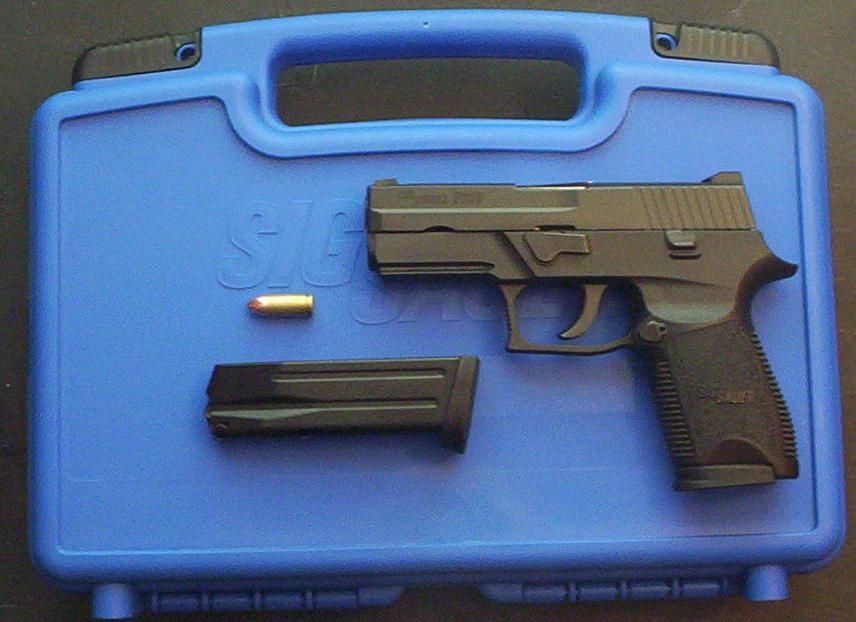
SIG Sauer P250 9mm

Photo by Joel7687Own work, CC BY-SA 3.0, Link

#2 – Sig Sauer P250, 9mm Para

Best For: No Experience, Unable/Unwilling to Improve Skills, certain Physical Handicaps (Low strength)

When the Sig P250 hit the U.S. market in late 2007, I was totally unimpressed by it except for its interesting and then unique modular design. The rest of the gun was uninspired: double-action only, a long, if light trigger, and that was pretty much it.

Shooting it did not yield any exemplary capability that made it anything more than a novelty to me, and much of the rest of the gun world responded in kind. It did see some government agency adoption here at home and abroad, but this was short lived in the face of other more capable guns.

All that being said, the P250 seems only a historical milestone, an also-ran on the path to the Sig Sauer P320 now newly adopted as the Army’s M17 handgun. This all hides one very pertinent perk, though: the P250 is very easy to load and shoot pretty well, while also being pretty dang safe thanks to its loooong, but smooth, trigger pull.

While it lacks a manual safety, seasoned shooters know that a “safer” trigger has more to do with the length of travel of the trigger than the weight of its pull; a longer travel means more feedback for a misplaced finger that something is happening, giving the shooter time to course-correct before getting to a bang, and also furnishing a degree of safety against an inanimate object entering the trigger guard and impinging on the trigger.

This is even nicer on the P250 because the trigger is otherwise pretty nice for a double-action only trigger, being smooth, hitch free and easy to manage all the way through the break. It is like the best of a DA revolver and semi-auto in one! In all other regards, the P250 is more or less a standard fullsize or service pistol: it carries plenty of ammo, has nice sights and also benefits from easily interchangeable grip modules that make the gun simple to tailor to most users’ hands.

While it is discontinued entirely as of 2018, there are still plenty of P250s, parts and mags floating around to make finding one comparatively simple and well worth your time if you or someone you know desires the perks of a service-caliber semi-auto pistol with an easy-to-use slide and trigger.

#1 – Ruger 22/45 Mark IV, .22LR

Best For: Nervous Nellies, No Experience

Ruger’s flagship .22 LR pistols are not just for plinking cans, punching paper and harvesting small game. The 22/45 series guns have always been vaunted because they combine the handling and shooting characteristics of a service handgun with the light recoil and easy operation of your typical .22. The result (though Ruger has delved into some pretty wild aesthetic choices) is a supremely capable pistol for anyone on our list of “needs help” shooters.

Instead of a slide, the 22/45 guns all utilize a bolt that features two prominent ears on either side of the gun. Combined with the easy cocking of the design and it will be a rare shooter that struggles with this handgun. 10 rounds of .22 LR are carried standard in the slim magazines and the entire package in most iterations is very slim and lightweight. The controls are easy to actuate with some practice, and a manual safety is standard.

The 22/45’s have always enjoyed a reputation as good shooters and the latest versions are no exception. Best of all, for those who may desire or require them from ailing eyes or concerns about bumps in the night, most variations can mount under barrel lights, lasers and optical sight as stock. All told, you enjoy the best in modern pistol design and theory in a light, easy-handling .22 LR.

Stoked with good, high-quality loads, these guns are surprisingly reliable and more than capable as defensive pieces. Don’t let the hot-rod looks and miniscule caliber fool you: these are serious workhorses.

Conclusion

No decent citizen who desires a gun for defense should be left out in the cold for lack of viable choices. Though they may be far from the mainstream shooting world’s conception of ideal defensive handguns, the choices presented above are all superb for overcoming common challenges faced by certain newcomers.

If you are a seasoned pro, take this knowledge and put it to good use should they turn to you for help. If you are a newbie yourself, have no fear: use what was presented in this article, head into your local gun shop and see which will work best for you.

With a little courage, a little practice and plenty of can-do, you will be getting rounds on target with confidence in no time.

firearms for people who hate them pin


via Modern Survival Online http://bit.ly/2AmL0W2

Friday, December 28, 2018

Lucid Dreaming | All RCs Fails - loss of lucidity???

What I can do if I know/or very suspicious that I'm dreaming, but I can't get the full lucidity(the awe experience feeling). In such moments I always try multiple RC, but they all fail. I can't control anything.

Here an example of this:

It's 9,30am and I'm doing my 'mojo', but it's like I can't fall asleep, so I open my eyes and look at the my portable digital watch to see how much time I wasted and it says 8am. So I jump out of bed while thinking I'm already dreaming, but my room look totally indetical, so I'm starting to RC one after another. Look away and back to the watch, but it still say 8.05am(in fact the clock is counting minutes normally) - fail, noseplug - fail, finger counting - fail, lamps - fail, float - fail, Reading rc - fail, phasing through walls - fails. So I'm just starting to think that I misread the watch in the first place and getting back to bed, only to awaken seconds later and to see it's 9.40am.

I have great number of these. So how to get lucid in these super realistic FA, if all RC fails?


via Lucid Dreaming - Dream Views - Attaining Lucidity http://bit.ly/2AjWrxL